Skip to content

Posts from the ‘Art History’ Category

Travel, Timing, and Reconstruction: Why You Can’t See What You Came to See

Washington DC had a very unusual earthquake in 2011.  It destroyed some of the statuary at the National Cathedral and cracked the Washington Monument, an iconic obelisk-shaped landmark in the center of the city.  This summer a massive scaffold has gone up over the tower to continue the repairs.  Reconstruction and restoration are common sights for travelers where long-term improvement projects often leave facades covered and historic interiors obstructed.  You can still enjoy these sites with in most cases with minimal impact on your visit!
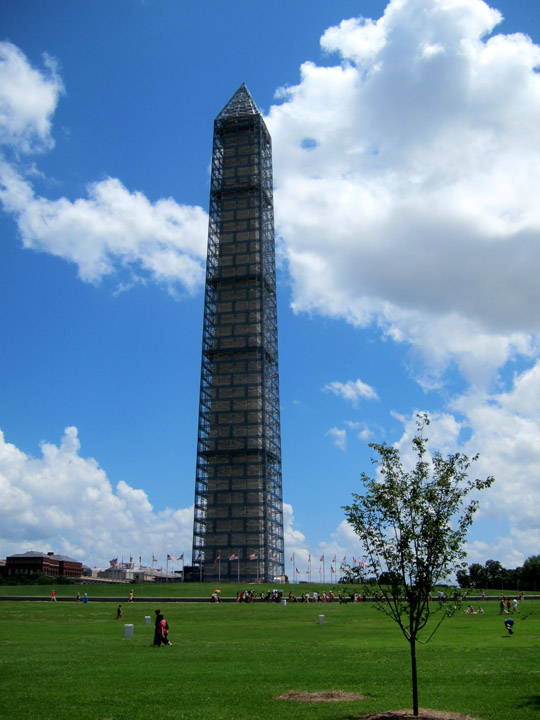
washington monument restoration

Restoration of the Washington Monument takes place behind an artistic scaffold.

Read more

Ardfert Cathedral and Abbey, County Kerry

Every day in Ireland seemed to bring another beautiful ruin.  Each one a massive stone structure clearly whittled down by time and the encroaching flora.  King Henry VIII’s anti-Catholic purge of Ireland left hundreds of Cathedrals and monasteries abandoned to decay.  Today they remain inviting and evocative structures to explore and enjoy.  Ardfert Cathedral and Abbey is one such peaceful place.  Like many of the ruins in Ireland, we had the whole site to ourselves and had an excellent impromptu picnic there.

Coming up on Ardfert Cathedral, County Kerry, Ireland

Coming up on Ardfert Cathedral, County Kerry, Ireland

Read more

Guess the Artist – French Addition

In honor of Bastille Day, I have a little French Art History trivia for you.  I found the following painting in Rouen and want to see if you can correctly guess the artist who painted it.  (No cheating and scrolling to the bottom!)

nature morte painting

Mystery painting of the Day at the Musee de Beaux Arts, Rouen, France

Read more

The Healing Ascelpium of Pergamon, Turkey

sacred way to the Ascelpium, Pergamon

The sacred way to the Ascelpium, just outside Pergamon, Turkey.

Even without the advantage of modern MRI’s and antibiotics, the Ancient Greeks understood something about health.  Just outside many of the largest ruins from the ancient world, you will find a Sanctuary to Asclepius, God of Health.  Taking in sick locals and travelers alike, most of these centers included steam-rooms, baths, theaters and doctors ready to interpret the patient’s dreams.  Seemingly the best cures resulted from a little relaxation and spa time.  And since near death patients were secreted out of the facility, it appeared the no one died at the Ascelpium under the care of the priests.

Read more

Bernini’s Rejected French Sculpture

st peters interior, Rome

Bernini created the interior marble facade, canopy and high altar of St. Peter’s Basilica, Vatican City (Photo: rachel_titiriga, flickr)

Gian Lorenzo Bernini (1598 – 1680) should be familiar to visitors to Rome.  He essentially created the Baroque city that we see today producing sculptures, fountains, buildings and the majority of the interior of St. Peter’s Basilica.  Considering that he started creating accurate portrait busts at 14 and continued to work until he was 82, Bernini is deservedly known as a prolific genius.  But did you know that even his work was occasionally rejected? Read more