Skip to content

Posts tagged ‘travel’

Prehistoric sites of Brú na Bóinne (Newgrange, Knowth and Dowth)

On my Irish road trip, I saw a lot of impressive things – jagged mountains, green valleys and wild coastline.  I also saw a lot of historic things – overgrown monastic ruins, abandoned farm houses and the ever present round tower.   But the most impressive and historic sites were Newgrange, Knowth and Dowth, three Neolithic mound tombs along the Boyne River and a UNESCO World Heritage Site.

Newgrange, part of the prehistoric Brú na Bóinne complex

Predating the Egyptian Pyramids, the mounds are passage tombs, meaning they contain one or more stone lined corridors where traces of human remains were found.  Newgrange is the largest and more famous of the three.  It aligns such that on the winter solstice the sunrise illuminates the inner chamber in what must have been a highly potent spiritual moment for its prehistoric builders.  You are allowed to enter the somewhat claustrophobic passage and view a chamber formed by an impressive corbelled ceiling.

While it looks beautiful, the stone exterior of Newgrange is a reconstruction from archaeological guesswork.  The white stone and river stone in the facade can be traced to sites quite a distance away.  It is possible that the stones were brought as offerings and left outside the portal and therefore might never have been part of a collapsed stone wall as the restoration assumes.

Stone carvings at Knowth

I am far more interested in prehistoric carvings and so I enjoyed Knowth a little more.  Both mounds are encircled with meter tall stones but those around Knowth are more extensively decorated.  While it is easy to try an interpret the swirls (everlasting life? rebirth?) and organized dots (there’s 12 on one rock, is this a lunar year reference?), I prefer to enjoy them for their design and to appreciate the ancient conviction that created these deep stone markings.  You cannot go far inside the Knowth passages but you can climb on top of the mound.  The Knowth site was occupied by humans in later periods so in restoring the prehistoric site, archaeologists had to go down through the remains of a Cistercians farm, Norman dwelling and Bronze Age village.

Newgrange as viewed from atop Knowth

The sites are only accessible from the Visitor Center which runs timed tours of 15-20 people by shuttle bus to each tomb.  You can choose just to see just one tomb but you are completely cheating yourself if you don’t visit both Newgrange and Knowth!  (Dowth is closed for posterity with plans to excavate it someday.)  During the obligatory wait before your tour time, the visitor center has a good video about Neolithic religious practices and some interesting exhibits.

Tips for Visiting

While the River Boyne site could be an easy day trip from Dublin, it’s worth spending the night nearby.  (And this way, you can see the carved crosses at Monasterboice before the tour buses show up!)  I found the Scholars Townhouse Hotel in Drogheda about 15 minutes from the UNESCO site.  The hotel is decorated with dark wood paneling and antiques making it feel elegant but very cozy.  When we arrived in the evening, candles lit the reception area and the staff could not have been nicer.  I loved the huge carved Victorian bar and the Cromwell battle ceiling paintings in the breakfast room.  (Disclosure: I am not receiving anything for writing about the hotel.  I just liked it and thought it was a good tip to pass along.)

Martin Luther King Jr Memorial Dedication August 28th

The Martin Luther King Jr. Memorial opened to the public today and will be dedicated in Washington, DC next weekend.  Information and concert tickets can be found on the official event website: Dedicate the Dream.

26 Aug 2011 UPDATE: The official dedicate date has been moved to an undeclared date in September or October due to the arrival of hurricane Irene in DC this weekend.  Friday and Saturday morning events are still planned.

At the time this was proposed, the World War II memorial had just opened and there was some groaning in DC that the Mall was too crowded for anything else.  To me, the National Mall is both an expansive green space and a record of our history, culture and heroes.  I am glad a nice spot of the Tidal Basin was set aside to honor MLK Jr. specifically and in a broader sense the US civil rights movement.  (An African-American History and Culture Museum is slated for the Mall in 2015 which is good because the only Museum remotely dedicated to the same subject matter was in Anacostia before – way, way off the beaten tourist path.)

One main features of the MLK site is a large bolder cut and opened in the middle called the “Mountain of Despair”.  The removed piece is set closer to the water and is called the “Stone of Hope”.  It is 30 ft tall and features a standing portrait of MLK emerging from the stone with arms crossed.  Flanking around the tidal basin, out from the Mountain stones, are slowly tapering stone walls engraved with quotes by Martin Luther King Jr.  Given the position of the monument on the Mall and its open lay-out, this seems like a very accessible and engaging space.  I see people picnicking and chatting in eye-sight of MLK Jr. along the Tidal Basin.

You get a good sense the site from this fly through video produced by the National Memorial Project Foundation:

As you would imagine, there has been the obligatory criticisms of the statue: it was made in China by a Chinese man, it’s not a good likeness, he looks confrontational, whatever.  The critique that I find the oddest is that the statue is too tall.  In fact, the MLK figure is just about as big as his nearest neighbors on the Mall: Lincoln with pedestal is ~30.5ft and Jefferson with pedestal is ~25ft.  MLK seems so much larger because he is not in a temple like those other two which defines a visual space and makes the figure seem smaller.  Likewise, you can go right up to him and so your viewing perspective changes to a more extreme angle.  I will concede that the stone block itself is pretty huge when viewed in the round.  For scale, here’s how some of my favorites on the Mall compare: (Gandhi is technically in Dupont Circle in front of the Indian Embassy but I thought he belonged here.)

Martin Luther King Jr. statue size relative to some of the notable DC memorial statues and a 6′ tall person which gives a better sense of scale.

To me the most powerful memorials are personally engaging and this often means that the elements exist on the viewer’s level.  For example, imagine how awesome it would have been to put a life-size statue of MLK Jr. on the steps of the Lincoln Memorial!  You could stand next to him and look out over the Mall while reading his “I Have a Dream” speech.  At least the newly constructed MLK Jr. Memorial lets you wander through his quotes and stand amid the literally and metaphorically looming mountain stones.

More than anything though, I hope that the MLK Jr. Memorial in person conveys his deep religious convictions and self-sacrifice.  As Martin Luther King Jr. said reflecting on how he wanted to be remembered, “Yes, if you want to say that I was a drum major, say that I was a drum major for justice. Say that I was a drum major for peace. I was a drum major for righteousness. And all of the other shallow things will not matter.”

I’m looking forward to visiting DC soon to see this new Memorial in person and hope you get a chance to check it out too!

10 Days in Mainland Greece Itinerary

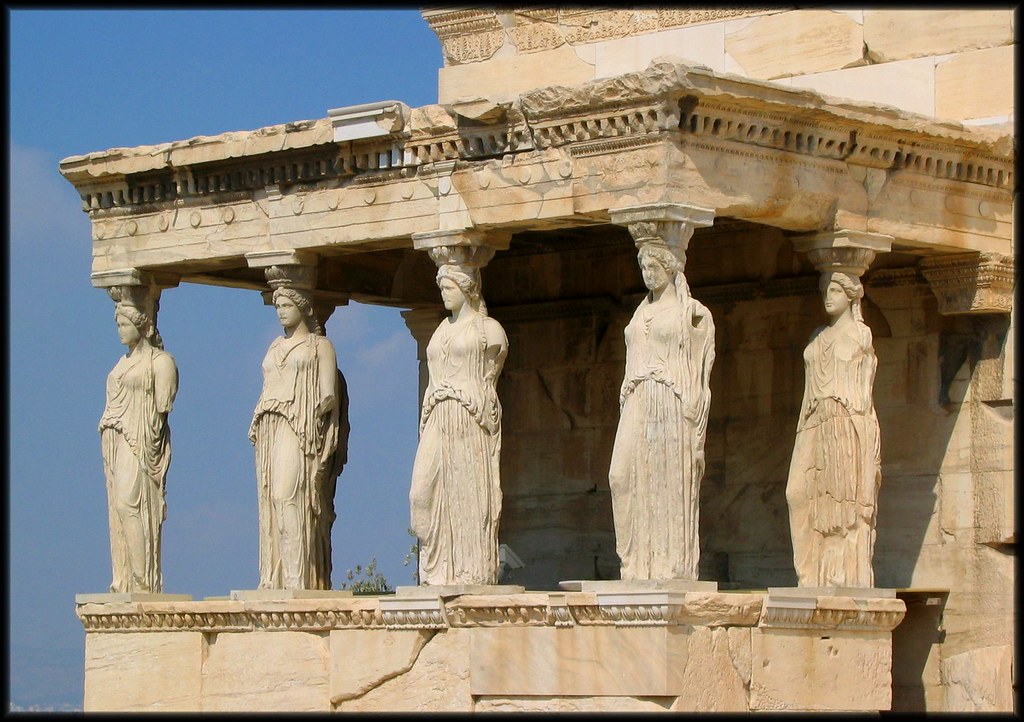
Porch of Caryatids, Erechtheion, Athens (Photo: Amplified-Photography)

I am going to be able to sneak in a trip to Greece this Fall!  Tickets and hotels are booked for September and the departure countdown has begun.  Obviously there is so much to see in Greece so I had to focus the trip.  With only 10 days, we just going to visit mainland Greece and will save exploring the islands for another trip.  It’s always better to pace yourself and try not to see too much.  That being said it is gong to be a busy trip!  Below is my itinerary for 10 days in Athens and mainland Greece.

10 Days in Mainland Greece driving route

Day 1 – Arrive in Athens in late afternoon. Basic wandering and orientation, eat delicious food.

Day 2 – Athens: Parthenon, Acropolis Museum and Roman Agora

Day 3 –  Athens: National Archaeological Museum, Kerameikos (Cemetary) and Syntagma square, explore the neighborhoods (maybe see a play or concert that evening?)

Day 4 – Pick up car, drive to Thermopylae (yes, you’ve heard of it), visit Delphi

Day 5 – Monastery of Hosios Loukas, Corinth, arrive in Olympia (this is the longest driving day of two 3hr blocks)

Day 6 – Visit Olympia – high probability I’ll run through the stadium, drive to Kardamyli

Day 7 – Morning exploring Kardamyli, drive to and explore Sparta

Day 8 – Visit medieval ghost-town of Mystras, drive to and explore Naplifon

Day 9 – Visit ruins of Mycenea, Tiryns and Epidaurus, back to Naplifon

Day 10 – Stop at Dafni Monastary on the way to the airport; leave for the US

Whew, what a trip!  I’m so excited!  This trip also includes 7 more UNESCO World Heritage Sites which is awesome!  I generally don’t like spending more than 2 or 3 hours a day in a car so this itinerary is paced with that in mind.  I let you know how that goes once I actually see what some of these mountain roads are like.  Other then a history and classical art binge, my other goals are to eat octopus, do some people watching, bring home a piece of art (most likely a modern reproduction given export rules) and enjoy Greece!

Of course I haven’t left yet, so trip suggestions are always welcome!

A Traveler’s Second Language

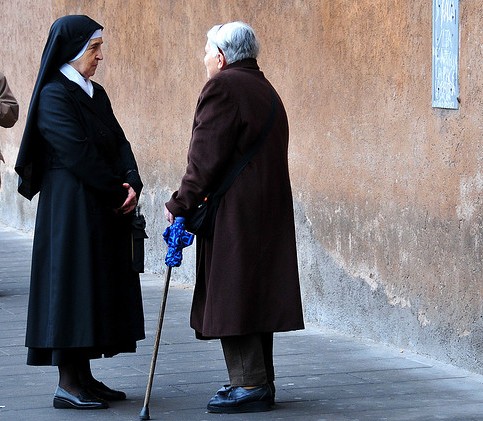
"Bonjour suora, comment allez-vous?" (Photo: Ed Yourdon)

There was a great column by Daisann McLane in National Georgraphic Traveler this month about the value of speaking a second language.  No matter where you are, it gives you another option for communication.   She argues that when people must communicate in neutral language (in her case, an American and Japanese woman speaking Spanish together), they are more conscientious of their pronounciation and use more standard, less slangy vocabulary.  This made me think of my own experience communicating in a third language.

The summer I spent in Florence, I lived in a convent which rented half of its rooms to travelers and students like me.  It was gorgeous place with cool stone floors and a peaceful inner garden, all hidden just down the street from the Duomo.  My room even had a 19th century fresco of angels on the ceiling!  The sisters were very kind and would join the guests for breakfast.  The only problem was that I barely spoke Italian so I limited to “Sì, grazie suora”.  Unless the sisters wanted to sell me a train ticket, I didn’t really know what to say.  But I was in luck; this was a French religious order so they all knew some French!  My four years of high school French came in pretty handy.

What a difference a little communication makes.  It was so much more fun to chat with the sisters, ask them what they were working on and answer their questions about what I had done each day.  As much as I love seeing art and scenery when I travel, it makes for a much richer experience if you can actually talk with locals.

(On a side note, my French is still way better than my Italian.)

#2: Ravenna – the Capital of Mosaics

In 2007, I flew in and out of Milan for a conference and decided to sneak in a few days afterward for what I considered to be an Art Pilgrimage.  I love Byzantine art and at the time was obsessed with seeing Ravenna, the self-proclaimed “Capital of Mosaics”.  With the division of the ancient empire and the fall of Rome itself, the center of the western empire was moved to the northern Italian city of Ravenna.  Between approximately 400-550 AD, Emperors Galla Placidia, Theodoric and Justinian constructed fantastic basilicas whose interiors are literally covered with vibrant and expressive mosaics.  Ravenna is so rich with art that 8 of its churches have been cited by UNESCO as a World Heritage Site.

On the coast 75miles south of Venice, Ravenna can be accessed by train from Milan via a transfer in Bologna.  Arriving in the late afternoon, I explored the city a bit and spent the night so that I could start the next morning in the Basilica of St. Vitale.  The Byzantine central circle upon circular chapel architecture provides a heavenly open space which at the time was flooded with golden morning sunlight.  The altar apse mosaics just glittered.  At first its a little disorienting because there is so much to look at.  The brightness and richness of St. Vitale is a good reminder that there was a long tradition of vivid color in Roman art.  I went slowly over each face, bird and Old Testament scene, many of which including a little divine hand directing events from a cloud!  You might think that mosaics – the arrangement of little bits of colored stone and glass – could never be anything more than decorative patterns, but the art was so shockingly expressive.  The faces of the Apostles, Justinian, Theodora and their attendants looked like realistic portraits.

Apse of St. Vitale depicting Christ as the Redeemer

Next I went to the Mausolem of Galla Placidia whose central altarpiece depicts a youthful, beard-less, Apollo-like Christ as the Good Sheppard.

Looking up here, you can see that even the decorative moldings in the Mausolem of Galla Placidia are covered with mosaics!

The Basilica of St. Apollinare Nuovo has parallel scenes of a procession of female and male martyrs.  The women in their gold and pearls and the men in their stark white robes make for an elegant continuity but each figure have enough unique details to warrant a long look.  Above this register are portraits of saints and small scenes from Jesus’ life.  If you are keeping track of Christ’s evolving iconography, he looks like a youthful Roman while performing miracles and is not depicted with a beard until the Last Supper panel.  As is common of early Christian art, the Passion panels jump from Simon carrying a skinny, mostly symbolic cross to the Marys at the tomb.  Even the Byzantines would have been too horrified by crucifixion to visually depict it.

The Arian Baptistry, the Neonian or Orthodox Baptistery (Battistero degli Ortodossi) and the Archiepiscopal Chapel are more intimate art experiences.  If your visit is anything like mine, you will be completely alone in these buildings.  Here again you will find interesting visual details in the procession of apostles.

Procession of saints in the Arian Baptistry

My one regret is that I did not get to St. Apollinare en Classe because it was, well, in Classe about 5km outside of Ravenna.  My plan was to rent a bike but when I couldn’t find a place, I went to the Theodoric’s Mausoleum instead which sits in the middle of a field and is surprisingly undecorated.

At the Mosaic School in Ravenna, you can watch artists work and see some displays about the process.

Beside the incredible art, Ravenna is a charming city in which to spend the day largely free of the tourist crowd.  The warm summer evening I was there, the whole city seemed to be out walking and shopping till 9 or 10pm.  As a single traveler, I felt complete comfortable with the crowd and helped myself to some gelato and people-watching.  The food was great too.  I had an amazing anchovy pizza for lunch and the side of grilled vegetables with my dinner stands out as one of the best dishes I’ve ever had.  I stayed at the Hotel Byron Centrale which was in a great location and cheap even though my single room was adorably small.  I can not understand why more people do not prioritize Ravenna when planning a trip to Italy.  It’s a pleasant city with impressive artistic treasures.  It was well worth the pilgrimage from Milan!