Skip to content

Posts tagged ‘Greece’

#5: Acropolis, Athens

It’s been a while since I worked on my UNESCO World Heritage Site series so let’s get back to it with an easily recognizable site – The Acropolis in Athens.
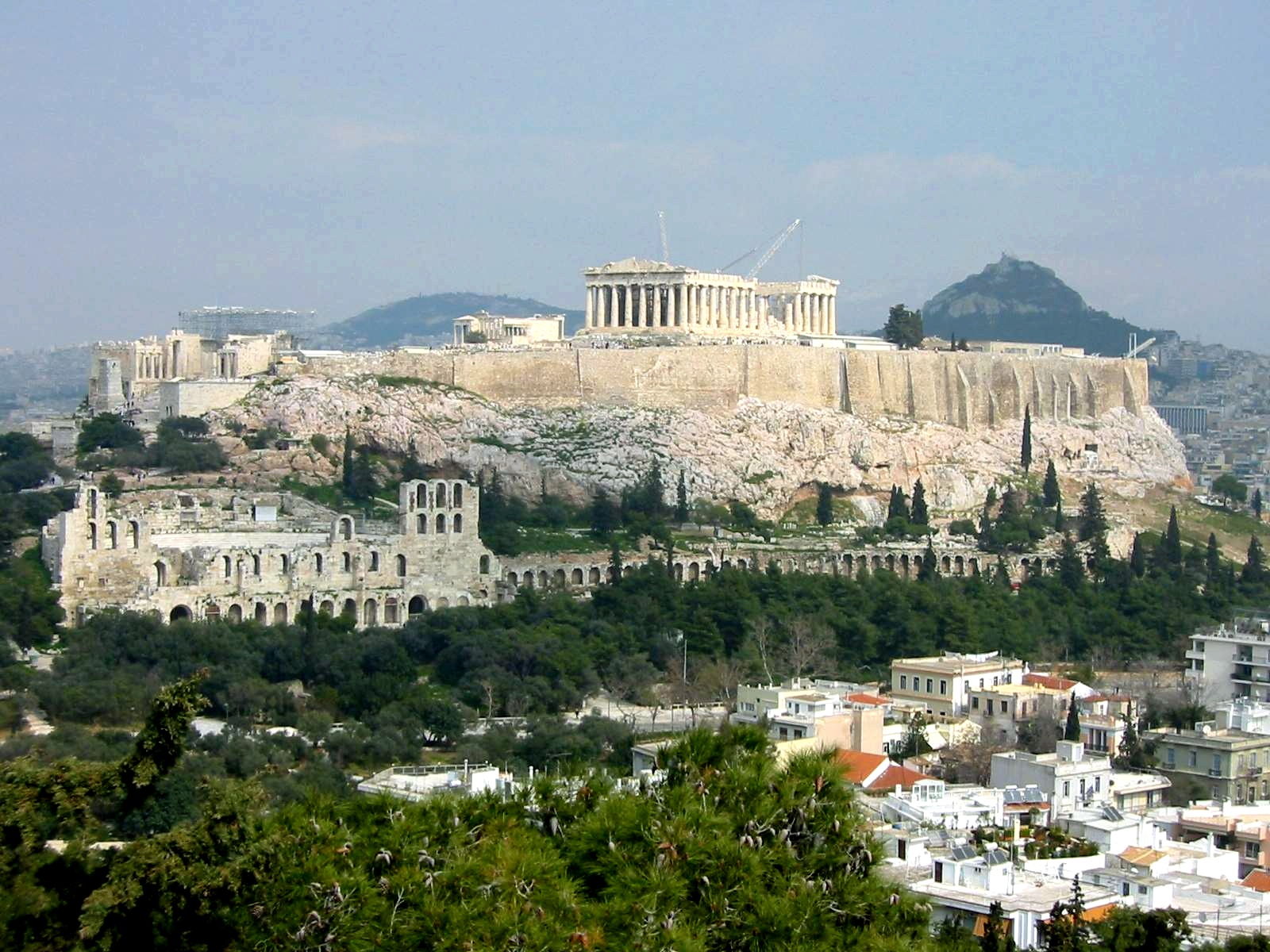
Parthenon Acropolis Athens

View of the Acropolis (Photo: Wikipedia)

Entering Athens, you are walled in by buildings and can easily lose your orientation but before long you turn a corner and there on an imposing plateau is the Acropolis.  The complex of temples including the Parthenon atop the rocky hill was originally filled with great art, commanding architecture and human activity in Classical Greece.  I could write long posts about each of the site’s elements but I’ll try to give an overview here.

Acropolis reconstruction

Reconstruction of the Acropolis (Photo: Roy George)

While there had been religious buildings and fortification on the rock for centuries already, the greatest construction effort was completed under the rule of Pericles during the height of the Greek empire (460-430 BC).  Visitors would have entered the site through a grand gateway known as the Propylaea. Once inside, along the right toward the Parthenon would have been the Brauroneion, a temple dedicated to Artemis protector of pregnant women and childbirth, and the Chalcotheke which is believed to be the Parthenon treasury.  Left from the entrance was a complex religious building called the Erechtheion which honored Athena as Protectress of Athens, Poseidon as rival for Athens and several ancient heroes.  Today the building is most recognizable for a porch of columns  shaped like maidens known as Caryatids.  The small Temple of Nike could be found to the right of the Propylaea before entering the site and is largely restored today.  A Greek and a Roman amphitheater were carved into the South side of the Acropolis rock.

Temple of Nike at the gates of the Acropolis

The Parthenon was dedicated to Athena, the Patron Goddess of Athens, and was believed to house a 40 foot tall ivory and gold statue of her.  The outer structure of Doric columns is 228.0 x 101.4 feet in size and has several “optical refinements” such as bulging columns and a bowed base so that the structure’s geometry looks perfect to viewers.  The triangular pediment facing the Propylaea depicted Athena winning over the city of Athens with her gift of an olive tree while the opposite pediment described her birth from Zeus’ head.  Square panels, or metopes, depicting mythical battles adorned the exterior of the Parthenon.  The interior cella was decorated with a continuous carved frieze of riders, priests, and pilgrims completing the annual Panathenaic procession from the cemetery through the market and on to the Acropolis.

East face of the Parthenon

The Parthenon has been attacked, repurposed and robbed several times.  The video below from the Hellenic Ministry of Culture does a good job chronicling the destruction.

You’ll also note that the video above spends a significant amount of time highlighting the removal of art collectively known as the Elgin marbles.  There is strong movement in Greece to return these sculptures from the British Museum to Athens.  The recently opened Acropolis Museum in Athens displays copies of all the Parthenon sculptures for context but I assume would prefer to have the originals.  If you can’t see them in either museum, there is a great virtual exhibit available online that lets you tour the Parthenon frieze.

elgin marbles

Virtual Parthenon Frieze project sponsored by the EU

While virtual recreations and artistic reconstructions are helpful, I still find it difficult to imagine the Acropolis during the Golden Age of Athens.  As fantastic as I picture it, the Acropolis was probably more colorful, more cluttered with statues and more imposing.

What do Europeans think of the Greeks now?

It almost doesn’t seem possible that the fate of Europe’s, and potentially the World’s, financial future may be riding on the Greek economy.  Like many, I’ve been watching the recent news coverage eagerly hoping restraint and austerity combined with German generosity would lead to a reasonable resolution of the EU economic instability.  With the news of a potential Greek vote on the loan offer (and its subsequent dismissal), I was wondering if an anxious Europe had had just about enough of Greece.  What do other Europeans, bound by a collective economic and political system but different cultures, think of the nation that clearly seems most incapable of pulling its own weight?  While I don’t think I know the answer, I saw a little bit of personal opinions surface while in Greece.

In September, we had dinner at a small restaurant in Kardamyli along the Southwest coast of Greece.  One of three couples there, we were essentially dining on the front deck of our Head Chef/Head Waiter Gregory’s home.  He was incredibly hospitable and entertaining making jokes the whole time.  The food was of course amazing – I have been craving zucchini fritters ever since that meal!  In chatting with Gregory after dinner, we learned that he had been a school teacher in Athens who retired a few years ago at 50 and moved home to start a restaurant.  With his government pension, he was now halfway through building this home/restaurant and was enjoying following his dream on the rural coast of Greece.

After we were all served courses of amazing food and pitchers of wine, the British couple was the first to finish and head out.  As they were presented the bill, Gregory announced that they owed 40,000,000 Euro.  They laughed and handed over 45 Euros promising to be back the next night.  The Belgian couple finished next and was given their bill for 35,000,000 Euro.  They were not nearly as amused by Gregory’s joke.

“Didn’t we already give you people 35 million Euro?” the man responded.  Unphased, Gregory reiterated how good the food was, how lovely the sunset had been and how perfect this evening beach air was for strolling.  “Surely this evening is worth 35million?” he quipped back, not dropping the joke’s pretense.

“No,” the diner replied.  “It is not nearly worth that much.”  Leaving 35 Euros for dinner, the Belgian couple departed.

How to see the Greek President on your vacation

When I travel there are certain things I plan – like making hotel arrangements before I depart or reading up on the sights.  I am not however someone who plans out every hour.  In fact, I like to wander some which is how I happened to get 10 ft from the President of Greece last month.  Let me explain…

On our second day in Athens, we wandered through the (rather touristy) shops of the Plaka and happened across Hadrian’s Gate and the Temple of Olympian Zeus.  It was around 6pm so the sun was getting low in the sky and giving off that gorgeous orange sun-light.  We walked through the ruins as the sun slipped below the Acropolis.

Temple of Olympian Zeus in Athens as the sun was setting

We left the park just before it closed at 8pm.  I heard oompa music in the city park across the street and followed it thinking we could see an outdoor concert.  There was a brass band standing in a large courtyard.  I could see tents set up off to the left. Families were milling about, kids were dancing to the music and I guessed it was some public festival.

Brass band and families enjoying the music

The music came to a stop.  A group of well-dressed people began lining up in front of the band.  One woman even had a huge bouquet of flowers.  Next, 6 or so unmistakable special security officers (tall, in suits with ear pieces) began running around.  At this point the crowd started getting more dense.  Everything looked ready for some arrival but we waited for another 10min or so.  I was then able to look up in my guidebook (discreetly of course) the yellow building behind us which was the Zappeion, an all-purpose event center.

Volkswagen Passat - The Presidential Car of Greece (Photo: cargurus.com) Technically this is the 2008 Lux addition but I thought it fits better with the story

Finally, four motorcycles come racing up on the right followed by a black four-door Volkswagen Passat.  An older man got out, shook hands, received the flowers (which one of the security guys threw in the trunk of the car – very classy) and made his way to a seat near the podium.  The TV cameras got into place and the crowd shifted to circle a small area of 60 or so seats in front of the podium.  A visibly nervous man got up to speak; even though his remarks were in Greek, I could still tell his voice was wavering.  My attention started to wain but I did catch him saying “UNICEF” and “Yuri Gagarin”.  A second older man, that I had not seen yet, got up to talk.  I kept whispering to my hubby, what is going on here?!

Speaker #2 - I still have no idea who this man is...

We wandered into a tent next to the podium which was filled with, of all things, Yuri Gagarin and Russian Space Program memorabilia.  At this point I wondered the VIP from the car was perhaps the cosmonaut Gagarin himself.  Moving further from the podium and into the fair, there was a informational booth.  I grabbed a program and waited to talk to the attendant.

Booklet from the information tent, it reads "Book Festival Zappeion"

In my best Greek I asked, Καλησπέρα, μιλάτε Αγγλικά?   Or, Good evening, do you speak English?  (An essential phrase!)  She did, and so I asked who had arrived to speak.  She said, “Karolos Papoulias, the President of Greece.  He is well loved by the people.”  My jaw dropped, surely something had not translated correctly.  We wandered back to the podium.

I’m use to American politicians who have an army of secret service agents that keep spectators in defined zones and aren’t allowed to just wander around the VIP.  Also, isn’t Greece facing severe austerity measures?  Where are the protesters if this is the President?

Finally, the President said a few short remarks and returned to his seat.  He was joined by the second speaker in the Russian Space tent for a private tour.  Here’s where I got the best photo of him.

President Karolos Papoulias being shown the Yuri Gagarin exhibit

Since my camera has a delay, most of my pictures look like the one below.  I think it is time for a new camera.

Slow camera = 6 photos of hair and not the President

The President came out of the tent, through the crowd and right past me.  In a bubble of security guards, he walked down the festival street past the book vendor stalls.  I followed along behind him.  I loved watching people’s reactions as he past by or they looked up and there he was.  It was touched to see little old ladies come up to him and just start chatting.   The conversations seemed pleasant and I could see admiration and a little awe in their faces.  Eventually, the President stopped by the UNICEF booth to buy a book and one other stall to say hello.  At the end of the street, his Passat awaited.  After shaking the nervous man’s hand one more time, he was off with his 4 motorcycle escort.

Afterward, we still couldn’t believe what we had witnessed.  We kept going over and over the details while we ate dinner.  It seems so surreal to just happen across the President of a country in such an un-orchestrated environment!  At least the Greeks attending the festival seemed to be just as surprised as us but were also respectful and amused by the President’s visit.  I guess Karolos Papoulias is “well loved” by his country after all.

Greek Strikes Affect Archaeological Sites

Archaeological sites in Athens are closed due to a 48hr Cultural Ministry strike (Photo: Petros Giannakouris / AP)

Strikes have returned to Athens.  To protest upcoming austerity measures, the municipal workers including metro employees and trash collectors are on a 48hr strike (Oct 13-14).  This time however, the Cultural Ministry has joined the strike causing the shut-down of major tourist attractions in Athens.

Athens metro on 48-hour strike in protest of coming austerity measures (Photo: Thanassis Stavrakis / AP)

While in Greece in early September, I only encountered a metro strike the day we arrived which meant we took a taxi ride into Athens – not a huge burden.  But air traffic controller strikes and the shut-down of essential tourist locations will make travel to Greece very inconvenient for visitors.

My sense of the Greek economy is that these cut-backs are essential and are long due.  I hope these issues can be resolved and the measures adopted without continued social unrest.

Tips for Visiting Delphi, Greece

Delphi was really amazing and should be a priority on any visit to Greece.  A little bit of advice can usually go a long way, so here are some tips to make sure you enjoy your visit.

1) The Delphi Museum Hours Are Variable

Cybele (left) rides a chariot pulled by a lion who is attacking a Giant, from the north frieze (Gigantomachy) of the Siphnian Treasury, on display in the Delphi Museum

I was warned (by a man in Athens no less) that the Delphi museum had odd hours.  This was strangely confirmed when the three recent guidebooks I consulted all listed different hours for the museum.  Once in Greece, I called ahead and found that the museum was closing at 3pm the day we wanted to go.  We had lunch on the run in Thermopylae and made it to Delphi with a hour for the museum.  Since the archaeological site itself is open from ~8am-8pm everyday, we saw bus loads of tourists dropped off just to look at the ruins because the museum was long closed.  I’d have felt a little cheated if I came all that way and didn’t get to see the famous Charioteer statue, the architectural decorations and votive objects in the museum!

2) Pace Yourself

Delphi is a lot bigger than you think it is and built on a steep hill.  If you really want to see most of the site and enjoy the staggering vistas, budget 4 hours at least to see Delphi.  I suppose you could run through it quickly and just see some parts but you wouldn’t have time to start mentally piecing all the ruins together.  It’s hard to approach a large archaeological like Delphi, which contains almost no complete buildings, and immediately grasp the scale.  It’s pretty rewarding to sit at different vantage points and imagine the ancient city.

Reconstruction of Upper Delphi

I was hoping that things would begin to cool in early September but it was still incredibly hot in Delphi.  Since there is very little shade, try to go first thing in the morning or in the afternoon (3-8pm) like we did.  Take breaks, wear a hat and drink lots of water.

3) Stay the Night in Arachova

Arachova – A more authentic and relaxing alternative to staying in Delphi

As you would imagine, the modern city of Delphi is a tourist trap.  The main street is lined with restaurants and cheap hotels each containing some iteration of Oracle, Apollo, Temple or Zeus in their title.  I guessed as much even before I left the US and made alternate arrangements…

Arachova is about 20min east of Delphi and is a lovely town.  What spares Arachova from the cheesy tourist malaise down the road is its status as a top winter destination for skiers who flock to Mt. Parnassos.  Arachova has great hotels and restaurants to serve the influx of mostly Athenians coming up to ski but is empty in the summer months.  Since the city draws Greek sports enthusiasts, you are spared the kitsch seen in Delphi.  Arachova was a beautiful, peaceful town without the crowds and a more authentic place to hang out .

View down the main street in Arachova

There are several nice hotel options; we stayed at Xenonas Iresioni‏.  It is on the edge of town but only a few minutes walk away from the center of things.  The staff was great and the room was comfortable with the biggest double bed we saw in all of Greece.  When I mentioned to the man at the front desk that I was unable to purchase a Delphi catalog because the museum shop had run out of the English version, he gave be an unused one that they had on hand.  Talk about helpful staff!