Skip to content

The Face of George Washington

US 1 dollarThanks to the US $1, George Washington has one of the most recognizable faces in America.  This President’s Day, I got to thinking about that portrait and two excellent exhibits I saw a few years ago at Mount Vernon and the National Gallery about the real likeness of George Washington.

Gilbert Stuart – “George Washington (The Athenaeum Portrait)” 1796, Museum of Fine Arts Boston and National Portrait Gallery, Washington DC

The dollar and a large number of contemporary and future Washington paintings are based on an unfinished portrait done by Gilbert Stuart in 1796.  At the time of the sitting, George was 64 and retired to Mount Vernon.  His teeth had been a constant source of pain since the first one was extracted when he was 22.  When he started his presidency, only one real tooth remained in his head.  Several sets of dentures were made for Washington over his life by incorporating human teeth and carved bone or tusk teeth into a metal cage.  None these were reported to have fit well and must have caused him considerable discomfort.
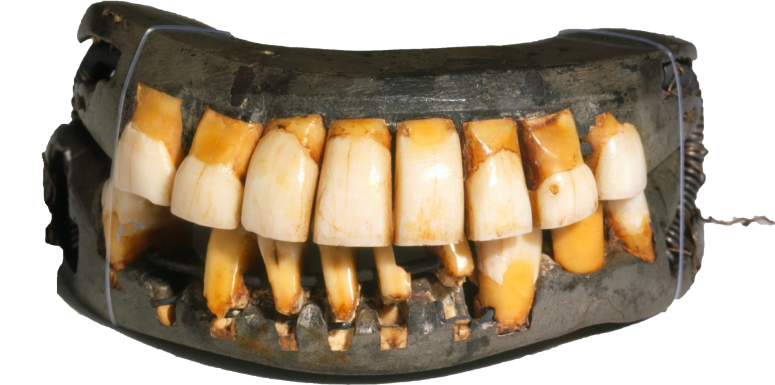
George Washington's only complete set of false teeth on display at Mount Vernon

George Washington’s only complete set of false teeth on display at Mount Vernon (Photo: Mount Vernon Museum)

On the day Washington sat for Gilbert Stuart, he was struggling with a set of false teeth.  Stuart notes, “When I painted him, he had just had a set of false teeth inserted, which accounts for the constrained expression so noticeable about the mouth and lower part of the face.”  Look back at Stuart’s portrait. Washington’s jaw does appears to be clenched, pushed somewhat forward and bulky.  This immediately recognizable portrait is likely not the most realistic.
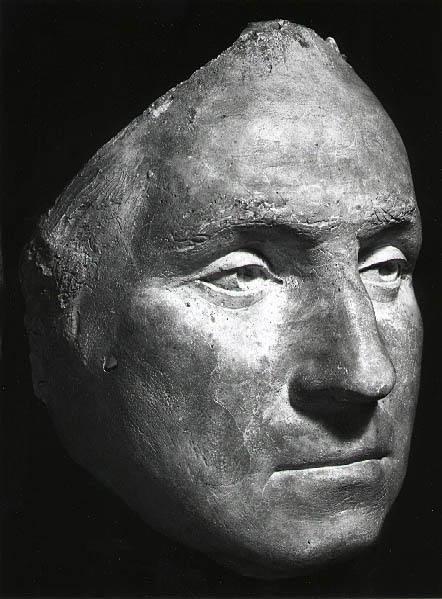
Jean Antoine Houdon - George Washington mask

Jean-Antoine Houdon “Life Mask of George Washington” 1785 (Photo: The Morgan Library and Museum, New York City)

Eleven years before the Stuart portrait, sculptor Jean-Antoine Houdon met with Washington a made a life mask – a process in which plaster is applied to a face for an accurate sculptural model.  This likeness seems less tense and the jaw line less protruded.
Many Faces of George Washington

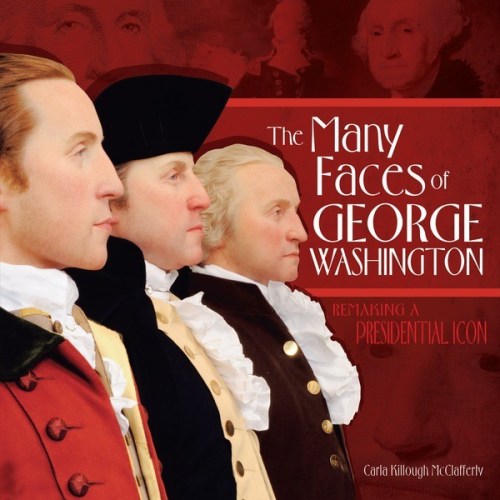
Cover of “Many Faces of George Washington” by Carla Killough McClafferty describing the Mount Vernon portrait project

This life mask and the bust Houdon made from it were used by Mount Vernon to create “the real George Washington”.  Through an interesting forensic anthropology project, the sculptures an other artifacts were scanned, analyzed and used to construct three wax faces meant to represent George Washington at 19, 45 and 57 year of age.  Life-sized figures were created by examining existing clothing and written descriptions of the Washington’s posture.  (You can watch a short video about the process done by the History Channel here.)  The end result is incredibly impressive.  The three Washington figures were one my favorite parts of visiting Mount Vernon as they help piece together a more life-like representation an American legends.

Young George Washington

A George Washington we are not used to seeing – 19 year old likeness reconstructed from historical and scientific evidence by Mount Vernon

Jet Lag & Movies

I very much get jet-lag.  And because it’s Friday, here’s a funny story to show you how bad it can be.

This last September, we arrived in Greece around 4pm after red-eying from the US and connecting/running through Charles de Gaulle.  With the metro on strike, it took a lot longer than we had expected to get to our hotel in the heart of Athens.  It looked like we had missed the nap window and so decided to walk around a little, get dinner and stay up until 8 or 9pm.  Feeling good, we hit up a rooftop bar for a drink and a spectacular view of the Acropolis.  Back at the hotel, my hubby started playing with the TV and found, of all things, The Patriot with Greek subtitles.

Maybe 10 minutes into the movie, I starting tearing up.  Bear in mind that at this point, I had watch a small battle scene, bad guys plotting revenge and some characters hiding from the British – nothing particularly emotional.  Then, when the family reunites at the beach, I started sobbing!  I remembered thinking the sappy parts of the movie seemed so forced the first time I watched this, but it didn’t matter this time.  Crying during a cheesy movies you’ve already seen – definitely a sign of jet lag!

I tried this test again the next day.  I must have got enough sleep because I was not at all affected by The Mask of Zorro.

Marathon Greece and Serious History Tourists

Our last day in Greece, we had a few hours to spare and a rental car so we decided to look for the ancient battlefield of Marathon.  It was here in 490 BC that the Greeks defeated a Persian invasion force.  After which a messenger ran the 24 miles back to Athens to declare the victory inspiring the modern marathon race.

This was the only time our GPS navigation failed us; apparently “Marathon Museum” was a little ambiguous!  Having been directed to the Marathon Run Museum, we got dubious directions toward the ancient battlefield and set out.  After several U-turns, we found ourselves traveling down a narrow road through a field where a crowd had gathered.  I almost didn’t believe what we saw: ancient Greeks engaged in battle.

greek hoplite reenactors

Hoplite reenactors taking a break at Marathon

Read more

Best Mountain Drive in Mainland Greece

The Greek mainland is arid and mountainous.   In a matter of minutes you can go from sea level to impressive elevations as we found out driving to Delphi from the coast.  I have always love the view down from the top of a mountain and there which quite a few contenders in Greece.  By far the most scenic stretch of road popped up as we traveled from Corinth to Olympia.

Best road in Greece

Specifically, I am talking about the mountain road from Levidi to Dafni as shown in the map below.  The high point (literally and proverbially) was the beautiful village of and the stunning valley views from around Langadia, or Lagkadia depending on spelling.

Most scenic drive in Greece

From Levidi, the road quickly climbed through slow switch-backs and hairpin turns.  The forest was dense but every so often there would a break to see the incredible drop into the valley and the smoothed, tightly packed range of mountains.  Pull offs to enjoy the view were scarce and small in size so you’ll likely need to back track if you miss one, but it’s worth it.  In tiny villages that clung to the mountain side, local life spilled out somewhat into the road making us slow down and wave as we passed through.

Hazy sunset over Langadia with miles of switch-back roads to go (Photo: DaydreamTourist)

Langadia

Langadia main square (Photo: Wikipedia)

While the mountain pass was beautiful, blind turns can be a little scary for any driver.  We set out late from Corinth and so it was 8pm when we reached Olympia and definitely dark.  I would try to get out of the mountains by dusk for best visibility.  Aside from the main national highway, Greek roads are decorated with memorials shaped like little Orthodox churches.  I presume these are to remember auto deaths; they serve as sad and constant reminders to drive safely. Luckily this stretch of mountain road is so beautiful you’ll want to drive slow just to make sure you can take it all in.

Roadside memorial in Greece

A church-shaped roadside memorials on a particularly tight curve in the road (Photo: DaydreamTourist)

Best Fortune Cookie Ever

Yesterday I had Chinese food for lunch and got the most inspirational fortune cookie ever!