Well look what I found in the July 21-27, 1901 issue of Fliegenden Blätter:
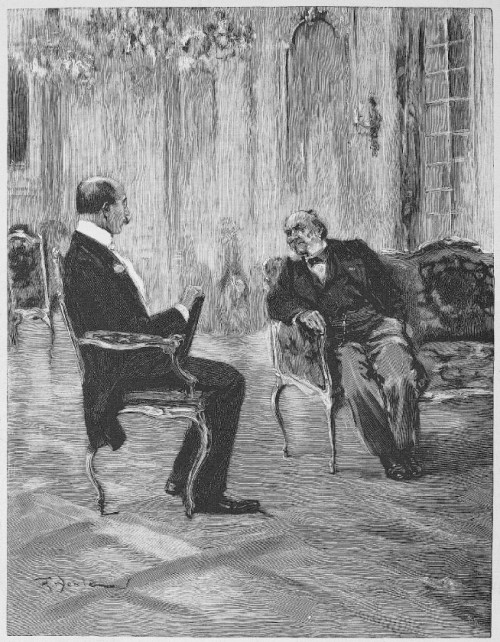
Familiar, no?
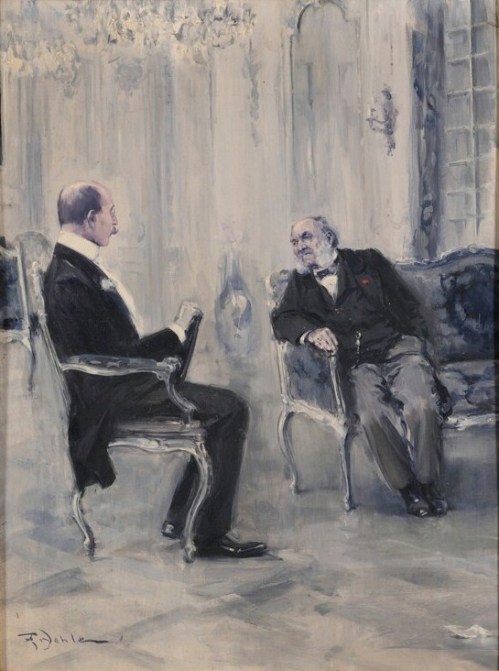
I finally found my painting! So there you have it, The Discourse was in fact created as an illustration as I suspected. The engraving was done by “Willis” and signed in bottom right corner. While not as beautiful as the oil painting, I am impressed by the amount of scenic detail picked up in the print version. The engraver even reproduced the broad diagonal strokes in the flooring which seem like such an after thought on the part of Wahle, likely meant to be cropped in the magazine lay-out process.
The print does settle one detail that I’ve been debating since I first saw the painting. For a work mostly done in muted blue and gray, the little red dash on the old man’s lapel always seemed like either a later addition or a playful detail. I’m happy to report that it seems to be reproduced in the magazine and must have been original to the image.
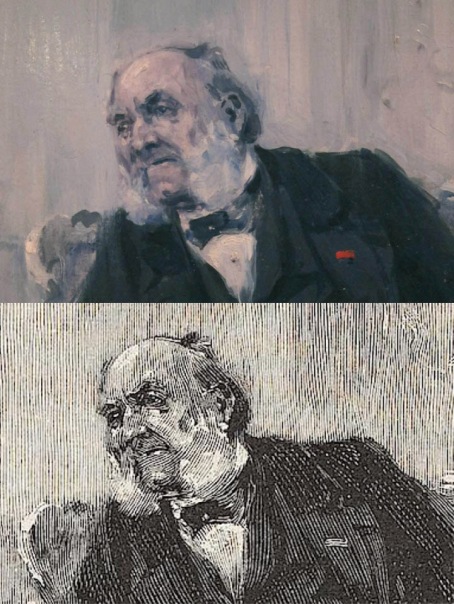
But what really matters is the accompanying text. As an illustration, what is the story here? Apparently the old man is a wealthy banker and the younger man is a Baron with financial problems. The image is entitled, “Ein Gemüthsmensch (A good-natured fellow).” I owe a big thanks to my fluent aunt and German uncle for the following translation:
“Gut denn, Herr Baron, ich gebe Ihnen meine Tochter und arrangire Ihre Schulden … doch wohl gemerkt, mit einem Theil der Mitgift!” …” Uber Herr Commerzienrath, Sie werden Ihr Kind nicht berauben?!”
“Ok then, Mr. Baron, I will give you my daughter and take care of your debts, but it comes out of the dowry!” … “But Mr. Bank President, do you want to deprive your child?!”
So, the Baron is trying to get both a wife and have all his debts paid off. He guilts his creditor with paternal responsibility as a means of getting the full dowry. It sounds like a social critique of the “dollar princesses” who used their new industrial-age familial wealth to marry into titled families. I suppose this was clever, if not funny, in 1901 but the humor doesn’t really translate today. There are a few other lame jokes on the same page, but at least this one is cute:
The Big Feast. Man (to the butcher): Was everything over the top at your daughters wedding? ….. O, let me tell you, the pig we ate could have taken a bath in all the Champagne we drank!
I’d like to look more closely at and translate other pages in Fliegenden Blätter to see if the jokes get any better. It’s hard to believe that such beautiful illustrations by Wahle, Reinicke, and Soblittgen were paired with silly jokes. For comparison, I might also check out the UK’s 19th century humor magazine Punch to see if century-old English jokes hold up at all.
I still find it hard to believe that my painting, and frankly all the other gorgeous images in the magazine, might be just lame jokes. It speaks to the available artistic talent and maybe to the quality of journal the public was use to. I’m still divided on whether Wahle was supplied the text/joke on which to base the image or if he created scenes which were then matched as best as possible to available stories. “The Flirtatious Officer” seems to suggest that the text influenced the image.

The Wahle market remains strong in Germany. Vor der Oper. (Before the Opera) sold by the Neumeister Auction House, Munich in September 2012 for 2600 Euro!
So what’s next now that I found “my Wahle”? I will continue to work on Wahle’s biography and more importantly his catalog – wrapping up my review of Fliegenden Blätter and then looking at other 19th century magazines. With paintings popping up every year (and most recent here), I continue to watch the auction market. It’s interesting to put each piece into context of his entire career portfolio so I like seeing what surfaces for sale. I also have references to Wahle’s participation in other art shows (besides the Munich Secessionists) that I will start researching too. It’s encouraging to find my painting and makes me more determined to finish what I started!
To read up on the entire Friedrich Wahle Project so far, click here.







 Daydream Tourist