Skip to content

Posts from the ‘Events’ Category

How to see the Greek President on your vacation

When I travel there are certain things I plan – like making hotel arrangements before I depart or reading up on the sights.  I am not however someone who plans out every hour.  In fact, I like to wander some which is how I happened to get 10 ft from the President of Greece last month.  Let me explain…

On our second day in Athens, we wandered through the (rather touristy) shops of the Plaka and happened across Hadrian’s Gate and the Temple of Olympian Zeus.  It was around 6pm so the sun was getting low in the sky and giving off that gorgeous orange sun-light.  We walked through the ruins as the sun slipped below the Acropolis.

Temple of Olympian Zeus in Athens as the sun was setting

We left the park just before it closed at 8pm.  I heard oompa music in the city park across the street and followed it thinking we could see an outdoor concert.  There was a brass band standing in a large courtyard.  I could see tents set up off to the left. Families were milling about, kids were dancing to the music and I guessed it was some public festival.

Brass band and families enjoying the music

The music came to a stop.  A group of well-dressed people began lining up in front of the band.  One woman even had a huge bouquet of flowers.  Next, 6 or so unmistakable special security officers (tall, in suits with ear pieces) began running around.  At this point the crowd started getting more dense.  Everything looked ready for some arrival but we waited for another 10min or so.  I was then able to look up in my guidebook (discreetly of course) the yellow building behind us which was the Zappeion, an all-purpose event center.

Volkswagen Passat - The Presidential Car of Greece (Photo: cargurus.com) Technically this is the 2008 Lux addition but I thought it fits better with the story

Finally, four motorcycles come racing up on the right followed by a black four-door Volkswagen Passat.  An older man got out, shook hands, received the flowers (which one of the security guys threw in the trunk of the car – very classy) and made his way to a seat near the podium.  The TV cameras got into place and the crowd shifted to circle a small area of 60 or so seats in front of the podium.  A visibly nervous man got up to speak; even though his remarks were in Greek, I could still tell his voice was wavering.  My attention started to wain but I did catch him saying “UNICEF” and “Yuri Gagarin”.  A second older man, that I had not seen yet, got up to talk.  I kept whispering to my hubby, what is going on here?!

Speaker #2 - I still have no idea who this man is...

We wandered into a tent next to the podium which was filled with, of all things, Yuri Gagarin and Russian Space Program memorabilia.  At this point I wondered the VIP from the car was perhaps the cosmonaut Gagarin himself.  Moving further from the podium and into the fair, there was a informational booth.  I grabbed a program and waited to talk to the attendant.

Booklet from the information tent, it reads "Book Festival Zappeion"

In my best Greek I asked, Καλησπέρα, μιλάτε Αγγλικά?   Or, Good evening, do you speak English?  (An essential phrase!)  She did, and so I asked who had arrived to speak.  She said, “Karolos Papoulias, the President of Greece.  He is well loved by the people.”  My jaw dropped, surely something had not translated correctly.  We wandered back to the podium.

I’m use to American politicians who have an army of secret service agents that keep spectators in defined zones and aren’t allowed to just wander around the VIP.  Also, isn’t Greece facing severe austerity measures?  Where are the protesters if this is the President?

Finally, the President said a few short remarks and returned to his seat.  He was joined by the second speaker in the Russian Space tent for a private tour.  Here’s where I got the best photo of him.

President Karolos Papoulias being shown the Yuri Gagarin exhibit

Since my camera has a delay, most of my pictures look like the one below.  I think it is time for a new camera.

Slow camera = 6 photos of hair and not the President

The President came out of the tent, through the crowd and right past me.  In a bubble of security guards, he walked down the festival street past the book vendor stalls.  I followed along behind him.  I loved watching people’s reactions as he past by or they looked up and there he was.  It was touched to see little old ladies come up to him and just start chatting.   The conversations seemed pleasant and I could see admiration and a little awe in their faces.  Eventually, the President stopped by the UNICEF booth to buy a book and one other stall to say hello.  At the end of the street, his Passat awaited.  After shaking the nervous man’s hand one more time, he was off with his 4 motorcycle escort.

Afterward, we still couldn’t believe what we had witnessed.  We kept going over and over the details while we ate dinner.  It seems so surreal to just happen across the President of a country in such an un-orchestrated environment!  At least the Greeks attending the festival seemed to be just as surprised as us but were also respectful and amused by the President’s visit.  I guess Karolos Papoulias is “well loved” by his country after all.

Auction Day 2: The Sale

The Skinner European and Decorative Arts auction spanned two days.  I watched some live and overall it was quite calm and orderly.  Bidders in the room came and went but usually there were only a dozen or so active at one time.  Some were clearly some “professionals” (antique shop owners? interior designers?) but there were also “private citizens” like me.  There were 8-12 employees on the phone with buyers.  Another two were handing all the active on-line bidding.  With 1300+ lots, things moved at a pretty good pace but I followed along without a problem.

It was interesting listening to the bidding volley back and forth.  Here was one of my favorite exchanges from the auctioneer:

“So we’ll open at $700.  $700 where?”

“$2100 online”

“(Laughing) $2100 is even better.  Do I have $2200?

Lot 3, Fine Yellow Gold, Cloisonne Enamel, and Stone-mounted Carved Rock Crystal Bowl (Photo: Skinner, Inc.)

Sadly, I wasn’t present for the most exciting item of the auction: a carved crystal bowl with a gold, enamel and stone base.  It was a delicate piece and had an auction estimate of $8-10, 000.  It sold for $201,450 including the buyer’s premium!  That’s incredible!  Other items going above their estimates included a 18th century French screen, a 19th century wooden Dionysius copy (which I presume is a rarity), and a painted porcelain plaque.  There were also many items that sold below their estimates so patience would have really paid off if you were looking to buy.

Lot 1127, Portrait of a Lady and Her Maid (Photo: Skinner, Inc.)

I was happy with one of the predictions I made during the preview session.  I really liked the early Spanish colonial Portrait of a Lady and Her Maid.  It was detailed and had a dark palate characteristic of its era.  There was also a wonderful naivete to it as evidenced by the woman’s face, upheld arm and her awkward position in a very non-linear chair.  This was a beautiful piece of folk art and I knew the $300-500 estimate was too low.

Lot 590, Georges Doussot's La Plage en Ete (Photo: Skinner, Inc.)

Of course, there always has to be the “one that got away” and in this case it was a lovely Impressionistic French beach scene from 1964.  I loved the bold colors, the composition and that you could still see the bare tan canvas since it wasn’t completely painted in.  Doussot’s style started out more somber and eventually became very cartoonist and child-like so this painting was a great treat.  I had bid more aggressively for another item and so I missed out on this one.

The good news is, I did buy a painting!  (If you recall, I left conservative bids on four items.)  I am really happy with it and the final auction price.  I am currently enjoying it on my wall!  Maybe I’ll write about it soon once I can do some more research on the piece and the artist.  Overall I had a great time at the auction and would recommend it to anyone with interest in art, history or the antiques industry!

Art Auction Day 1: Previews

I’ve always envisioned that down the road I would be able to own some antiques and pieces of art.  If you look around, you can find affordable decorative pieces for not much more than modern equivalents made in China from the home decor big box stores.

As part of my quest, I have started going to art and antique auctions.  It is standard practice for an auction to hold “preview” sessions beforehand so that interested buyers can inspect pieces up close.  These viewings are in many ways like visiting a museum with a very eclectic collection but are also way more hands-on since you are allowed to open drawers, turn over statues and handle objects (carefully of course).  Even if you are not a very serious buyer, visiting an auction preview can be a lot of fun.This past weekend, there was a European Furniture and Decorative Arts auction at Skinner in Boston.  Overall I was impressed with the diversity of items offered.  There were painted porcelain vases, chandeliers,  gilded mirrors, loads of tortoise shell boxes and delicate glass pieces in addition to the usual dressers and paintings.  You can flip through the catalog online or view each individual item here.

Lot 1004, Grand Tour Micromosaic Plaque (Photo: Skinner Inc.)

One of the obvious highlights of the show was a micromosaic depicting Rome.  It was less than a foot in length but incredibly detailed.  Examining it really closely, I still couldn’t believe it was constructed of inlay.  It would have been difficult to execute even if it were a painting.  Clearly the craftsmanship made this a rare and spectacular work of art.  The subject matter was not as unique as I saw several 19th-20th century “grand tour” art examples including oils, watercolors and bronzes all with the obvious beach, castle and ruins included.  Having just seen the whole range of tourist art in Greece, it’s funny to think that people have always wanted and continue to pick up souvenirs when they travel abroad.

Lot 1253, Bronze of a Classical Muse (Photo: Skinner Inc.)

One piece that I really loved was a bronze Classical Muse by French sculptor Albert Ernest Carrier-Belleuse (1827-1887).  I liked the figure’s pose and her elegant, detailed costume.  At over a foot tall and two feet wide, it is a pretty substantial work of art and was probably more than I was looking for right now.

I did find four items that I was interested in buying and left bids. My art budget is pretty low right now, so my bids were all under the auction estimates.  If I won, then great, I would have bought a really nice piece of art and if not, there would be future auctions.  I also left bids rather than bid live to make sure I didn’t get carried away!

Stay tuned to see how the auction went and how I did….

Greek Strikes Affect Archaeological Sites

Archaeological sites in Athens are closed due to a 48hr Cultural Ministry strike (Photo: Petros Giannakouris / AP)

Strikes have returned to Athens.  To protest upcoming austerity measures, the municipal workers including metro employees and trash collectors are on a 48hr strike (Oct 13-14).  This time however, the Cultural Ministry has joined the strike causing the shut-down of major tourist attractions in Athens.

Athens metro on 48-hour strike in protest of coming austerity measures (Photo: Thanassis Stavrakis / AP)

While in Greece in early September, I only encountered a metro strike the day we arrived which meant we took a taxi ride into Athens – not a huge burden.  But air traffic controller strikes and the shut-down of essential tourist locations will make travel to Greece very inconvenient for visitors.

My sense of the Greek economy is that these cut-backs are essential and are long due.  I hope these issues can be resolved and the measures adopted without continued social unrest.

Why Art Lovers Should Care about the 2011 Nobel Prize in Chemistry

The Nobel Prize in Chemistry was awarded last week to Dan Shechtman “for the discovery of quasicrystals”. On hearing that, no doubt some people shrugged their shoulders and thought, “You can win THE Nobel Prize for discovering not-quite crystals?”  (Not quite.)  While this Nobel discovery may not cure diseases, it has a very compelling history and a visual appeal that has not been captured in the Press. In 1982, Shechtman discovered physical evidence for something that science thought was impossible. He was smart enough to realize what he was looking at and was strong enough to defend the discovery.  However, it was only a matter of time until someone found the physical evidence since mathematicians had proved the possibility of quasicrystals in the 1970s and amazingly artisans had conceptualized them graphically 600 years earlier.

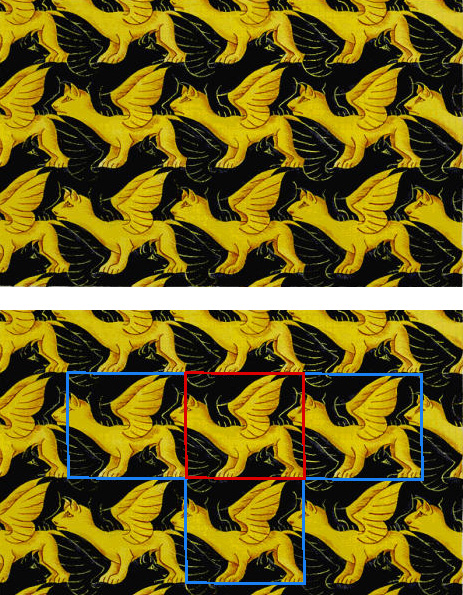
The unit cell in red can be cut and pasted, or translated, to yield the repeating winged lion pattern in the blue boxes. (Photo: mcescher.com, symmetry gallery)

Crystallography is the study of how matter packs in 3D.  For stability, solids organize in repeat patterns of a discrete unit (call this the “unit cell”) so that all atoms, in all three dimensions, are in the same pattern and are related by some sort of symmetry.  The most basic symmetry is called “translational symmetry” which is like “cut and paste symmetry”. You take the unit cell and paste it to left, and then again, and then so on.  In the 2D M. C. Escher image above, the unit cell is shown in red and in blue are the translated unit cells showing how the pattern repeats.  Crystalline materials can also have rotational symmetry which means that if you turn the unit cell you get the same thing you started with.  In the image above, the winged lions do not have rotational symmetry because they only overlay correctly if you rotate them 360*.

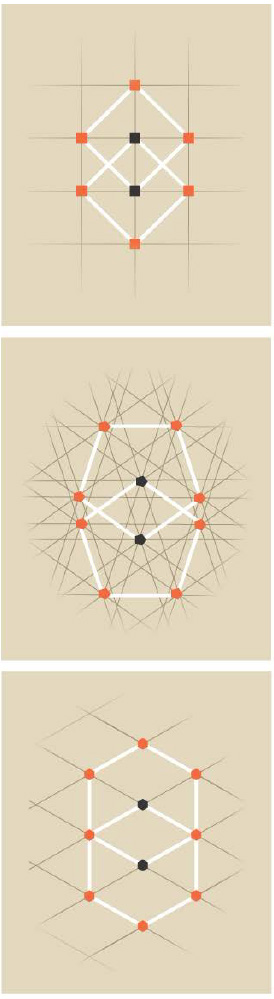
It was believed that translational symmetry was the most fundamental ordering pattern so only rotations that maintained the cut and paste pattern were allowed, such as 180*, 120*, 90*,  and 60* rotations or what is known as 2-, 3-, 4-, and 6-fold symmetry.  Sven Lidin illustrates this proof and why 5-fold symmetry is not allowed in the Nobel Prize citation for Shechtman, shown below.  There is some more rigorous mathematical proofs behind this, but you essentially can see the set up for Shechtman’s discovery.

4-fold (above) and 6-fold (below) rotations preserves the translational symmetry of design. 5-fold rotation (middle) generates a new disordered pattern. (Source: Sven Lidin, Nobel Prize Committee)

While looking at an aluminum-manganese material, Shechtman realized he had found 10-fold and 5-fold rotational symmetry which was thought to be not allowed. The material did have long-range order like a crystal but not translational symmetry.  Quasicrystals are therefore ordered materials that lack translational symmetry.  It seems like a simple concept but proving it required telling the entire crystallographic community that they had completely missed something. Luckily, art and mathematics had set the groundwork for this discovery.

A Penrose tiling, named after Sir Roger Penrose who formalized this geometry in the 1970s, lacks translational symmetry but has a 5-fold rotational symmetry (Photo: wikipedia)

The Penrose tiling above is a 2D quasi-crystal in that it does not have translational symmetry but has long-range order and 5-fold rotational symmetry (i.e. if you turned it clockwise from one point of the central start to the next point on the central star, it would be the same).  After the discovery of quasicrystals, physicists Peter J. Lu and Paul J. Steinhardt published a wonderful article in Science describing the appearance of Penrose patterns in Medieval Islamic tile work from as early as 1200 CE.  The supplementary data section in this paper has some lovely architectural examples.

(above) Spandrel detail from the Darb-i Imam shrine in Isfahan, Iran; (below) graphical depiction of the tiling pattern overlaid on the spandral image (Credit: Ju and Steinhardt, Science, 315, p1106-1110.)

Albrecht Dürer also drew some quasicrystalline tiles in his 1525 work “A manual of measurement of lines, areas and solids by means of a compass and ruler” which were subsequently analyzed by Casper and Fontano in 1996.

Albrecht Dürer penrose tiles done in 1525 (Photo: rarebookroom.org)

It’s exciting to see places where science and art overlap.  Congratulations to Dan Shechtman for the Nobel Prize and also to the mathematicians and artists who contributed to a deeper understanding of the organization of matter.