Light on the Rooftop had an awesome post about street art on Freshly Pressed the other day. She showed that non-conventional and public art can still be very high quality. I haven’t seen that level of street art while in Europe (unless the Bogside murals count) but I did catch an irreverent cartoon version of a classical Greek god. I thought it was funny, or at least a funny departure from the typical Hermes iconography.
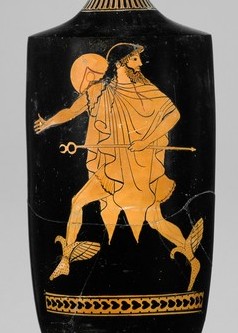
Hermes, as depicted in antiquity:
Terracotta oil flask depicting Hermes ca. 480–470 BC (Photo: Metropolitan Musuem of Art)
Modern Hermes painted above an abandoned building in Nafplion: (Google Translate tells me that EPMHE is “Hermes” in Greek if the winged helmet weren’t enough. On the billboard, he was facing an alligator in a Zoot suit which I am not sure how to interpret.)
I have been following the upheaval in Libya and came across a press release from UNESCO pleading for the protections of Libya’s archaeological sites. As the statement reads: “Experience shows that there is a serious danger of destruction during times of social upheaval. It has taught us to look out for looting by unscrupulous individuals, that often damages the integrity of artifacts and of archaeological sites. Careless dealers who buy these objects and fragments are in fact inciting more looting. It is therefore crucial that the international antiquities market be particularly wary of objects from Libya in the present circumstances,” Irina Bokova [Director-General of UNESCO] cautioned.
Leptis Magna (Photo: wanderingchiara)
I am reminded of the looting in Iraq following the 2003 US intervention but also of citizens protecting the Egyptian Museum in Cairo last February amid the riots. Libya has 5 designated UNESCO World Heritage Sites spanning Prehistoric, Phoenician, Greek and Roman periods. I have even seen tours advertised (well, not anymore) to Libya to view these magnificent works of art. My thoughts are certainly with the Libyan people who I hope have peace and stability soon, but it would be a tragedy if violence and lawlessness destroys their cultural heritage.
If you are near London, you have 2 weeks left to see the exhibit Close Examination: Fakes, Mistakes & Discoveries at the National Gallery. If you are like me and can not make it, they thankfully have a very cool set of case studies on-line to compliment the exhibit.
Conservation Science is the application of chemical and biological techniques to the study of paintings and art objects. Analysis and identification of an artist’s materials is beneficial for conservators who must select the best processes for cleaning a work. However, a lot of other information can be gained which helps art historian understand the “life” of the work such as where and when it was executed, how the artist completed the piece and if later additions were made. For example, x-ray analysis can show places in which a part of a painting, like a hand or face, was reworked. Sometimes this is done by the artist, or as the National Gallery shows in some examples, by later owners to suit the period’s tastes or possible make the painting more desirable to buyers. Four Figures at a Table by The Le Nain Brothers (below) is a really striking example of how much more we can learn about a painting through scientific analysis.
What could be underneath the pleasant country scene in the Four Figures at a Table by The Le Nain Brothers? (Photo: The National Gallery, London)
We take it for granted now that an artist would sign his or her work but this was not always the case. Carefully connoisseurship of an artist’s style can help attribute paintings but sometimes it is scientific analysis that can either rule out a great master or identify a painting’s creator. The fakes section of the National Gallery’s on-line exhibit is great too! In the end, scientific evidence will always trump exquisite craftsmanship.
It looks right, but how would you know if Botticelli painted Madonna of the Veil? (Photo: The National Gallery, London)
Sad to see a little damage to the National Cathedral in Washington DC caused by the 5.8 earthquake Tuesday. The East coast of the US doesn’t expect this sort of thing!
Angel down at the Washington National Cathedral (Photo: Connor Simpson, The Atlantic Wire)
The Martin Luther King Jr. Memorial opened to the public today and will be dedicated in Washington, DC next weekend. Information and concert tickets can be found on the official event website: Dedicate the Dream.
26 Aug 2011 UPDATE: The official dedicate date has been moved to an undeclared date in September or October due to the arrival of hurricane Irene in DC this weekend. Friday and Saturday morning events are still planned.
At the time this was proposed, the World War II memorial had just opened and there was some groaning in DC that the Mall was too crowded for anything else. To me, the National Mall is both an expansive green space and a record of our history, culture and heroes. I am glad a nice spot of the Tidal Basin was set aside to honor MLK Jr. specifically and in a broader sense the US civil rights movement. (An African-American History and Culture Museum is slated for the Mall in 2015 which is good because the only Museum remotely dedicated to the same subject matter was in Anacostia before – way, way off the beaten tourist path.)
One main features of the MLK site is a large bolder cut and opened in the middle called the “Mountain of Despair”. The removed piece is set closer to the water and is called the “Stone of Hope”. It is 30 ft tall and features a standing portrait of MLK emerging from the stone with arms crossed. Flanking around the tidal basin, out from the Mountain stones, are slowly tapering stone walls engraved with quotes by Martin Luther King Jr. Given the position of the monument on the Mall and its open lay-out, this seems like a very accessible and engaging space. I see people picnicking and chatting in eye-sight of MLK Jr. along the Tidal Basin.
You get a good sense the site from this fly through video produced by the National Memorial Project Foundation:
As you would imagine, there has been the obligatory criticisms of the statue: it was made in China by a Chinese man, it’s not a good likeness, he looks confrontational, whatever. The critique that I find the oddest is that the statue is too tall. In fact, the MLK figure is just about as big as his nearest neighbors on the Mall: Lincoln with pedestal is ~30.5ft and Jefferson with pedestal is ~25ft. MLK seems so much larger because he is not in a temple like those other two which defines a visual space and makes the figure seem smaller. Likewise, you can go right up to him and so your viewing perspective changes to a more extreme angle. I will concede that the stone block itself is pretty huge when viewed in the round. For scale, here’s how some of my favorites on the Mall compare: (Gandhi is technically in Dupont Circle in front of the Indian Embassy but I thought he belonged here.)
Martin Luther King Jr. statue size relative to some of the notable DC memorial statues and a 6′ tall person which gives a better sense of scale.
To me the most powerful memorials are personally engaging and this often means that the elements exist on the viewer’s level. For example, imagine how awesome it would have been to put a life-size statue of MLK Jr. on the steps of the Lincoln Memorial! You could stand next to him and look out over the Mall while reading his “I Have a Dream” speech. At least the newly constructed MLK Jr. Memorial lets you wander through his quotes and stand amid the literally and metaphorically looming mountain stones.
More than anything though, I hope that the MLK Jr. Memorial in person conveys his deep religious convictions and self-sacrifice. As Martin Luther King Jr. said reflecting on how he wanted to be remembered, “Yes, if you want to say that I was a drum major, say that I was a drum major for justice. Say that I was a drum major for peace. I was a drum major for righteousness. And all of the other shallow things will not matter.”
I’m looking forward to visiting DC soon to see this new Memorial in person and hope you get a chance to check it out too!


 Daydream Tourist
