New York Public Library

NewYork City Public Library Lion

Iconic Lion of the New York City Public Library (Photo: Daydream Tourist)

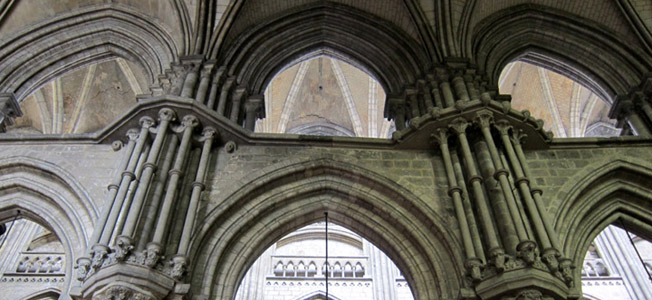
While I was in town, I stopped by the New York Public Library to do some research for the Friedrich Wahle Project.  While I was able to cross out one lead, most of the books I needed were in storage or locked up in the prints department.  I did at least get to wander around and enjoy the beautiful library interior which made the trip over to Bryant Park well worth it.

New York Public library

New York Public library, second floor reading room (Photo: Daydream Tourist)

Picasso and Françoise Gilot Exhibit in NYC

Picasso and Gilot exhibit poster

While in New York City this past weekend visiting friends, I happened across a lamp post advertisement featuring one of my favorite portraits ever, Femme au collier jaune (1946) by Pablo Picasso.  (This image should be familiar to anyone who has seen my blog before!)  Turns out this privately owned work is in New York as part of the exhibit, “Picasso and Françoise Gilot: Paris–Vallauris 1943–1953″ at the Gagosian Gallery from May 2 – June 30, 2012.  Having not previously heard about the exhibit, I stumbled upon the poster around the corner from the gallery; clearly this was fate.

The surprisingly impressive show pulls together select domestic, intimate pieces by Picasso of Françoise Gilot (his mistress from 1944 to 1953) and of the two children they had together.  The portraits are not strongly cubist but are notable for their bold lines and compositional simplicity.  I especially liked a series of printed portraits of Gilot that had been altered and refined through 10 iterative versions while still maintaining a relatively high degree of realism.  A skilled artist herself, I really enjoyed seeing Gilot’s paintings alongside Picasso’s.

Since photography is not allowed in the exhibit, the following shots are from the NYC Loves NYC blog which attended the opening night celebration.

Admiring a portrait of Gilot and children by Picasso (Photo: Noel Y. C., NYC Loves NYC blog)

PICASSO and FRANÇOISE GILOT (Paris-Vallauris, 1943-1953) Exhibition

Two bright family portraits by Gilot if I remember correctly (Photo: Noel Y. C., NYC Loves NYC blog)

Viewing Femme au collier jaune(1946) which is on loan from a private collection (Photo: Noel Y. C., NYC Loves NYC blog)

Additional images available from Gagosian Gallery here.

Munich Secessionists Catalogs

Embossed logo on the cover of the Munich Secessionist catalog (Photo: Princeton University Library)

Having decided that Wahle was part of the Munich Secessionist art movement based on his circle of friends, I sought out the catalogs for the Secessionist exhibits to see if he ever did show his art with this group.  While I didn’t find many specifics about this paintings, I did find some key biographical information.

The Offizieller Katalog der Internationalen Kunst-Ausstellung des Vereings bildernder Künstler Müchens (A.V.) “Secesion”, or in English, The Official Catalog of the International Art Exhibition of the Association of Munich “Secession” Visual Artists can be mostly found online thanks to Princeton University.  The Secessionists showed annually from 1893 to 1919,  with 1901 and 1909 dedicated to solely to medieval art and Hans von Marées respectively.  The exhibits began in a 12 room gallery on Prinzregentenstrasse and  Pilotystrasse and in 1898 moved to Koenigsplatz which today in the main museum complex in Munich.

Koenigsplatz gallery in Munich site of the majority of the Secessionist art exhibits (Photo: http://muc.in/)

Friedrich Wahle is listed as showing artwork in the 1893 (inaugural) and 1898 shows.   In 1893, Wahle has two pieces listed which are noted as only “gauche” and also for sale.  Gauche is a more opaque version of watercolor painting which explains why these works are listed in the watercolors, pastels, etc. catalog section and not in the oil paintings section.  In 1898, two Wahle works of “grisaille” are listed in the watercolors, pastels, etc. section.  Grisaille is more of a term for monochromatic visual images rather than a particular artistic medium.  These paintings may have been studies or images more in line with his gray-blue works (like The Discourse and The Wine Connoisseur).  No other descriptive information, such as subject matter, is noted in the catalog.  While some images from the show are reproduced in the catalog, Wahle’s works are not.  I am still tracking down the 1895 and 1897 catalogs, but otherwise these are the only pieces by Wahle shown as part of the Munich Secessionist exhibits.

Friedrich Wahle's addresses in Munich Map

Wahle’s residences in Munich: Art School (Blue), Address 1 (Red), Address 2 (Green) and Address 3 (Yellow)

One of the most interesting elements of the catalogs is their membership roll which is printed at the end.  Fritz Wahle is listed as an “ordinary member” of the Munich Secessionist Society in every catalog.  Member addresses are also printed.  In 1893, when he was 30 years old, Wahle lives on 33 R Kaulbachstrasse which is only 700 meters from the art school.  From 1894-1900, he lived at 4/4 Ainmiillerstrasse. Then at age 39, and from 1902 onward, he is listed at 16 Klugstrasse in Gern which was a western suburb at the time and is now part of central Munich.  What can I speculate about these moves?  Was marriage and family a factor here?  I need to do some more research about Munich, but maybe he married in 1894 and the couple moved into a new apartment.  Then after six years, several children and a profitable career as an illustrator, the Wahle family moved to a bigger house in the suburbs.

Portrait of Friedrich Wahle by Hugo Kaufmann

Portrait of the Painter Wahle by Hugo Kaufmann, featured in the 1899 Munich Secessionist Exhibit Catalog (Photo: Princeton Library)

The last, very interesting clue is a portrait bust of Wahle.  At the back of each Secessionist catalog are 20 or so reproductions of the paintings and statues in the show.  Sculptor Hugo Kaufmann produced Bildnis des Malers Wahle (Portrait of the Painter Wahle), an image of which is featured in the 1899 Munich Secessionist catalog.  This can only be a portrait of fellow Secessionist Friedrich Wahle.  It looks like I finally found a reliable likeness of Wahle!  You can judge for yourself if it looks like cartoon Fritz Wahle.

Fritz Wahle Auction Catalog

Friedrich Wahle, Gespräch Auf Dem Boulevard (Talk On The Boulevard) - sold July 2007

So as part of the Friedrich Wahle Project, I am assembling a catalog of his drawings and paintings.  Using mainly online auction records from the last three decades, I’ve managed to put together a pretty interesting list.  So here is approximately what I know so far:

I have found 61 documented Friedrich Wahle paintings with auction records (this also includes two painting currently for sale on eBay).  Of these 61 records, images are available for only 22 of them.  I mainly just know that Wahle paintings exist; I still need to tie them together chronologically and match them to art exhibits or magazine pages where they may have been originally published.

There are additionally 2 unassigned images with no auction records and 1 painting that surfaced on the German version of “Antiques Roadshow”.  I found 1 Wahle illustration from a 1914 book of translated German short stories (likely reprinted from a periodical).

Most auction sales have taken place in Germany, with 14 total having been sold in Italy, Sweden, Denmark, Austria, Switzerland and the USA combined.  During his lifetime, Wahle may have only been known regionally or nationally and so the majority of his works have been surfacing in Germany.

The Discourse (my painting) at 49.5 x 36.8 cm is actually a common size for Wahle’s oil paintings.  This may correspond to a full magazine page and so subsequent 37 x 37cm or 21 x 14cm works may have been partial page images.  Also, almost all of the paintings I’ve found are oil on board; there are only a couple watercolors and half a dozen oil on canvas paintings.  As a prolific professional illustrator, oil on board seems to be an intuitively cheap and easy medium.

Overall, Wahle’s subject matter has focused on the interactions of people going about daily life.  It’s incredible how many of his paintings show two people talking!  The palette does tend to be natural colors and tones.  The image at the top of this post, Talk On The Boulevard, has some delightful color in the woman’s hat whereas The Service Personnel has muted brown with warm yellow and green.  Some paintings are executed in a blue monochromatic fashion like The Discourse and The Wine Connoisseur below.  I presume this was to facilitate the lithographic processing for reproduction but since I can’t yet date the “blue” paintings, I can’t correlate them to changes in magazine printing technology. 

Friedrich Wahle, Das Dienstpersonal (The Service Personnel) – sold March 2012

I also find it interesting that many of the oil on board works are not finished up to the edges.  For commercial printing, space would have been needed to crop the image or overlay text.  I hope I find The Wine Connoisseur in Fliegende Blatter because I am certain that the ghostly butler figure on the right was completed cropped out of the final image.

Friedrich Wahle, Der Weinkenner (The Wine Connoisseur) - unsold March 2012

Having gone through 7 years worth of issues of the magazine Fliegende Blatter, I have found 96 Wahle works in addition to the 61 above.  If we assume that he may have been active from approximately 1880-1920, then there could potentially be a lot more paintings to find!  While continuing to document these illustration, I am going to start contacting auction houses and galleries in Germany to locate additional information but more importantly, images of sold paintings.  I really hope to be able to match black and white magazine images with their painted source material.

The Shakespeare Travel Tour (Part I)

In honor of William Shakespeare birthday (thought to be on April 23, 1564), I wanted to take a look at some of this plays. While some were set in England to be historically accurate, many of the plays are set in exotic cities through Europe and the Mediterannean to capture the imagination of the audience.  Here are just a few of my favorite locales.

HAMLET - Kronborg Castle, Elsinore, Denmark

Will you find the ghost of the King walking the ramparts of Kronborg Castle? (Photo: Kronborg Castle, Agency for Palaces & Cultural Properties, Denmark)

As Marcellus points out in Act 1, “Something is rotten in the state of Denmark.”  Hamlet and his troubled family lived in the city of Elsinore on the northeastern tip of the easternmost Danish Island of Zealand.  The events of the play were likely set in Kronborg Castle which overlooks the coast.  Originally built in the early 15th century (so probably too late for Hamlet’s story), the castle was enlarged in the Renaissance and is a UNESCO World Heritage Site today.  The Kronborg embraces its Shakespearean heritage hosting a festival of plays every August.  No word though if traveling bands of actors are allowed to participate in the festival or not.

ALL’S WELL THAT ENDS WELL – Southern France & Florence

View of Perpignan, one of the largest cities in the Roussillon region of Southern France (Photo: Martin Addison, Flickr)

All’s Well That Ends Well is a bizarre comedy.  Helena, the smart commoner, cures the King’s illness and is granted whatever she wants in return.  She chooses a hot nobleman who protests throughout the wedding, declares he will not be with her until she has his child (impossible task at that point) and then runs away on a war campaign.  Helena weeps with her mother-in law but then decides to spy on her nobleman, I mean, go on a pilgrimage exactly where he is waging war.  Helena disguises herself as a maiden the nobleman has fallen for and well, gets pregnant.  Finally everything is revealed, the marriage is reconciled and they all live happily ever after.

This comedy could really have been set anywhere, but Shakespeare chooses two beautiful, romantic locales.  Helena and the nobleman are from the Roussillon, a Catalan region of Southern France in the Eastern Pyrenees.  The area became part of Aragon after 1344 but is treated as an independent kingdom in the play.  The nobleman runs off to battle in Florence, Italy which turns out to be an excellent place for a romantic interlude.

THE TEMPEST – Bermuda

Prospero may have wandered along Bermuda's Pink Beach (Photo: simsbury119, Flickr)

Prospero, his daughter, the comic relief and two evil brothers with entourage are all shipwrecked on a magical island.  The audience is never explicitly told where this fantastic island is located, but it may have been in North America.  The Tempest was written within a year after news of a sensational Caribbean shipwreck reached London (1).  It is very likely that Shakespeare set this tragic play of betrayal and forgiveness on the exotic and well-publicized island of Bermuda which must have seemed very magical indeed in 17th century England.

(1) Shakespeare, William. The Tempest. Ed. Henry Norman Hudson. New York: Ginn and Company, 1909. Shakespeare Online. 20 Aug. 2010.