I’m very excited to have joined a group of excellent bloggers for the monthly ArtSmart Roundtable! These folks love travel and art history as much as I do, so it’s a great fit. Each month we pick a theme to write about and for October it is architecture. Check below for links to all the other awesome ArtSmart Roundtable posts!
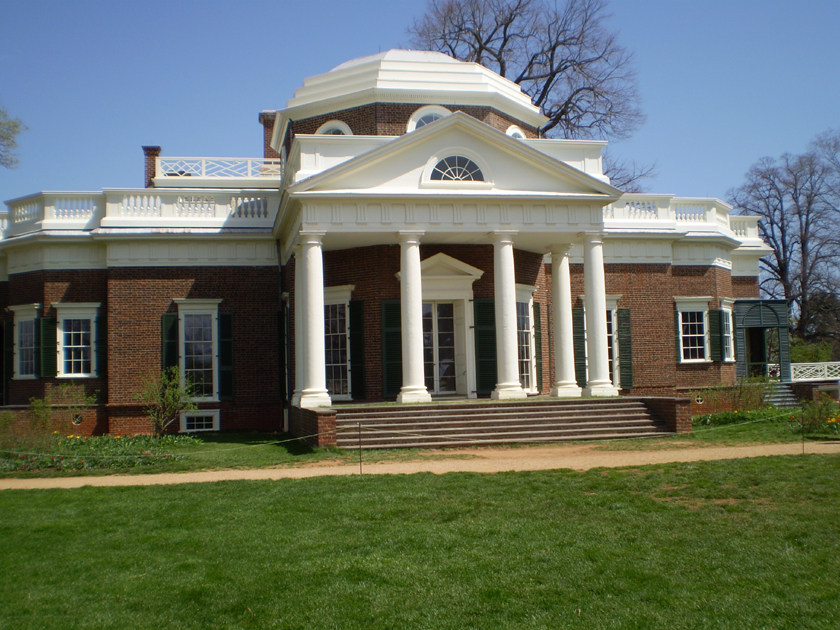
My travel itineraries always include visits to restored or recreated historic homes. It brings me just a little bit closer to the past when I can see a Tudor, Victorian or Art Deco building complimented by its matching contemporary decor. Many times they are more impressive on the inside than they are on the outside. There is one historic American home though with such an elegant Neoclassical design that it was named a UNESCO World Heritage Site – Thomas Jefferson’s Monticello in Charlottesville, VA.
Monticello’s west portico in early April (Photo: Daydream Tourist)
Mycenae outer wall viewed from below (Photo: Daydream Tourist)
Don’t go to Mycenae if you want classical Greek architecture. It does not have elegant ionic columns or passionate friezes of Gods battling. It is not sophisticated artistically but still worth the trip. You visit Mycenae because it is a fortress so impressive and old that is was selected as a UNESCO World Heritage Site. (And #6 in my series.)
Winter solstice sunrise illuminating the main passage at Newgrange (Photo: Alan Betson, Irish Times)
Earlier in my UNESCO World Heritage Site series, I discussed the Neolithic mound tomb Newgrange which is outside Dublin. Around the winter solstice, approximately Dec 18-23, the morning sun enters through an opening over the doorway and illuminates the main stone passageway and the central burial chamber. It’s interesting to think of the religious significance this event – cremated human remains being touched by the sun – must have held.
Diagram of winter solistice sunrise at Newgrange (Newgrange by G, Stout & M. Stout, 2008, Newgrange)
Over the last few days, a handful of lucky lottery winners have huddled inside the chamber to watch what is usually a magnificent spectacle. (It’s actually been a little overcast this week so the effect may have been reduced.)
It’s been a while since I worked on my UNESCO World Heritage Site series so let’s get back to it with an easily recognizable site – The Acropolis in Athens.
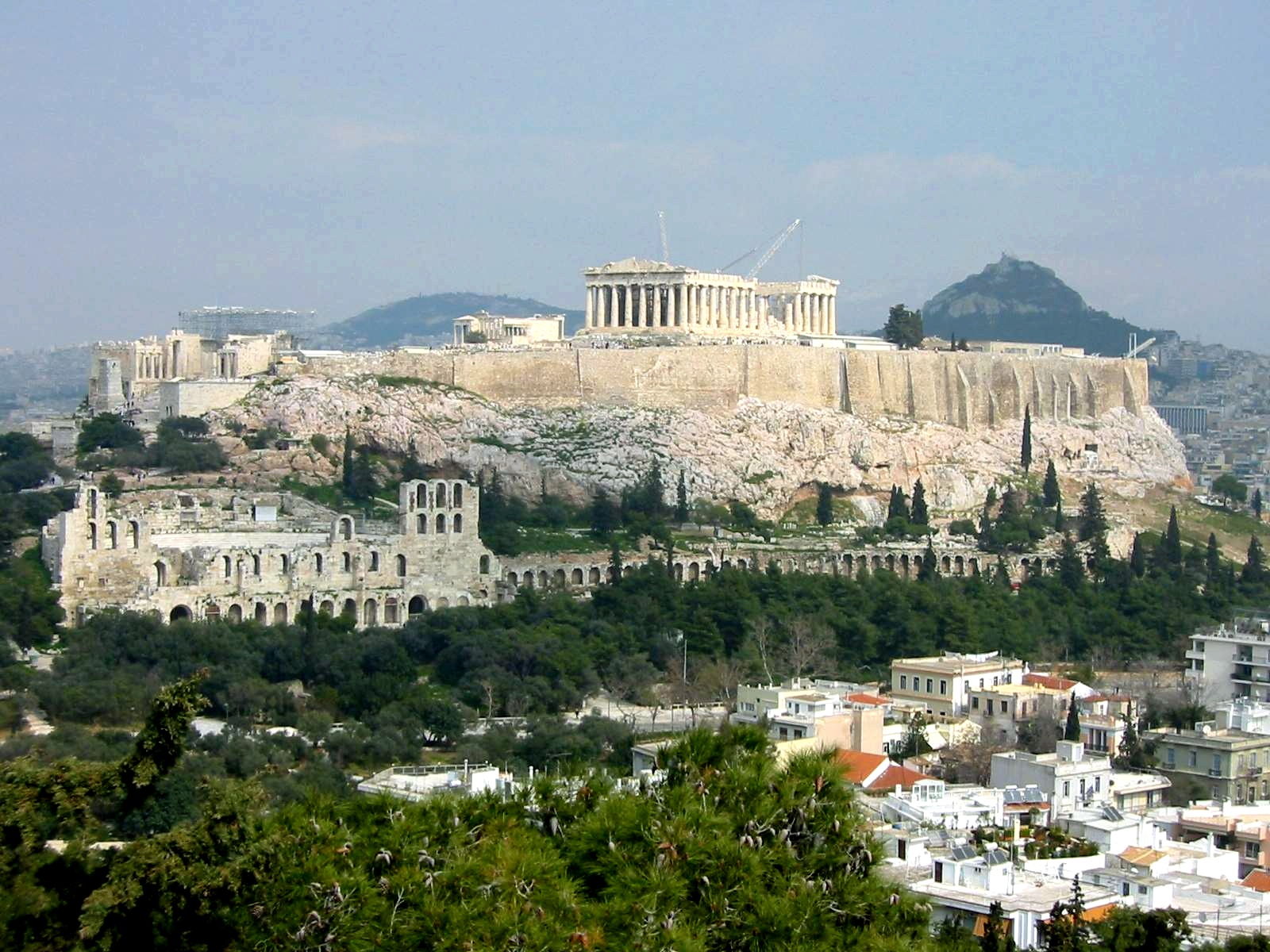
View of the Acropolis (Photo: Wikipedia)
Entering Athens, you are walled in by buildings and can easily lose your orientation but before long you turn a corner and there on an imposing plateau is the Acropolis. The complex of temples including the Parthenon atop the rocky hill was originally filled with great art, commanding architecture and human activity in Classical Greece. I could write long posts about each of the site’s elements but I’ll try to give an overview here.
Reconstruction of the Acropolis (Photo: Roy George)
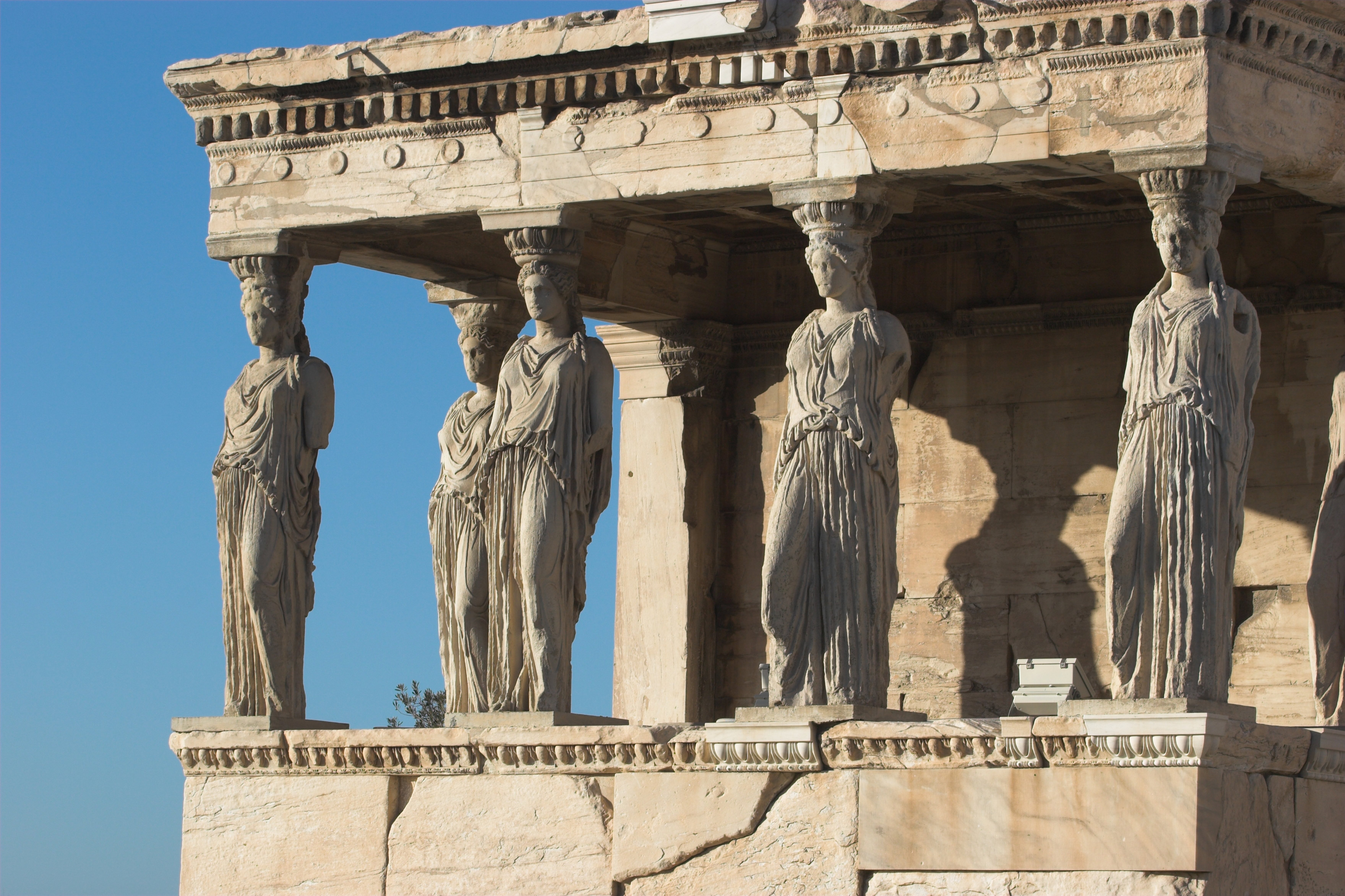
While there had been religious buildings and fortification on the rock for centuries already, the greatest construction effort was completed under the rule of Pericles during the height of the Greek empire (460-430 BC). Visitors would have entered the site through a grand gateway known as the Propylaea. Once inside, along the right toward the Parthenon would have been the Brauroneion, a temple dedicated to Artemis protector of pregnant women and childbirth, and the Chalcotheke which is believed to be the Parthenon treasury. Left from the entrance was a complex religious building called the Erechtheion which honored Athena as Protectress of Athens, Poseidon as rival for Athens and several ancient heroes. Today the building is most recognizable for a porch of columns shaped like maidens known as Caryatids. The small Temple of Nike could be found to the right of the Propylaea before entering the site and is largely restored today. A Greek and a Roman amphitheater were carved into the South side of the Acropolis rock.
Temple of Nike at the gates of the Acropolis
The Parthenon was dedicated to Athena, the Patron Goddess of Athens, and was believed to house a 40 foot tall ivory and gold statue of her. The outer structure of Doric columns is 228.0 x 101.4 feet in size and has several “optical refinements” such as bulging columns and a bowed base so that the structure’s geometry looks perfect to viewers. The triangular pediment facing the Propylaea depicted Athena winning over the city of Athens with her gift of an olive tree while the opposite pediment described her birth from Zeus’ head. Square panels, or metopes, depicting mythical battles adorned the exterior of the Parthenon. The interior cella was decorated with a continuous carved frieze of riders, priests, and pilgrims completing the annual Panathenaic procession from the cemetery through the market and on to the Acropolis.
East face of the Parthenon
The Parthenon has been attacked, repurposed and robbed several times. The video below from the Hellenic Ministry of Culture does a good job chronicling the destruction.
You’ll also note that the video above spends a significant amount of time highlighting the removal of art collectively known as the Elgin marbles. There is strong movement in Greece to return these sculptures from the British Museum to Athens. The recently opened Acropolis Museum in Athens displays copies of all the Parthenon sculptures for context but I assume would prefer to have the originals. If you can’t see them in either museum, there is a great virtual exhibit available online that lets you tour the Parthenon frieze.
Virtual Parthenon Frieze project sponsored by the EU
While virtual recreations and artistic reconstructions are helpful, I still find it difficult to imagine the Acropolis during the Golden Age of Athens. As fantastic as I picture it, the Acropolis was probably more colorful, more cluttered with statues and more imposing.
On my Irish road trip, I saw a lot of impressive things – jagged mountains, green valleys and wild coastline. I also saw a lot of historic things – overgrown monastic ruins, abandoned farm houses and the ever present round tower. But the most impressive and historic sites were Newgrange, Knowth and Dowth, three Neolithic mound tombs along the Boyne River and a UNESCO World Heritage Site.
Newgrange, part of the prehistoric Brú na Bóinne complex
Predating the Egyptian Pyramids, the mounds are passage tombs, meaning they contain one or more stone lined corridors where traces of human remains were found. Newgrange is the largest and more famous of the three. It aligns such that on the winter solstice the sunrise illuminates the inner chamber in what must have been a highly potent spiritual moment for its prehistoric builders. You are allowed to enter the somewhat claustrophobic passage and view a chamber formed by an impressive corbelled ceiling.
While it looks beautiful, the stone exterior of Newgrange is a reconstruction from archaeological guesswork. The white stone and river stone in the facade can be traced to sites quite a distance away. It is possible that the stones were brought as offerings and left outside the portal and therefore might never have been part of a collapsed stone wall as the restoration assumes.
Stone carvings at Knowth
I am far more interested in prehistoric carvings and so I enjoyed Knowth a little more. Both mounds are encircled with meter tall stones but those around Knowth are more extensively decorated. While it is easy to try an interpret the swirls (everlasting life? rebirth?) and organized dots (there’s 12 on one rock, is this a lunar year reference?), I prefer to enjoy them for their design and to appreciate the ancient conviction that created these deep stone markings. You cannot go far inside the Knowth passages but you can climb on top of the mound. The Knowth site was occupied by humans in later periods so in restoring the prehistoric site, archaeologists had to go down through the remains of a Cistercians farm, Norman dwelling and Bronze Age village.
Newgrange as viewed from atop Knowth
The sites are only accessible from the Visitor Center which runs timed tours of 15-20 people by shuttle bus to each tomb. You can choose just to see just one tomb but you are completely cheating yourself if you don’t visit both Newgrange and Knowth! (Dowth is closed for posterity with plans to excavate it someday.) During the obligatory wait before your tour time, the visitor center has a good video about Neolithic religious practices and some interesting exhibits.
Tips for Visiting
While the River Boyne site could be an easy day trip from Dublin, it’s worth spending the night nearby. (And this way, you can see the carved crosses at Monasterboice before the tour buses show up!) I found the Scholars Townhouse Hotel in Drogheda about 15 minutes from the UNESCO site. The hotel is decorated with dark wood paneling and antiques making it feel elegant but very cozy. When we arrived in the evening, candles lit the reception area and the staff could not have been nicer. I loved the huge carved Victorian bar and the Cromwell battle ceiling paintings in the breakfast room. (Disclosure: I am not receiving anything for writing about the hotel. I just liked it and thought it was a good tip to pass along.)






 Daydream Tourist