Miracles and Russian Icon Copying “Errors”
Take a good look at the icon below (without reading its name).

Holy Virgin of the Three Hands (Museum of Russian Icons)
Apr 20

Take a good look at the icon below (without reading its name).
Holy Virgin of the Three Hands (Museum of Russian Icons)

Juno in her former home, a suburban Boston estate garden (Photo: MFA)
The Museum of Fine Arts in Boston is hosting an interesting conservation project. An impressive Trajanic or Hadrianic Period (early second century A.D.) statue of Juno was moved into the George D. and Margo Behrakis Gallery of ancient art this week. Given its massive size of 13ft and 13,000 lbs, conservator will be examining, cleaning and repairing the work in situ. Recently donated to the Museum of Fine Arts, the statue has spent the last 100 years in an estate garden just outside of Boston. The resulting wind, snow, freeze-thaw, biological and vandal damage has taken a toll on the piece. The Museum is raising money to support the conservation. You can learn more about this on-going project at the MFA’s website.
I’m particularly interested in the analysis of the head. It is clear that it was reattached at one or more times in the piece’s history; however, it also seems that the head and body are not the same marble and may have been united at a later time. Given that little historical information exists about the piece prior to the 17th century, curators and conservators will have to rely on scientific analysis to understand the past of this statue.

Juno's head was removed to protect it during transport (Photo: MFA, Boston)

Layers of plaster and glue illustrate past repairs to the neck of Juno. (Photo: MFA, Boston)

Close up of the iron pin holding the right arm in place. (Photo: MFA, Boston)
Mar 9

The other day I wrote about the Eastern Orthodox iconography of John the Baptist. Let me take a step back now and spend a little more time on the amazing institution where I saw those pieces: The Museum of Russian Icons. Located in Clinton, MA, about an hour drive from Boston, the modern facility displays hundreds of excellent Russian icons. It was such a pleasant surprise to find this small museum; it is definitely one of my favorite New England hidden gems.
The Museum houses the personal collection of Gordon B. Lankton. An executive at a plastic company, he bought his first icon at a flea market in Russia while on a business trip. Mr. Lankton became fascinated by the style and imagery and returned from his subsequent business trips with more icons. (Now new pieces are acquired through well-respected international auction house.) With well over 100 icons, Mr. Lankton decided the collection would be best displayed at a museum, but a suitable organization could not be found in New York City or Boston. He then decided to keep the icons in Clinton and so the current Museum was opened in 2006 in a renovated carpet factory. The museum space is elegant and an excellent platform for enjoying the art. The Museum now has over 500 icons and objects in its collection and has a friendly and informed staff. With 12,000-17,000 visitors annually, you’re also likely to enjoy the works with some peace and quiet.
Images of the collection were taken by me, except the last one of the museum interior.

"Vladimir Mother of God" circa 1680 (Museum of Russian Icons)

Lower central detail of "Vladimir Mother of God" showing candle damage (Museum of Russian Icons)

"Saint Nicholas of Zaraisk, The Wonderworker and Holy Bishop of Myra with Scenes from his life" Suzdal School, 16th Century (Museum of Russian Icons)

Detail from "Christ, Not Made by Hands (Allegory)", circa 1600 (Museum of Russian Icons)

"Mary Magdalene" circa 1890 (Museum of Russian Icons)

The honor system cafe (pay at the gift shop upstairs) is a nice touch with imported Russian treats, a hot beverage machine and these antique tea kettles.

Modern interior of Museum of Russian Icons (Image from Wikipedia)
The new Crystal Bridge Museum of American Art, assembled and funded by Walmart heiress Alice Walton, opens today in Bentonville, Arkansas. NPR Weekend Edition covered some of the controversy (or in my opinion, non-controversy) regarding the acquisition of art pieces from non-museum public and private institutions like universities and libraries. While listening, I went browsing through the collection on-line. I immediately recognized something on the main page of the 19th Century gallery:
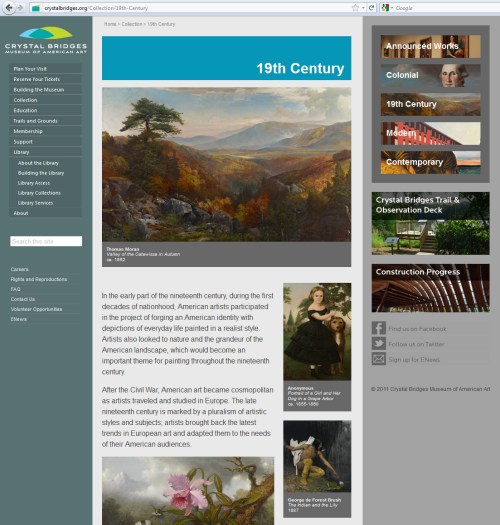
That little girl with her dog was sold at Skinners Inc in Boston at the March 7, 2010 American Furniture & Decorative Arts auction! With an auction estimate of $8-12,000, she sold for $41,475 (despite her pouty scowl).
News coverage of the museum’s opening has noted the supposed difficulty of finding quality American art pieces with which to create a new museum. I think the above example clearly illustrates that there are beautiful pieces still in family or private collections that have not made it into museums. I can only imagine that there was an army of art historians and curators sweeping the country looking for these undervalued pieces in American museums, commercial galleries and auctions. Likewise, university, library or hospital collections may not attract the visitor the art deserves and so I see no problem with works being sold so that the funds can go toward the primary missions of the institutions.
I’m not sure when I’ll be in Arkansas but at least the highlights are online.
Oct 12

The Artist inspecting his work (Photo: EPA/ALFREDO ALDAI)
Bilbao – Spanish artist Antonio Lopez looks at his work of art Man and Woman, consisting of two sculptures in polychrome wood, during the presentation of an exhibition dedicated to him at the Fine Arts Museum in Bilbao, Spain, 10 October 2011. The exhibition runs from 10 October 2011 to 22 January 2012. EPA/ALFREDO ALDAI. Story and photo from Artdaily.com
At first I didn’t realize this was the artist inspecting his work. I like the photo much more when I imagine the old man to be a somewhat intimidated museum-goer.



 Daydream Tourist