Skip to content

Posts tagged ‘Italy’

Photo of the Week – Lost in Italy

Seminarians in Siena (Photo: Daydream Tourist)

This is a picture from my 2005 trip to Italy.  In Siena, we came across two seminarians in black cassocks trying to read a map.  They were so perfectly framed by the medieval street.  I keep coming back to this image as one of my favorite from the trip.  Besides taking the photo quickly while their backs were turned, my friends and I chatted with these guys and gave them directions.  Turns out they were actually from Minnesota.  They and some other classmates were exploring Tuscany before heading to Rome for theological studies.

Statue Conservation in Action at the MFA Boston

Roman Juno statue

Juno in her former home, a suburban Boston estate garden (Photo: MFA)

The Museum of Fine Arts in Boston is hosting an interesting conservation project.  An impressive Trajanic or Hadrianic Period (early second century A.D.) statue of Juno was moved into the George D. and Margo Behrakis Gallery of ancient art this week.  Given its massive size of 13ft and 13,000 lbs, conservator will be examining, cleaning and repairing the work in situ.  Recently donated to the Museum of Fine Arts, the statue has spent the last 100 years in an estate garden just outside of Boston.  The resulting wind, snow, freeze-thaw, biological and vandal damage has taken a toll on the piece.  The Museum is raising money to support the conservation.  You can learn more about this on-going project at the MFA’s website.

I’m particularly interested in the analysis of the head.  It is clear that it was reattached at one or more times in the piece’s history; however, it also seems that the head and body are not the same marble and may have been united at a later time.  Given that little historical information exists about the piece prior to the 17th century, curators and conservators will have to rely on scientific analysis to understand the past of this statue.

Juno's head was removed to protect it during transport (Photo: MFA, Boston)

Layers of plaster and glue illustrate past repairs to the neck of Juno. (Photo: MFA, Boston)

roman statue repair with iron pin

Close up of the iron pin holding the right arm in place. (Photo: MFA, Boston)

Tacky Tourist Souvenirs

Sparta danger shirt

A reference from the movie "300" at a Greek tourist tee-shirt shop

When I was in Sicily, I met a fellow traveler who had an on-going contest with his girlfriend.  Whenever they traveled, they had to bring back the most ridiculous tourist junk as a gift for the other.  This is an absolutely brilliant idea!  Tacky tourist stuff is ubiquitous at popular attractions.  It’s an international phenomena; you can find this stuff everywhere!

Moose nugget earrings - $3.95

Growing up in Alaska, I would cringe at the variety of souvenirs made from “mouse nuggets”.  As large as a moose is, their excrement is actually just a pile of 1 inch pellets.  Someone though it would be funny to lacquer a couple and make jewelry out of it and the idea has taken off.  You can get drink swizzles, rings, and key chains too.  People must be buying these assorted “nugget” items because you can always find them in tourist shops.  But just so we’re clear, moose nuggets are poop!

Michelangelo's David light switch plate - $9.99

Hands down the worst inspiration for tacky tourist stuff is Michelangelo’s David!  If you’ve ever been to Florence, you know that you can’t go 2 blocks without seeing this guy on everything from desk clocks to aprons.  And most of it is a little tasteless.  Come on, it’s not like people have never seen a nude statue before!

So what have been your favorite examples of tacky tourist junk?

Reconstructing Art: Duccio’s Maesta

1878 Iguanodon

In1878 this seem like a fine reconstruction of an Iguanodon, despite the fact that its tail would be broken in this posture. (Photo: University of Bristol, Earth Science Dept.)

Walking through the ruins of the Acropolis and looking over the plaster copies of the Parthenon Frieze this last fall, I tried to put it all back together visually.  Thankfully there were digital reconstructions to look to, but I got to wondering if wholesale reconstruction of a work of art is even possible.  In most cases, pieces can be broken or destroyed and critical details of the overall assembly can be lost.  (It’s a tangential example but I’m thinking of all the miss-assembled Victorian dinosaur skeletons.)  Then I remembered Duccio’s Maestà in Siena.

The Three Marys at the Tomb by Duccio, part of the Maestà altarpiece in Siena (Photo: Web Gallery of Art)

Duccio’s expansive Maestà Altarpiece was installed in the Siena Cathedral on June 9, 1311.  The double sided piece is estimated to have been 4.7 by 5 meters in dimension.  It was composed of a central panel (The Virgin and Christ Enthroned with Saints and Angels) and over 70 smaller scenes depicting New Testament iconography.  Sadly this grand style of altarpiece went out of fashion and in 1711, the panels were dismantled, sawed apart, and dispersed.  Most of the pieces are now back in Siena. Careful scholarship, analysis, and restoration has shed light on its original construction and composition.

Maesta alterpiece

Virgin and Child panel of the Maesta alterpiece by Duccio, Museo dell’Opera, Siena (Photo: profzucker, Flickr)

The Maestà altarpiece is not displayed in its reconstructed state which allows for better viewing of the visually rich story panels.  These were likely executed by Duccio’s workshop but are all interesting.  The central Virgin and Child panel alone is incredibly impressive.  I remember seeing it at the Museo dell’Opera del Duomo in Siena.  The room was fairly dark with a few spotlights on the panel which made the gilding glow.

Duccio Maesta front panel

Duccio Maestà front panel reconstruction with missing pieces shown in gray (Image: DaydreamTourist)

On the front of the altarpiece would have been a Marian cycle in the pinnacles and the birth and childhood of Jesus in the lower predella. The reverse panel depicts the Passion sequence in the main section and scenes from the ministry of Christ along the pinnacles and predella. In the reconstruction images above and below, panels not presently in Siena are shown in black and white (missing panels are not shown).  You have to actually go to Washington DC and Madrid respectively to see two of my favorites: the Nativity with Isaiah and Ezekiel and Christ and the Samaritan Woman.  It is also possible to appreciate how pieces may have been shaved and shaped since being freed from the altarpiece frame.  I have also accepted the interpretation that a piece showing the coronation of the Virgin now in Hungry was featured in the central front panel pinnacle.  This makes sense thematically in the context of the smaller pinnacle images showing the life of Mary and would be appropriate subject matter for the period and location.  The reconstructions also assumes that the pinnacle angels mirrored each other since only 4 of the 12 total exist today.

Duccio Maesta back

Duccio’s Maestà back panel assembly with missing pieces noted in gray (Image: DaydreamTourist)

Viewed as a whole, the complexity and ambitiousness of the project is evident.  Whether or not the framing decorative elements are exactly correct is a moot point given the wealth of visual story-telling and the fairly confident reconstitution of the narrative flow.  It’s amazing that almost all of the panels have survived.  The Maestà demonstrates that reconstruction, at least digitally, goes a long way in understanding the artist’s intentions, the work’s visual impact, and how contemporary viewers would have encountered the piece.

Reconstructions adapted from the Web Gallery of Art.

Reference: Siena, Florence and Padua: Art Society and Religion 1280-1400, Volume II: Case Studies, edited by Diana Norman, 1995.

A Traveler’s Second Language

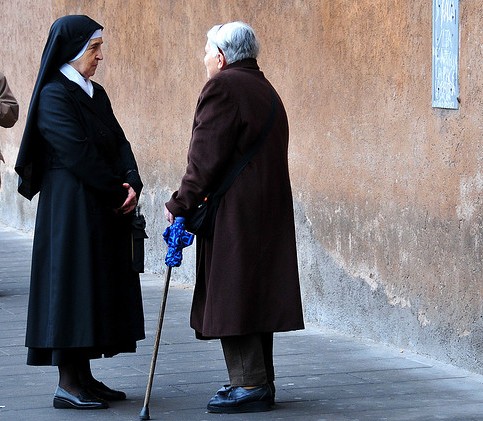
"Bonjour suora, comment allez-vous?" (Photo: Ed Yourdon)

There was a great column by Daisann McLane in National Georgraphic Traveler this month about the value of speaking a second language.  No matter where you are, it gives you another option for communication.   She argues that when people must communicate in neutral language (in her case, an American and Japanese woman speaking Spanish together), they are more conscientious of their pronounciation and use more standard, less slangy vocabulary.  This made me think of my own experience communicating in a third language.

The summer I spent in Florence, I lived in a convent which rented half of its rooms to travelers and students like me.  It was gorgeous place with cool stone floors and a peaceful inner garden, all hidden just down the street from the Duomo.  My room even had a 19th century fresco of angels on the ceiling!  The sisters were very kind and would join the guests for breakfast.  The only problem was that I barely spoke Italian so I limited to “Sì, grazie suora”.  Unless the sisters wanted to sell me a train ticket, I didn’t really know what to say.  But I was in luck; this was a French religious order so they all knew some French!  My four years of high school French came in pretty handy.

What a difference a little communication makes.  It was so much more fun to chat with the sisters, ask them what they were working on and answer their questions about what I had done each day.  As much as I love seeing art and scenery when I travel, it makes for a much richer experience if you can actually talk with locals.

(On a side note, my French is still way better than my Italian.)