Skip to content

Posts tagged ‘history’

Mysterious Bull Legs

Four-legged winged bull in the Khorsabad Court exhibit (Photo: Oriental Institute)

I was recently in Chicago and decided to get off the beaten path and visit the Oriental Institute at the University of Chicago.  It’s a great, albeit small museum covering Mesopotamia, Persia, Egypt and other ancient near Eastern civilizations.

One exhibit area is domonated by pieces from the court of King Sargon II who ruled Assyria from 721-705 B.C.  In the center is a 16ft tall winged bull with a human head.  This sufficiently impressive piece along with its twin would have guarded a city entrance.

Looking more closely at the bull figure, it appears to have been made for viewing from very specific angles and not so much in the round.  In the image above, the bull has four legs when you look straight on, but if you move 90 degrees, there are two symmetrical legs under the head.  From the right angle, you can see that there are 5 legs!

This protective bull genie has an extra leg!

The Louvre also has some 5-legged Assyrian human-headed winged bulls.  It just goes to show that you should look carefully at art.

Prehistoric sites of Brú na Bóinne (Newgrange, Knowth and Dowth)

On my Irish road trip, I saw a lot of impressive things – jagged mountains, green valleys and wild coastline.  I also saw a lot of historic things – overgrown monastic ruins, abandoned farm houses and the ever present round tower.   But the most impressive and historic sites were Newgrange, Knowth and Dowth, three Neolithic mound tombs along the Boyne River and a UNESCO World Heritage Site.

Newgrange, part of the prehistoric Brú na Bóinne complex

Predating the Egyptian Pyramids, the mounds are passage tombs, meaning they contain one or more stone lined corridors where traces of human remains were found.  Newgrange is the largest and more famous of the three.  It aligns such that on the winter solstice the sunrise illuminates the inner chamber in what must have been a highly potent spiritual moment for its prehistoric builders.  You are allowed to enter the somewhat claustrophobic passage and view a chamber formed by an impressive corbelled ceiling.

While it looks beautiful, the stone exterior of Newgrange is a reconstruction from archaeological guesswork.  The white stone and river stone in the facade can be traced to sites quite a distance away.  It is possible that the stones were brought as offerings and left outside the portal and therefore might never have been part of a collapsed stone wall as the restoration assumes.

Stone carvings at Knowth

I am far more interested in prehistoric carvings and so I enjoyed Knowth a little more.  Both mounds are encircled with meter tall stones but those around Knowth are more extensively decorated.  While it is easy to try an interpret the swirls (everlasting life? rebirth?) and organized dots (there’s 12 on one rock, is this a lunar year reference?), I prefer to enjoy them for their design and to appreciate the ancient conviction that created these deep stone markings.  You cannot go far inside the Knowth passages but you can climb on top of the mound.  The Knowth site was occupied by humans in later periods so in restoring the prehistoric site, archaeologists had to go down through the remains of a Cistercians farm, Norman dwelling and Bronze Age village.

Newgrange as viewed from atop Knowth

The sites are only accessible from the Visitor Center which runs timed tours of 15-20 people by shuttle bus to each tomb.  You can choose just to see just one tomb but you are completely cheating yourself if you don’t visit both Newgrange and Knowth!  (Dowth is closed for posterity with plans to excavate it someday.)  During the obligatory wait before your tour time, the visitor center has a good video about Neolithic religious practices and some interesting exhibits.

Tips for Visiting

While the River Boyne site could be an easy day trip from Dublin, it’s worth spending the night nearby.  (And this way, you can see the carved crosses at Monasterboice before the tour buses show up!)  I found the Scholars Townhouse Hotel in Drogheda about 15 minutes from the UNESCO site.  The hotel is decorated with dark wood paneling and antiques making it feel elegant but very cozy.  When we arrived in the evening, candles lit the reception area and the staff could not have been nicer.  I loved the huge carved Victorian bar and the Cromwell battle ceiling paintings in the breakfast room.  (Disclosure: I am not receiving anything for writing about the hotel.  I just liked it and thought it was a good tip to pass along.)

Habsburg Anscestors

The last of the Habsburg dynasty, Otto von Habsburg died this week and was buried in an elaborate state funeral.  In this age of “William and Kate” royals, it is interesting to think that these people once ruled as heads of state and for Otto at least, he was raised thinking he absolutely could.  More than any other line, I am fascinated by Austria’s Habsburgs.  It does not hurt that I have been to Vienna which is wholly their capitol.  Depending on what you count as the empire, the Habsburgs ruled for 600-800 years.  In that time there were a lot of very fascinating monarchs; here are just a few of my favorite Habsburgs.

Read more

#1: The Pyramid Fields from Giza to Dahshur

Hey what's this...

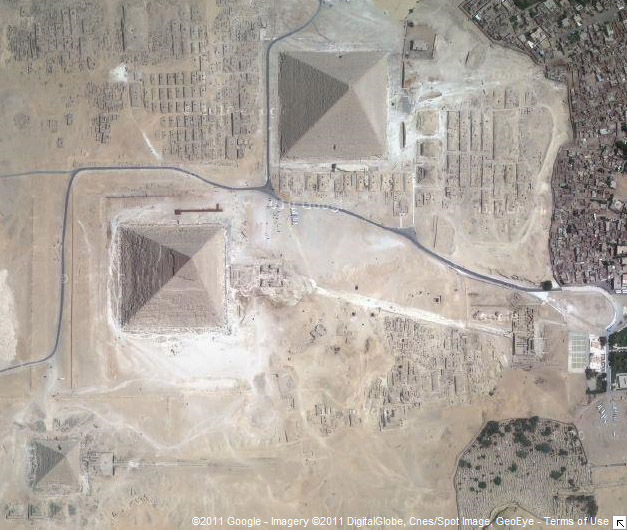
Why not start with one of the most famous ancient sites: the Pyramid Complex of Giza.  The “site” includes several monuments which trace the conceptual evolution of a divine shape now universally recognized as a pyramid but more importantly a visual record of engineering trial and error.  Chronologically, the first innovation can be seen in Djoser’s stacked mastabas or the Step Pyramid in Saqqara.  Previously, pharaohs were buried under large rectangular brick structures until architect, priest and generally creative guy Imhotep though stone would be better and that six progressively small mastabas would be an even better way to exalt the king.  30 years later, King Sneferu was determined to smooth the form a 17 miles south in Dashur.  I would imagine that the visual correlation of ascending to Ra the Sun God made for a strong theological rationale for the pyramid shape.  Sneferu’s reign created the so called Bent Pyramid which rises gradually then changes to a shallow angle of ascent about halfway up.  Presumably there was a problem baring the weight of the building and a more conservative angle was needed to complete it.  I can’t fault the builders at all for this awkward looking pyramid; these were constructed with only the most basic tools, fundamental building technology and the brute force of thousands.  Sneferu was finally successful and completed the Red Pyramid next door.  Finally, the pyramid everyone remembers is that of Sneferu’s son Khufu (2589-66BC) – The Great Pyramid.  Just outside the Cairo, it is constructed from 15 ton stone blocks and surrounded by temple complexes, minor pyramids to Queens, the Sphinx, and an impressive solar boat reconstructed painstakingly from over a thousand pieces.  Set behind Khufu’s pyramid is that of Khafre and Menkaure which get progressively smaller in size.  After this, kings no longer chose to construct pyramids which puts this incredible boom and bust of Old Kindom funerary building in only a ~164 year window.  While you can’t climb the pyramids like you use to do hundreds of years ago, it is still impressive sight and high on my To Do list!

 Getting there: Once in Cairo, taxi tours to Giza, Saqqara and Dashur can be arranged with most hotels.  It generally good advice to arrange the price ahead of time, find a driver who speaks English, and work out how long you want to tour around.  It’s very possible to see all three sites in one day.  Myself, if I’m going to Egypt it’s going to be for a while and I’m going to see more than just the Pyramids.  I’ve got my eyes on Gap Adventure’s Egyptian Archaeology Adventure and will tack on a few days in Alexandria.