Skip to content

Posts tagged ‘history’

Surprising Iconography of John the Baptist

Traveling in Europe is so much more interesting if you understand the iconography of Christian art.  You can quickly recognize the stories played out in panel painting or identify individual saints on the facade of a Cathedral.  Once you get past the “who and what” fundamentals of a work of art, you can examine the execution and atheistic choices the artist made in depicting the Annunciation, the Descent from the Cross, St Peter or St Catherine.  That is, I thought I knew the major iconography of the Saints.

John the Baptist - El Greco

El Greco “John the Baptist”, M. H. de Young Memorial Museum, San Francisco

St. John the Baptist is easy to pick out of a line up: under dressed and in camel hair, many times with a staff or lamb and generally looking disheveled.  Given his importance, John is often one of the first Saints to be included in domestic devotional altarpieces and is usually placed prominently in larger groupings.

"The Last Judgement Triptych" by Hans Memling

John the Baptist (with the bare knee) sits on the right, the counterweight to Mary in this detail of “The Last Judgement Triptych” (1467-71) by Hans Memling (Muzeum Narodowe, Gdansk)

Last week, I visited the Museum of Russian Icons in Clifton, MA.  (Their collection is incredible; I’ll post more on that soon.)  I was enjoying the range of Mary and Child iconography (hurray Hodegetria), when I noticed something really surprising.

"Smolensk Mother of God" by the monk Filaret (c. 1680), Museum of Russian Icons

“Smolensk Mother of God” by the monk Filaret (c. 1680), Museum of Russian Icons

On the left frame is a small winged angel Gabriel figure but on the right frame is St. John the Baptist with wings.  With the fur robe and scruffy face, it is undeniably John the Baptist.  I was really confused by this;  Saints are never depicted with wings.

"Smolensk Mother of God" by the monk Filaret (c. 1680), Museum of Russian Icons

Frame detail from “Smolensk Mother of God” by the monk Filaret (c. 1680), Museum of Russian Icons

While I did see other “regular” images of St. John the Baptist throughout the museum’s icons, wings popped up again in one other piece.  In the lower half of this work, there is a beheading scene (right) and the head being given to a woman (left) further providing evidence that the central figure is St. John the Baptist.

St. John the Baptist with Wings, Museum of Russian Icons

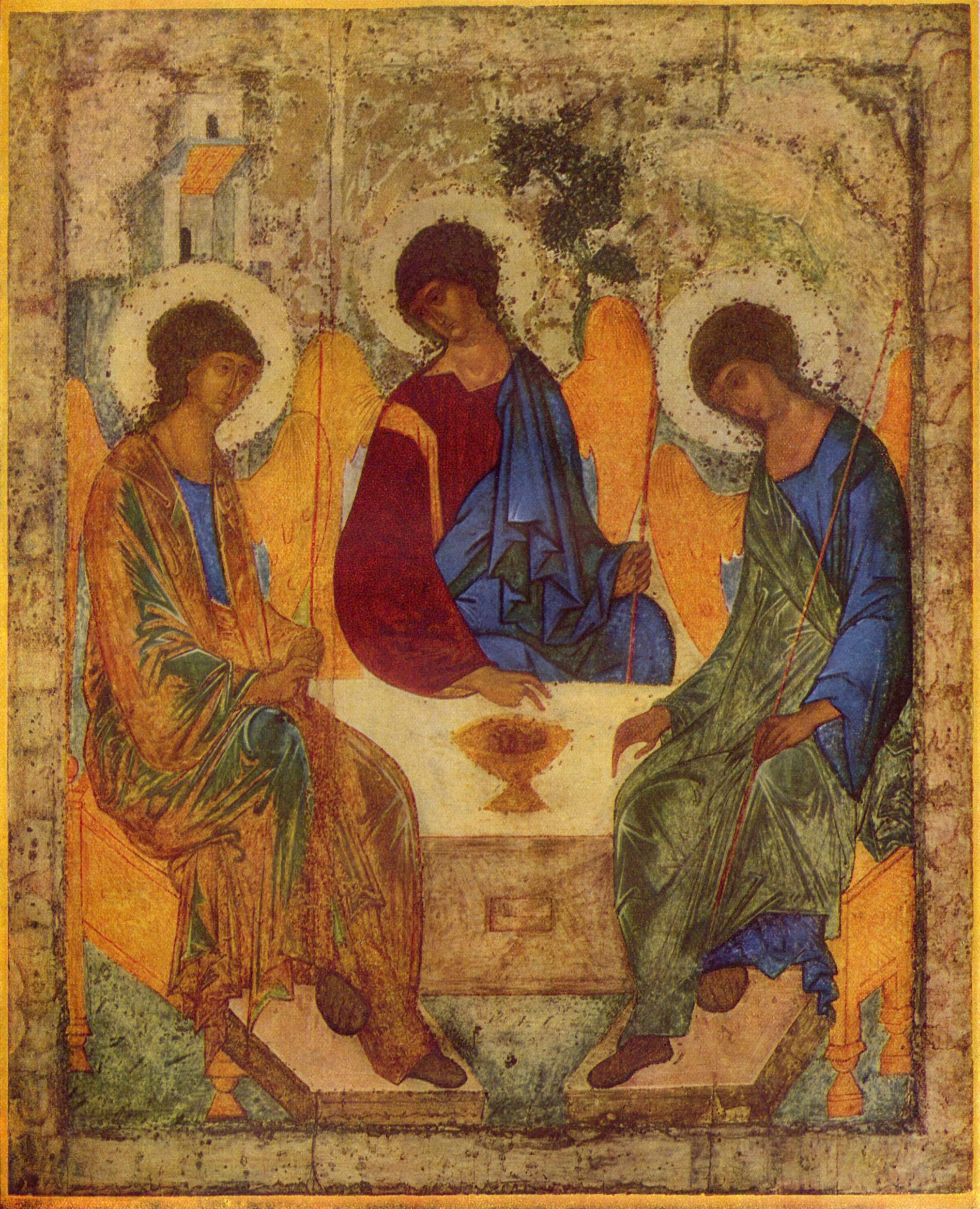
I was really intrigued by John the Baptist with wings so I talked with one of the museum docents.  In Russian iconography (like most Christian art), angels have wings.  But besides the seraphim, there is a set of angel that act as messengers.  Their wings symbolize the ability to communicate between the divine and humans.  For example, the three travelers/angels who visited Abraham are popular in Russian art.  One iconographic aspect of John the Baptist is his role as prophet declaring the arrival and ministry of the Christ.  In this way, John acts like a divine messenger and can therefore be shown with wings.  John is also the only Saint ever shown in Russian art with wings, perhaps given that he was Jesus’ cousin and played a critical role in the gospels.

Finding these angelic wings brings an interesting nuance to the John the Baptist visual program.  In the two cases I found, he is holding a scroll which is in line with the messenger role the wings suggest.  It is also a nice example of differences between the Western and Eastern Christian art traditions.  I wonder if the rules really are so strict for depiction with wings?  Could this divine messenger aspect apply to Old Testament prophets too?  That image would have to present a prophet in a heraldic way, but surely it’s possible.  I guess I have something new to look for in the catalog of Eastern Orthodox art!  But there you have it, St. John the Baptist with angel wings.

The Face of George Washington

US 1 dollarThanks to the US $1, George Washington has one of the most recognizable faces in America.  This President’s Day, I got to thinking about that portrait and two excellent exhibits I saw a few years ago at Mount Vernon and the National Gallery about the real likeness of George Washington.

Gilbert Stuart – “George Washington (The Athenaeum Portrait)” 1796, Museum of Fine Arts Boston and National Portrait Gallery, Washington DC

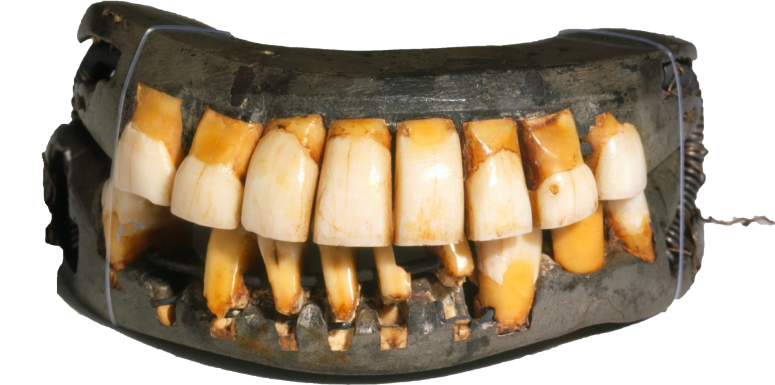
The dollar and a large number of contemporary and future Washington paintings are based on an unfinished portrait done by Gilbert Stuart in 1796.  At the time of the sitting, George was 64 and retired to Mount Vernon.  His teeth had been a constant source of pain since the first one was extracted when he was 22.  When he started his presidency, only one real tooth remained in his head.  Several sets of dentures were made for Washington over his life by incorporating human teeth and carved bone or tusk teeth into a metal cage.  None these were reported to have fit well and must have caused him considerable discomfort.

George Washington's only complete set of false teeth on display at Mount Vernon

George Washington’s only complete set of false teeth on display at Mount Vernon (Photo: Mount Vernon Museum)

On the day Washington sat for Gilbert Stuart, he was struggling with a set of false teeth.  Stuart notes, “When I painted him, he had just had a set of false teeth inserted, which accounts for the constrained expression so noticeable about the mouth and lower part of the face.”  Look back at Stuart’s portrait. Washington’s jaw does appears to be clenched, pushed somewhat forward and bulky.  This immediately recognizable portrait is likely not the most realistic.

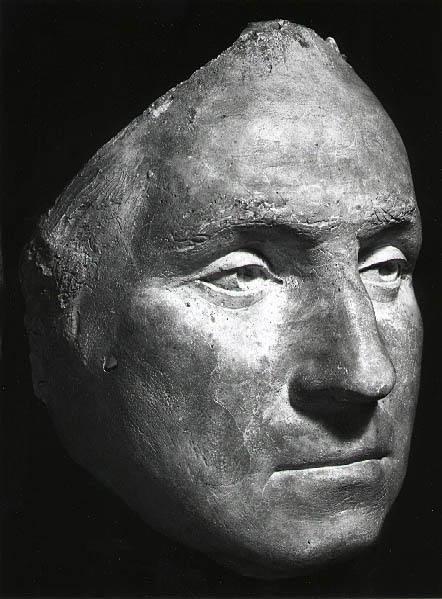
Jean Antoine Houdon - George Washington mask

Jean-Antoine Houdon “Life Mask of George Washington” 1785 (Photo: The Morgan Library and Museum, New York City)

Eleven years before the Stuart portrait, sculptor Jean-Antoine Houdon met with Washington a made a life mask – a process in which plaster is applied to a face for an accurate sculptural model.  This likeness seems less tense and the jaw line less protruded.

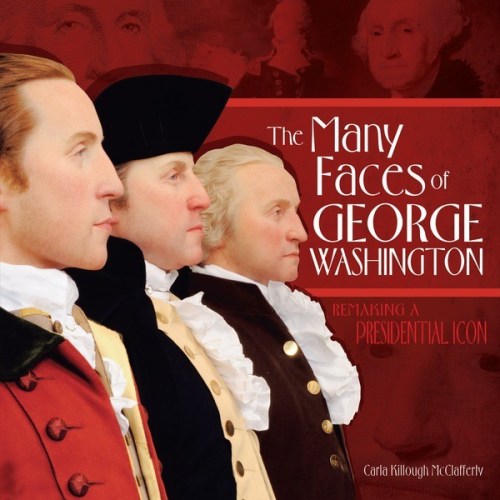
Many Faces of George Washington

Cover of “Many Faces of George Washington” by Carla Killough McClafferty describing the Mount Vernon portrait project

This life mask and the bust Houdon made from it were used by Mount Vernon to create “the real George Washington”.  Through an interesting forensic anthropology project, the sculptures an other artifacts were scanned, analyzed and used to construct three wax faces meant to represent George Washington at 19, 45 and 57 year of age.  Life-sized figures were created by examining existing clothing and written descriptions of the Washington’s posture.  (You can watch a short video about the process done by the History Channel here.)  The end result is incredibly impressive.  The three Washington figures were one my favorite parts of visiting Mount Vernon as they help piece together a more life-like representation an American legends.

Young George Washington

A George Washington we are not used to seeing – 19 year old likeness reconstructed from historical and scientific evidence by Mount Vernon

Marathon Greece and Serious History Tourists

Our last day in Greece, we had a few hours to spare and a rental car so we decided to look for the ancient battlefield of Marathon.  It was here in 490 BC that the Greeks defeated a Persian invasion force.  After which a messenger ran the 24 miles back to Athens to declare the victory inspiring the modern marathon race.

This was the only time our GPS navigation failed us; apparently “Marathon Museum” was a little ambiguous!  Having been directed to the Marathon Run Museum, we got dubious directions toward the ancient battlefield and set out.  After several U-turns, we found ourselves traveling down a narrow road through a field where a crowd had gathered.  I almost didn’t believe what we saw: ancient Greeks engaged in battle.

greek hoplite reenactors

Hoplite reenactors taking a break at Marathon

Read more

The First Year was Rough for the Pilgrims

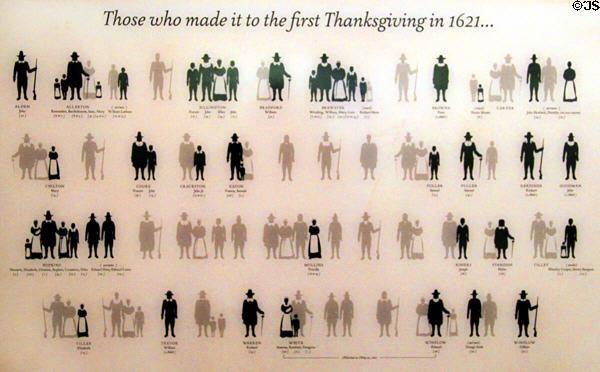
Of the 102 voyagers on the Mayflower, only 53 survived the first year to celebrate the “original Thanksgiving” in Nov 1621.  Of the 18 adult women who made the voyage, 14 died in the first year.  The Pilgrim Hall Museum in Plymouth has a really interesting graphic illustrating the decimation of the early settlers. (See colonist before and after the first year).

original Pilgrims Mayflower

Original parties on the Mayflower. (Photo: Jim Steinhart)

Mayflower passengers who survived to the first Thanksgiving

Mayflower passengers who survived to the first Thanksgiving (Photo: Jim Steinhart)

Photos by Jim Steinhart, phototravelbase.com.

Happy Thanksgiving!

Help Transcribe an Ancient Text Online

So, how is your Ancient Greek?

Greek papyrusIf you can recognize shapes, then you can help researchers transcribe 500,000 papyri fragments as part of the Ancient Lives Project.  In 1897, two British researchers began excavating the remnants of a Greco-Roman city in Egypt known as Oxrhynchus or ‘City of the Sharp-Nosed Fish’.  What resulted from the dig was a treasury of texts which have yet to be completely translated.

To expedite the process, the papyri have been scanned and are presented on-line so that the greater internet world can help transcribe the pieces.  Through an easy user interface, you are presented a fragment and need to identify letters with the help of an ancient alphabet at the bottom of the screen.  The Ancient Lives project is sponsored by several organizations: Oxford Papyrologists and Researchers, The Imaging Papyri Project, The Oxyrhynchus Papyri Project, the Egypt Exploration Society, Citizen Science Alliance, the University of Oxford and the Arts & Humanities Research Council.

I’ve done about a dozen fragments myself which was pretty cool.  How often does 5-10minutes of down time turn into an archaeological project?  Enjoy!