Skip to content

Posts tagged ‘Boston’

New Stikmen in Boston

yellow stikman, Boston, MA

After a drought of sightings, I found two new stikmen around Boston!  Last weekend, I was walking through Cambridge and found two new and very fresh stikmen who had not been there the week before.

Harvard stikman, Cambridge, MA

It was maybe 5 years ago in Washington DC that I saw my first “stikman”.  Stuck to the road inside a cross-walk was an 8 inch robot or alien looking creature made of white industrial vinyl.  It was an interesting little figure, but I thought it was a one-off piece of street art.  Then I started noticing stikmen all over – in Georgetown, in Dupont Circle, and down the National Mall.  It seemed like a well coordinated but subtle urban art campaign.  I assumed it was a DC phenomena because there were so many of them.  (At the time, I missed this Washington Post article noting 150 stikmen in the DC area.)  I was shocked to then spot more of these alien-robots in New York City, Boston and Seattle.  Turns out stikmen have been found in Indianapolis, Toronto, and even Denmark!  There is an extensive Flickr collection of stikmen sightings.
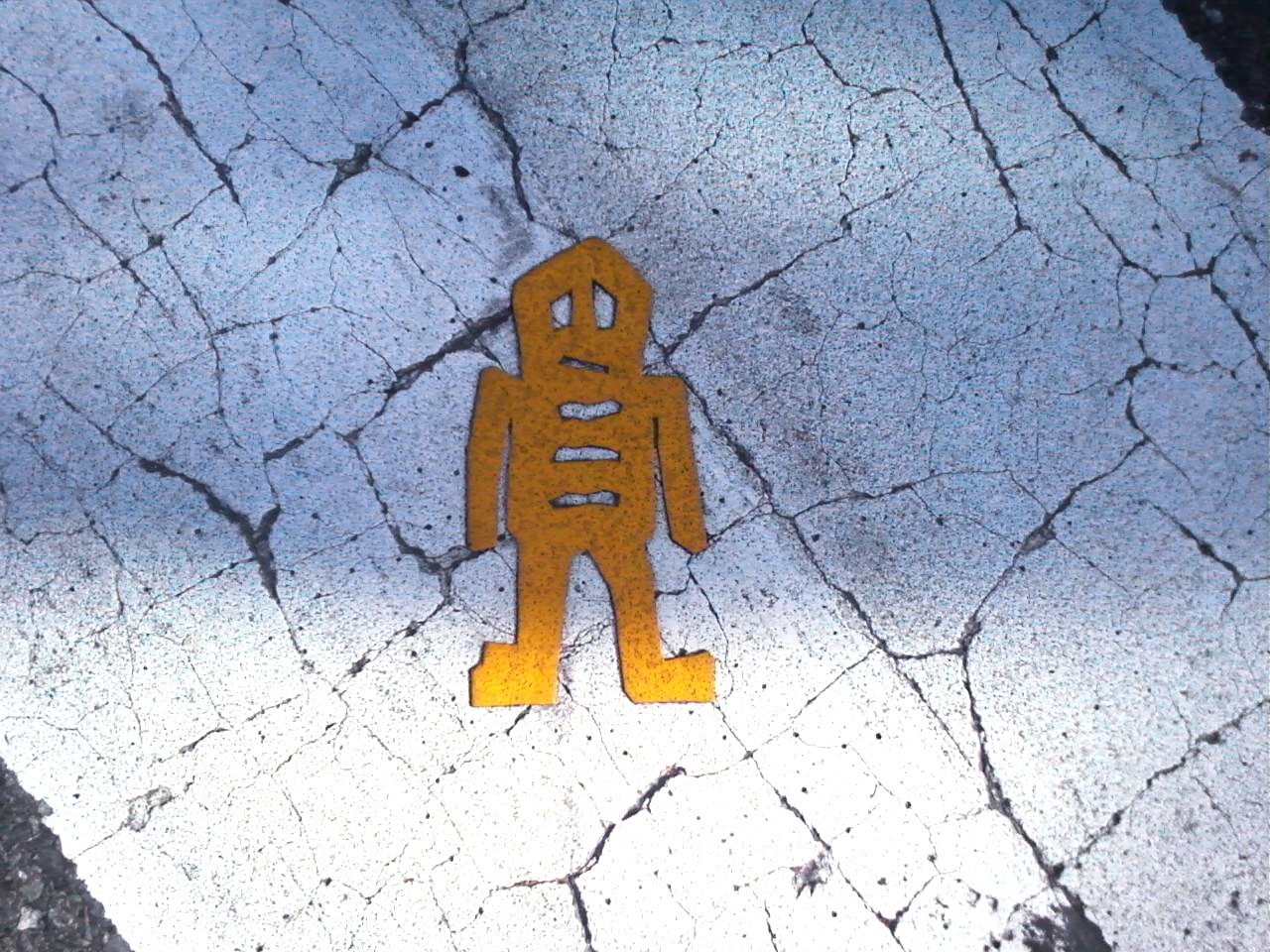
yellow stikman in crosswalk

The road stickers are just one aspect of the stikman project that was started 20 years ago.  The artist “Bob” (who has remained anonymous throughout) had a solo exhibition at pandemic gallery in NYC this past Spring.  The stikman project began with 3D stick figures (hence the name) affixed to city elements and has since branched out to stencils, hidden components in posters and, of course, the road stickers.

After I first noticed the stikmen, I would mention them to friends or pointed them out whenever one popped up.  No one claimed to have seen them before.  I think that’s why I like the stikmen.  They are right there on the road, thousands of people walk over them, and yet no one notices them.  These awkward, but endearingly primitive little figures are silently watching city life go by.  Over time, traffic and weather warps and wears away the stickers.  While their degradation makes for some beautiful effects, it does mean that the stikmen don’t last very long.  The first Boston stikman I found by South Station disappeared years ago.  Maybe that’s why I am so excited to see some new stikmen in the neighborhood!

So have you ever seen a stikman?  Keep your eyes open; you never know where he’ll turn up!

**UPDATE – I spotted a wooden stikman in Chicago!**

Boston Harborfest: Tall Ships and Fifes and Drums

USS Constitution, Boston

The USS Constitution “Old Ironsides” will be celebrating the bicentennial of several famous naval victories this year

Boston really does know how to do the 4th of July.  The week long Harborfest brings together lots of American history, colonial revolutionaries and roving bands of Redcoats, tall ships, good food, great music and a firework spectacular.  I met some folks from Florida last night during the festivities who were there checking Harborfest off their Bucket List.  I’ve been in DC for several Independence Day celebrations and I have to admit that Boston is more fun.

Read more

Statue Conservation in Action at the MFA Boston

Roman Juno statue

Juno in her former home, a suburban Boston estate garden (Photo: MFA)

The Museum of Fine Arts in Boston is hosting an interesting conservation project.  An impressive Trajanic or Hadrianic Period (early second century A.D.) statue of Juno was moved into the George D. and Margo Behrakis Gallery of ancient art this week.  Given its massive size of 13ft and 13,000 lbs, conservator will be examining, cleaning and repairing the work in situ.  Recently donated to the Museum of Fine Arts, the statue has spent the last 100 years in an estate garden just outside of Boston.  The resulting wind, snow, freeze-thaw, biological and vandal damage has taken a toll on the piece.  The Museum is raising money to support the conservation.  You can learn more about this on-going project at the MFA’s website.

I’m particularly interested in the analysis of the head.  It is clear that it was reattached at one or more times in the piece’s history; however, it also seems that the head and body are not the same marble and may have been united at a later time.  Given that little historical information exists about the piece prior to the 17th century, curators and conservators will have to rely on scientific analysis to understand the past of this statue.

Juno's head was removed to protect it during transport (Photo: MFA, Boston)

Layers of plaster and glue illustrate past repairs to the neck of Juno. (Photo: MFA, Boston)

roman statue repair with iron pin

Close up of the iron pin holding the right arm in place. (Photo: MFA, Boston)

Maybe the Best Russian Icon Collection in America

The other day I wrote about the Eastern Orthodox iconography of John the Baptist.  Let me take a step back now and spend a little more time on the amazing institution where I saw those pieces: The Museum of Russian Icons.  Located in Clinton, MA, about an hour drive from Boston, the modern facility displays hundreds of excellent Russian icons.  It was such a pleasant surprise to find this small museum; it is definitely one of my favorite New England hidden gems.

The Museum houses the personal collection of Gordon B. Lankton.  An executive at a plastic company, he bought his first icon at a flea market in Russia while on a business trip.  Mr. Lankton became fascinated by the style and imagery and returned from his subsequent business trips with more icons.  (Now new pieces are acquired through well-respected international auction house.)  With well over 100 icons, Mr. Lankton decided the collection would be best displayed at a museum, but a suitable organization could not be found in New York City or Boston.  He then decided to keep the icons in Clinton and so the current Museum was opened in 2006 in a renovated carpet factory.  The museum space is elegant and an excellent platform for enjoying the art.  The Museum now has over 500 icons and objects in its collection and has a friendly and informed staff.  With 12,000-17,000 visitors annually, you’re also likely to enjoy the works with some peace and quiet.

Images of the collection were taken by me, except the last one of the museum interior.

Mother of God Russian icon

"Vladimir Mother of God" circa 1680 (Museum of Russian Icons)

Russian icon damage

Lower central detail of "Vladimir Mother of God" showing candle damage (Museum of Russian Icons)

Saint Nicholas Russian Icon

"Saint Nicholas of Zaraisk, The Wonderworker and Holy Bishop of Myra with Scenes from his life" Suzdal School, 16th Century (Museum of Russian Icons)

cloth Russian icon

Detail from "Christ, Not Made by Hands (Allegory)", circa 1600 (Museum of Russian Icons)

Mary Magdalene Russian icon

"Mary Magdalene" circa 1890 (Museum of Russian Icons)

The honor system cafe (pay at the gift shop upstairs) is a nice touch with imported Russian treats, a hot beverage machine and these antique tea kettles.


Interior of the Museum

Modern interior of Museum of Russian Icons (Image from Wikipedia)


Cognition as Sculpture: Jaume Plensa at MIT

Jaume Plensa’s “The Alchemist” at MIT (Photo: DaydreamTourist)

Many modern artists find themselves returning to familiar themes for continued exploration.  Catalan artist Jaume Plensa has created a catalog of large curved metal sculptures shaped into contemplative figures. I find something other-worldly about these figures, especially those made of letters, as if this were some futuristic totem waiting for us to decode them.

Read more