Skip to content

Posts tagged ‘art history’

MFA to Sell Impressionist Works to Purchase Rare Caillebotte

"Man at His Bath" by Gustave Caillebotte

To help fund the purchase a rare piece by Impressionist Gustave Caillebotte, the Museum of Fine Arts in Boston is selling eight works.   These paintings by Claude Monet, Paul Gauguin, Alfred Sisley, Camille Pissarro, Auguste Renoir and Vasily Vereshchagin are expected to fetch between $16.6 million and $24.3 million.  It is not surprising that the MFA will need to sell art to raise the funds; its donors have recently and generous supported a fantastic new American Art wing and a Contemporary Art wing.  The painting is well worth the sell-off (especially since the paintings in question have not been exhibited since 2003) and I look forward to its permanent place at the MFA.

The new acquisition is “Man at His Bath” which is notable because there are not many works Caillebotte available and is extraordinary because there are very few Impressionist male nudes.  Gustave Caillebotte (1848 – 1894) was fortunate enough to be wealthy during Belle Epoch Paris which allowed him to buy works from his friends Monet, Renoir and others known today as the Impressionist.  While his patronage may have had a longer lasting effect, Caillebotte himself was a very gifted artist.  He and Édouard Manet are my favorite painters from the late 19th century Parisian art scene mainly because they focused on daily activities while often alluding to the darkness of modern urban life.  While “Man at His Bath” is mundane but intimate, his most famous work “Paris Street; Rainy Day” at the Art Institute of Chicago depicts isolated figural groupings moving through dreary streets.  Both paintings are expertly composed with a balance of light and dark and interesting lines.  Caillebotte’s unique nude “Man at His Bath” is an excellent addition at the MFA – definitely worth a landscape or two.

"Paris Street; Rainy Day" by Gustave Caillebotte

A Virtual Visit to the “Cave of Forgotten Dreams”

Every blockbuster seems to come out in 3D these days.  The only one I actually saw this summer didn’t have superheroes, but was actually a documentary about prehistoric art.  In “Cave of Forgotten Dreams”, Werner Herzog and a 3D film crew were allowed to shoot the recently discovered Chauvet Caves in the South of France which contains animal drawings over 30,000 years old.  Realizing that a few decades of tourist traffic has severely damaged the Lascaux Caves, the French government has limited access to Chauvet meaning that this movie may be your only way of seeing the cave art.

Grouping of horses from Chauvet (Image from Bradshaw Foundation)

I know Herzog is famous and an “artist” but this documentary would have been better if the History Channel had complete control and not just acted as a producer.  Herzog tried to be reflective about what it means to be human and our ability as modern people to understand Upper Paleolithic humans but it came off shallow – like he was just throwing out some rhetorical questions.  He tried to add historical context through an atlatl demonstration and a trip to see early female stone figurines, but it wasn’t quite enough.

What I was looking for was more analysis of the cave.  In one of the best scenes, an archaeologist describes a series of painted hand imprints and what this teaches us about the artist.  (Spoiler Alert!  He was six feet tall and had a broken pinky finger!)  There is also cool digital fly-through of the cave but the narration doesn’t clearly enough establish the lay-out of the cave, the locations of the art within it, and the possible cultural meaning of the art’s placement.  I hate to say it, but National Geographic or NOVA would have done this in the first 15 minutes.

Crowd of elegant lions (Image from the Bradshaw Foundation)

As much additional history as I would have liked, the art in Chauvet is absolutely amazing and the film does a good job of capturing its beauty.  I could have watched 20 more minutes of slow pans over the cave paintings.  The horses and lions seemed more realistic than other similarly dated cave drawings.  The composition of the animal groupings is also very sophisticated placing layer on layer of figures.

To explore Chauvet cave on-line, see the French Ministry of Culture or the Bradshaw Foundation which is dedicated to the preservation of rock art.  And by all means, watch “Cave of Forgotten Dreams”.

*UPDATE* – As of June 22, 2014, the Cauvet Caves have been named a UNESCO World Heritage Site!  You definitely need to see this film now since visitors are still not allowed within the real cave.

#2: Ravenna – the Capital of Mosaics

In 2007, I flew in and out of Milan for a conference and decided to sneak in a few days afterward for what I considered to be an Art Pilgrimage.  I love Byzantine art and at the time was obsessed with seeing Ravenna, the self-proclaimed “Capital of Mosaics”.  With the division of the ancient empire and the fall of Rome itself, the center of the western empire was moved to the northern Italian city of Ravenna.  Between approximately 400-550 AD, Emperors Galla Placidia, Theodoric and Justinian constructed fantastic basilicas whose interiors are literally covered with vibrant and expressive mosaics.  Ravenna is so rich with art that 8 of its churches have been cited by UNESCO as a World Heritage Site.

On the coast 75miles south of Venice, Ravenna can be accessed by train from Milan via a transfer in Bologna.  Arriving in the late afternoon, I explored the city a bit and spent the night so that I could start the next morning in the Basilica of St. Vitale.  The Byzantine central circle upon circular chapel architecture provides a heavenly open space which at the time was flooded with golden morning sunlight.  The altar apse mosaics just glittered.  At first its a little disorienting because there is so much to look at.  The brightness and richness of St. Vitale is a good reminder that there was a long tradition of vivid color in Roman art.  I went slowly over each face, bird and Old Testament scene, many of which including a little divine hand directing events from a cloud!  You might think that mosaics – the arrangement of little bits of colored stone and glass – could never be anything more than decorative patterns, but the art was so shockingly expressive.  The faces of the Apostles, Justinian, Theodora and their attendants looked like realistic portraits.
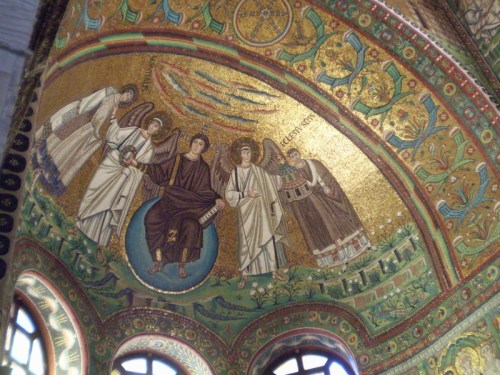
Apse of St. Vitale depicting Christ as the Redeemer

Next I went to the Mausolem of Galla Placidia whose central altarpiece depicts a youthful, beard-less, Apollo-like Christ as the Good Sheppard.
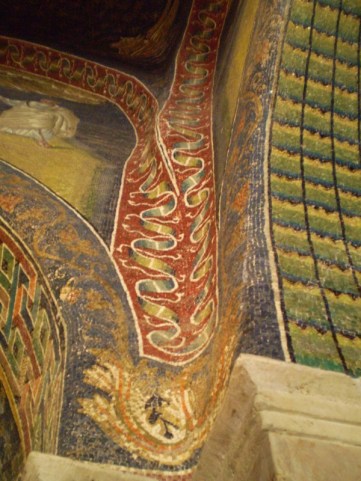
Looking up here, you can see that even the decorative moldings in the Mausolem of Galla Placidia are covered with mosaics!

The Basilica of St. Apollinare Nuovo has parallel scenes of a procession of female and male martyrs.  The women in their gold and pearls and the men in their stark white robes make for an elegant continuity but each figure have enough unique details to warrant a long look.  Above this register are portraits of saints and small scenes from Jesus’ life.  If you are keeping track of Christ’s evolving iconography, he looks like a youthful Roman while performing miracles and is not depicted with a beard until the Last Supper panel.  As is common of early Christian art, the Passion panels jump from Simon carrying a skinny, mostly symbolic cross to the Marys at the tomb.  Even the Byzantines would have been too horrified by crucifixion to visually depict it.

The Arian Baptistry, the Neonian or Orthodox Baptistery (Battistero degli Ortodossi) and the Archiepiscopal Chapel are more intimate art experiences.  If your visit is anything like mine, you will be completely alone in these buildings.  Here again you will find interesting visual details in the procession of apostles.

Procession of saints in the Arian Baptistry

My one regret is that I did not get to St. Apollinare en Classe because it was, well, in Classe about 5km outside of Ravenna.  My plan was to rent a bike but when I couldn’t find a place, I went to the Theodoric’s Mausoleum instead which sits in the middle of a field and is surprisingly undecorated.

At the Mosaic School in Ravenna, you can watch artists work and see some displays about the process.

Beside the incredible art, Ravenna is a charming city in which to spend the day largely free of the tourist crowd.  The warm summer evening I was there, the whole city seemed to be out walking and shopping till 9 or 10pm.  As a single traveler, I felt complete comfortable with the crowd and helped myself to some gelato and people-watching.  The food was great too.  I had an amazing anchovy pizza for lunch and the side of grilled vegetables with my dinner stands out as one of the best dishes I’ve ever had.  I stayed at the Hotel Byron Centrale which was in a great location and cheap even though my single room was adorably small.  I can not understand why more people do not prioritize Ravenna when planning a trip to Italy.  It’s a pleasant city with impressive artistic treasures.  It was well worth the pilgrimage from Milan!