If you can recognize shapes, then you can help researchers transcribe 500,000 papyri fragments as part of the Ancient Lives Project. In 1897, two British researchers began excavating the remnants of a Greco-Roman city in Egypt known as Oxrhynchus or ‘City of the Sharp-Nosed Fish’. What resulted from the dig was a treasury of texts which have yet to be completely translated.
To expedite the process, the papyri have been scanned and are presented on-line so that the greater internet world can help transcribe the pieces. Through an easy user interface, you are presented a fragment and need to identify letters with the help of an ancient alphabet at the bottom of the screen. The Ancient Lives project is sponsored by several organizations: Oxford Papyrologists and Researchers, The Imaging Papyri Project, The Oxyrhynchus Papyri Project, the Egypt Exploration Society, Citizen Science Alliance, the University of Oxford and the Arts & Humanities Research Council.
I’ve done about a dozen fragments myself which was pretty cool. How often does 5-10minutes of down time turn into an archaeological project? Enjoy!
On the University of Chicago campus last month, I stumbled across Arnaldo Pomodoro’s Grande Disco. It is a looming, industrial and futuristic disk that seems to be splitting open along several seams. When examining the details up-close, you half expect the thing to open further and start talking. (That’s how a science fiction movie involving modern outdoor art would begin.)
Grande Disco (1968) by Arnaldo Pomodoro, University of Chicago
I was drawn to the sculpture for its design but also because I recognized it. I thought I saw this in Milan, what was it doing next to a Medical School building on the University of Chicago campus? Turns out there are five other “Grande Discos” throughout the world each made within the same general time frame and varying slightly in design. Located in urban, commercial and green spaces, the pieces are enhanced by the environments they have been placed into. See what you think of these outdoor installations. Personally, I think the Grande Disco does the best in the two extreme environments: the rolling green sculpture park and in the shadow of North Carolina skyscrapers.
It’s been a while since I worked on my UNESCO World Heritage Site series so let’s get back to it with an easily recognizable site – The Acropolis in Athens.
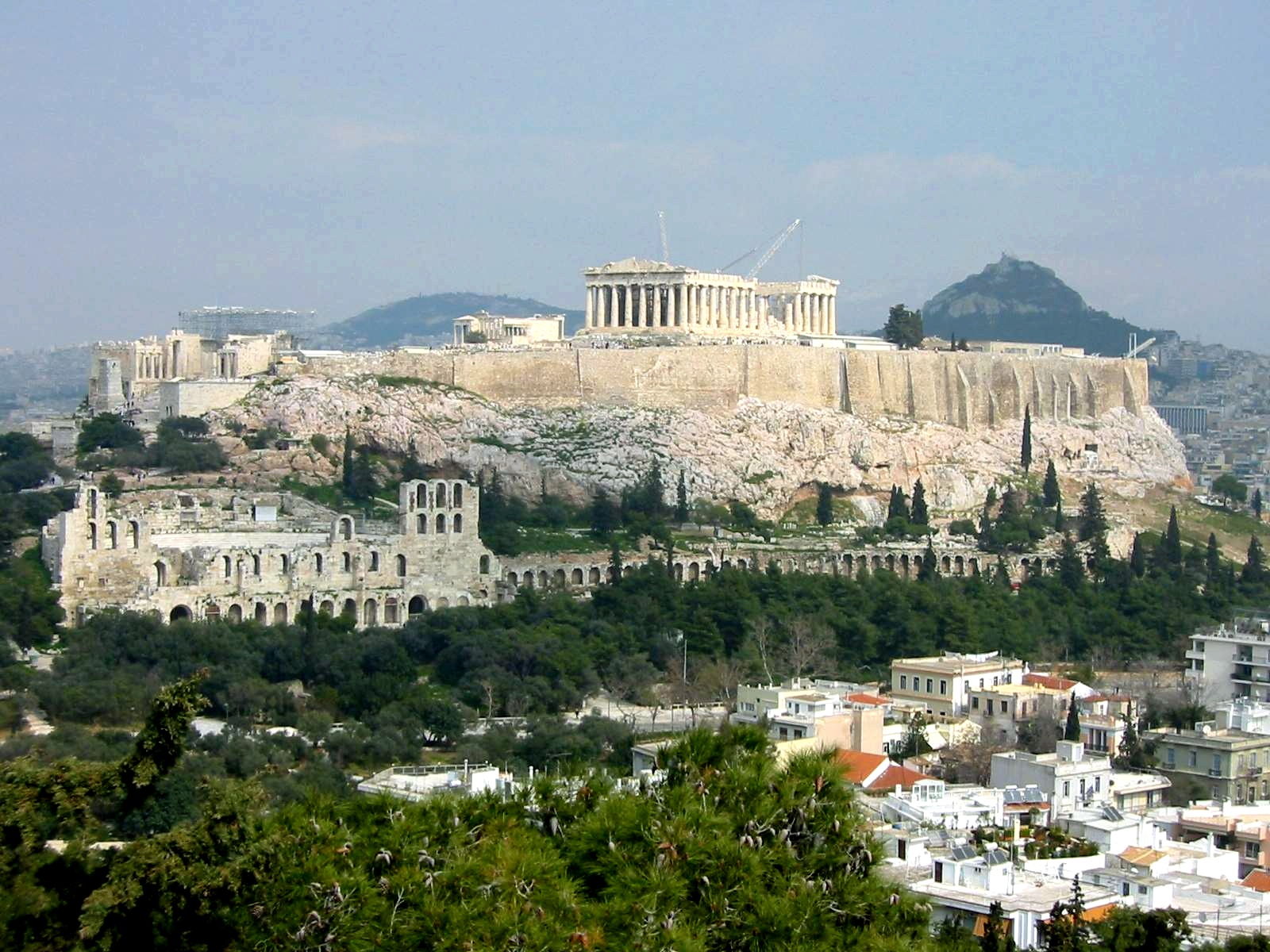
View of the Acropolis (Photo: Wikipedia)
Entering Athens, you are walled in by buildings and can easily lose your orientation but before long you turn a corner and there on an imposing plateau is the Acropolis. The complex of temples including the Parthenon atop the rocky hill was originally filled with great art, commanding architecture and human activity in Classical Greece. I could write long posts about each of the site’s elements but I’ll try to give an overview here.
Reconstruction of the Acropolis (Photo: Roy George)
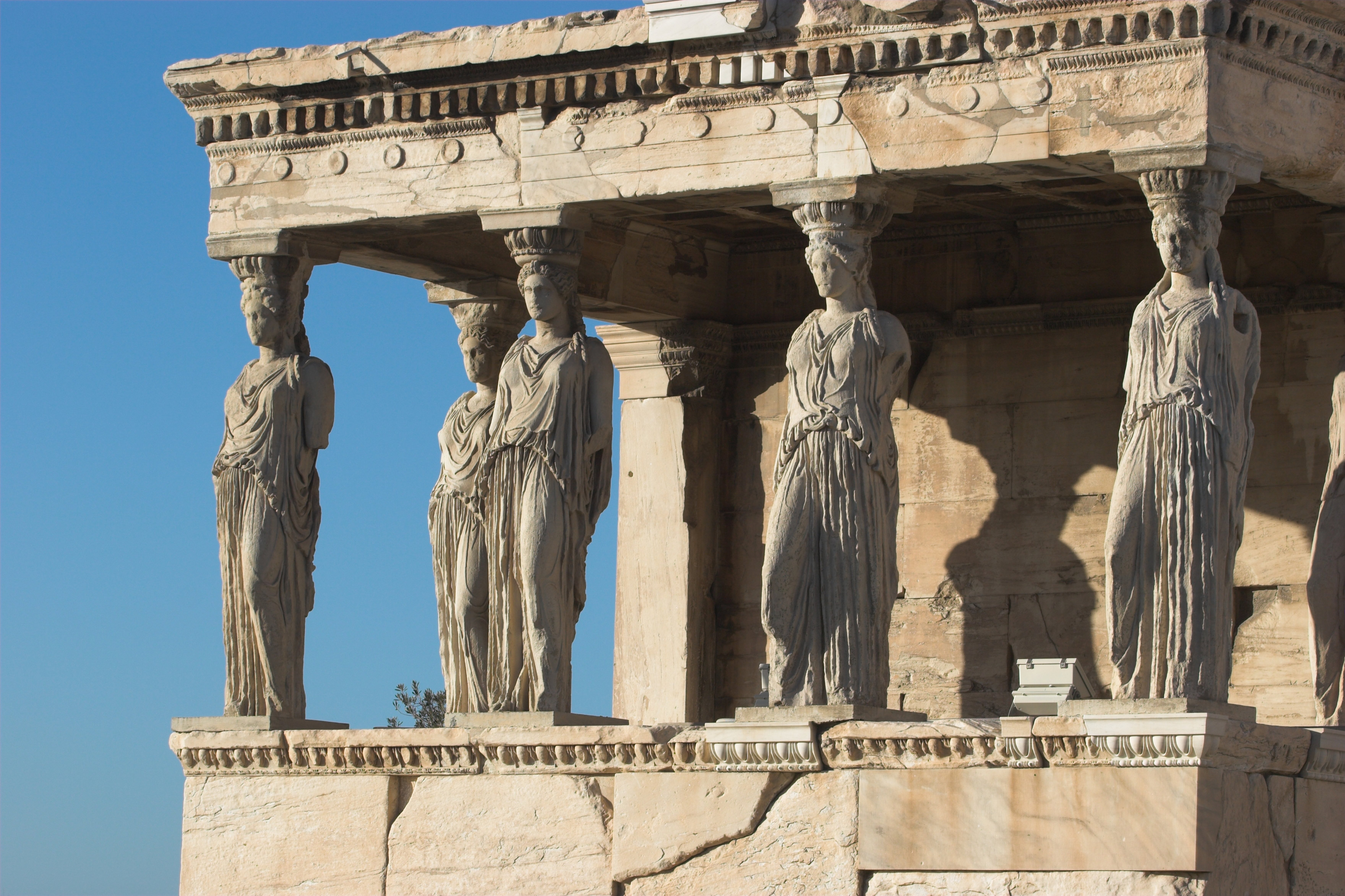
While there had been religious buildings and fortification on the rock for centuries already, the greatest construction effort was completed under the rule of Pericles during the height of the Greek empire (460-430 BC). Visitors would have entered the site through a grand gateway known as the Propylaea. Once inside, along the right toward the Parthenon would have been the Brauroneion, a temple dedicated to Artemis protector of pregnant women and childbirth, and the Chalcotheke which is believed to be the Parthenon treasury. Left from the entrance was a complex religious building called the Erechtheion which honored Athena as Protectress of Athens, Poseidon as rival for Athens and several ancient heroes. Today the building is most recognizable for a porch of columns shaped like maidens known as Caryatids. The small Temple of Nike could be found to the right of the Propylaea before entering the site and is largely restored today. A Greek and a Roman amphitheater were carved into the South side of the Acropolis rock.
Temple of Nike at the gates of the Acropolis
The Parthenon was dedicated to Athena, the Patron Goddess of Athens, and was believed to house a 40 foot tall ivory and gold statue of her. The outer structure of Doric columns is 228.0 x 101.4 feet in size and has several “optical refinements” such as bulging columns and a bowed base so that the structure’s geometry looks perfect to viewers. The triangular pediment facing the Propylaea depicted Athena winning over the city of Athens with her gift of an olive tree while the opposite pediment described her birth from Zeus’ head. Square panels, or metopes, depicting mythical battles adorned the exterior of the Parthenon. The interior cella was decorated with a continuous carved frieze of riders, priests, and pilgrims completing the annual Panathenaic procession from the cemetery through the market and on to the Acropolis.
East face of the Parthenon
The Parthenon has been attacked, repurposed and robbed several times. The video below from the Hellenic Ministry of Culture does a good job chronicling the destruction.
You’ll also note that the video above spends a significant amount of time highlighting the removal of art collectively known as the Elgin marbles. There is strong movement in Greece to return these sculptures from the British Museum to Athens. The recently opened Acropolis Museum in Athens displays copies of all the Parthenon sculptures for context but I assume would prefer to have the originals. If you can’t see them in either museum, there is a great virtual exhibit available online that lets you tour the Parthenon frieze.
Virtual Parthenon Frieze project sponsored by the EU
While virtual recreations and artistic reconstructions are helpful, I still find it difficult to imagine the Acropolis during the Golden Age of Athens. As fantastic as I picture it, the Acropolis was probably more colorful, more cluttered with statues and more imposing.
Four-legged winged bull in the Khorsabad Court exhibit (Photo: Oriental Institute)
I was recently in Chicago and decided to get off the beaten path and visit the Oriental Institute at the University of Chicago. It’s a great, albeit small museum covering Mesopotamia, Persia, Egypt and other ancient near Eastern civilizations.
One exhibit area is domonated by pieces from the court of King Sargon II who ruled Assyria from 721-705 B.C. In the center is a 16ft tall winged bull with a human head. This sufficiently impressive piece along with its twin would have guarded a city entrance.
Looking more closely at the bull figure, it appears to have been made for viewing from very specific angles and not so much in the round. In the image above, the bull has four legs when you look straight on, but if you move 90 degrees, there are two symmetrical legs under the head. From the right angle, you can see that there are 5 legs!
This protective bull genie has an extra leg!
The Louvre also has some 5-legged Assyrian human-headed winged bulls. It just goes to show that you should look carefully at art.
Vincent Van Gogh, Self Portrait (1889), Musee d"Orsay, Paris
60 minutes had a good story Sunday on a new biography of Vincent Van Gogh. Steven Naifeh and Gregory White Smith, who won a Pulitzer Prize for their biography of Jackson Pollock, wrote Van Gogh: The Life which was released today (Oct 18). The authors appear to have written an authoritative 976 page biography enlisting the help of several assistants to pour over every scrap of letter or newspaper associated with Van Gogh.
I’m curious to read their analysis of Van Gogh’s potential medical diagnoses and his relationships with other, but the most surprising revelation of the book appears to be their theory that he was shot by someone else and did not commit suicide. The 25min news piece sets up the argument nicely with historical inconsistencies and some reflection on Van Gogh’s extreme loneliness and isolation.
Vincent Van Gogh’s art is visionary and his works are masterpieces. Aside from the potentially sensational murder or suicide story, I am looking forward to a well researched biography of the artist most easily discounted as just insane rather than purposefully creative by art history.
 If you can recognize shapes, then you can help researchers transcribe 500,000 papyri fragments as part of the Ancient Lives Project. In 1897, two British researchers began excavating the remnants of a Greco-Roman city in Egypt known as Oxrhynchus or ‘City of the Sharp-Nosed Fish’. What resulted from the dig was a treasury of texts which have yet to be completely translated.





 Daydream Tourist