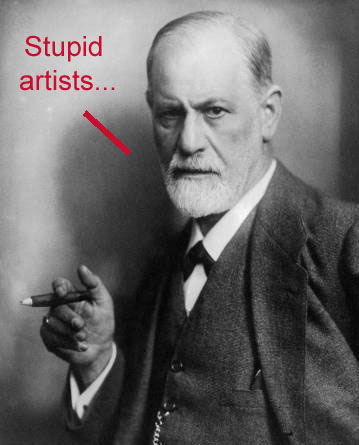
As readers of this blog know, I bought an early 20th century German painting by a little known illustrator, Friedrich Wahle, and have since been researching the artist’s life and portfolio. The catalog research has been going well and I’ve figured out what he looked like and even where he lived in Munich from 1893-1902. Then, out of nowhere, a scandal emerged. Apparently, Fritz Wahle may have been involved in a love triangle with Sigmund Freud’s fiance (and future wife) Martha Bernays. Given some of Freud’s vehement writing decrying artists as wild seducers, I can’t help but think my Wahle may be the one who jaded the father of modern psychology.
Sigmund Freud and Martha Bernays met in Vienna and were quickly engaged in 1882. Because he felt he lacked the means to impress her family, Freud demanded that the engagement be kept secret. To hide their relationship, her love letters to him were disguised as academic correspondence arriving to the University of Vienna. Freud’s love letters to Martha were addressed to and delivered by their mutual friend Fritz Wahle.
At first I though this name was just a coincidence. Looking at American immigration records, there were a dozen or so men named Fritz Wahle during this period. But then again, the Friedrich Wahle I have been researching would have been only 2 years younger than Martha. The “Fritz” in this love story is described as an artist. Freud even makes a cheeky reference to their academic cover-up referring to their friend “Dr. Wahle of Prague”. I know very little about Friedrich Wahle’s youth, but it is possible that after being born in Prague that his family came to the Austrian capital of Vienna. Likewise, since he was Jewish, he may have known Martha whose grandfather was a famous rabbi. So while this necessitates a lot more historical research (art school records, census, genealogy, etc), it’s a distinct possibility that Fritz was a close friend of Martha and Sigmund.
Honestly, I really hope this is the right Fritz Wahle because he was involved in a juicy story! Although engaged to Martha’s cousin Elise, Fritz spent a lot of time with Martha accompanying her to events and even serving as her art teacher. Very soon into the engagement, Sigmund proved to an incredibly jealous boy-friend criticizing friends and even family members that occupied Martha’s time. This included her “brotherly friend” Fritz who Freud apparently believed had a reputation for “being able to coax a woman away from another man” [1]. In this case, Freud was perhaps rightly suspicious.

Martha Bernays, 1884 (Photo: IPA)
Only two months into the secret engagement, a mutual friend tells Freud that Fritz and Martha had recently kissed. In a rage, Freud confronts Fritz and reveals that he and Martha are engaged. Fritz apparently then bursts into tears, declares his undying love for Martha and starts to write her a passionate letter asking her to leave Sigmund. Freud tares up the letter in Fritz’s face. I presume this was followed by some yelling but they eventually cooled down, and parted ways. Freud continued to brood over the confrontation and forbids Martha to see Fritz. He writes:
The man who brings tears to my eyes must do a great deal before I forgive him. He is no longer my friend, and woe to him if he becomes my enemy. I am made of harder stuff then he is, and when we match each other he will find he is not my equal. [1, letter to Martha, 1882]
Martha is initial reluctant to abandon her friendship, but Freud is adamant. While she maintains that Fritz was never more than a friend, Martha eventually concedes to break off all contact and correspondences with Fritz. (Perhaps this is what drives Fritz’s move to Munich? I wonder if the engagement to cousin Elise was broken off?)
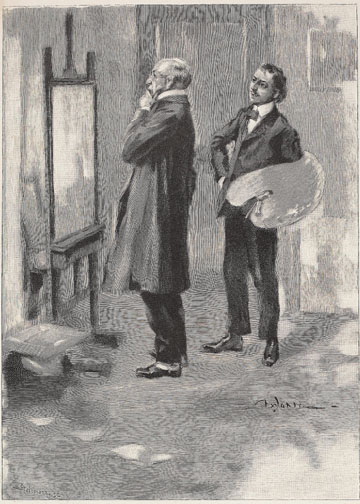
Friedrich Wahle “Art Student and Teacher” Fliegende Blatter, 1904
Not to psychoanalyze the father of modern psychology but perhaps this episode created a new animosity towards artists or revealed an existing insecurity compared to them? The analytical Freud seemed a bit threatened by creative-types writing:
I think there is a general enmity between artists and those engaged in the details of scientific work. We know that they posses in their art a master key to open with ease all female hearts, whereas we stand helpless at the strange design of the lock and have first to torment ourselves to discover a suitable key to it. [1]
Freud also seemed disgusted by Fritz’s apparently delayed realization that he loved Martha which only seemed to surface once confronted with her engagement to Sigmund. While the situation may seem like teenage drama or the stuff of a good romantic-comedy, Freud took the “guy friend with a crush” storyline to indicate a deep weakness of character. His critique of Fritz’s behavior foreshadows his later career in psychology:
The solution of the Puzzle is this: only in logic are contradictions unable to coexist; in feelings they quite happily continue alongside each other. To argue like Fritz, is to deny one half of life. Least of all must one deny the possibility of such contradictions in feelings with artists, people who have no occasion to submit their inner life to strict control of reason. [1, letter to Martha July 8, 1882]
Friedrich (Fritz) Wahle may have led a very interesting life indeed!
References:
[1] Ernest Jones, The Life and Work of Sigmund Freud. Basic Books: New York, New York; 1953.
Peter M. Newton, Freud: From Youthful Dream to Mid-Life Crisis. The Guilford Press: New York, New York; 1995.
Lisa Appignanesi and John Forrester, Freud’s Women. Basic Books: New York, New York; 1992.
Norman N. Holland “Freud and the Poet’s Eye: His Ambivalence Toward the Artist”. PSYART: A Hyperlink Journal for the Psychological Study of the Arts. December 15, 2009. Available here. Sept 17, 2012.









 Daydream Tourist