Skip to content

Posts tagged ‘art’

2011 World Press Photo Winners

Nothing is more compelling than an image.  It is task of the photojournalist to translate a news event into something more emotionally engaging.  Each year the World Press Photo foundation recognizes these professionals by selecting the top images from a variety of categories recognizing the power of an image to connect the public to traumatic world events, interesting people and moments of humanity.  The 2011 winners are available on-line and can be seen at traveling exhibits throughout the world. (I should warn you that some images will be considered graphic as they contain dead bodies or body parts.  The link above to the collection will display small images which can be enlarged by clicking.)

2nd Prize Spot News Stories: Corentin Fohlen (France, Fedephoto) - Anti-government riots, Bangkok, Thailand, May

Going beyond the compelling subject matter, the photos are so well composed that you have to appreciate them as art.  For example, the image above by Corentin Fohlen of anti-government riots in Bangkok has an interesting blue-gray palette punctuated by orange from the fire and the man’s shirt.  The taut sling-shot and extended arm dominates the foreground and introduce tension and violence which is balanced by the resting rioters to the left.

Mumbai, India by Martin Roemers (The Netherlands, Panos Pictures) part of the Metropolis series which won 1st Prize Daily Life Stories

My favorite images are the Metropolis series by Martin Roemers which won 1st prize – Daily Life Stories.  By using a long exposure time, he has captured the blurred silhouettes of cars, trains and people in several major urban centers. The implied movement gives the viewer a sense of action expressing the commotion and vitality of these cities.  What I love the most about these 10 images is the balance between motion and stillness.  While some people anonymously blend together, there are always a few individuals perfectly in focus.
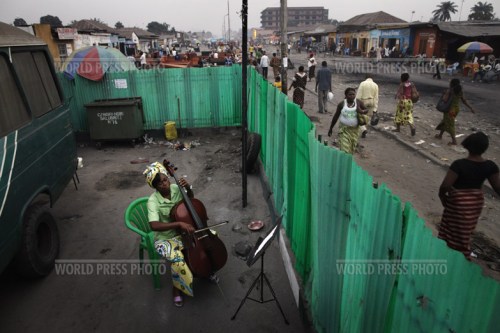
Andrew McConnell (Ireland, Panos Pictures for Der Spiegel) - 1st Prize Arts and Entertainment Single. Joséphine Nsimba Mpongo practices the cello, Kinshasa, DR Congo

I encourage you to look through the gallery and find your own favorites!

Bob Dylan’s source material uncovered

For starters, I didn’t even realize that Bob Dylan painted but apparently he has a show which opened at the Gagosian Gallery in New York City.  It is not the brush work or color choices but the subject matter of this show that is getting some media attention.  The New York Times reports that many of the works are copied from known photographs including two by Henri Cartier-Bresson and Life Magazine’s Dmitri Kessel.  Artinfo.com has a good slide show comparing the Dylan work with the source photograph.

Top: An early 1900's photograph of a field worker in China Bottom: A painting from Dylan's "Asia Series" (Photo: artinfo.com)

Is this the art equivalent of sampling someone’s song?  Should we consider this forgery? Is this worth hanging in a gallery? Yes and No.  Artists have always trained by copying paintings or, in the last century, photographs.  There are prestigious museums today that exhibit workshop copies of masterworks or paintings done in the style of a master by one of their apprentices.  These pieces lose composition points because the student artist didn’t think of the subject, colors or lay-out themselves, but they are still well executed and beautiful so we admire these paintings.  Likewise, Dylan doesn’t get any credit for creative design since the photographer set up the composition of the image.  I suppose he did select the collection and add color since these are black and white photographs but there is no strong theme among the paintings’ subject matter and the color is more naturalistic than anything.  Next we look for execution, and baring something truly creative that I am not seeing in these news article photos, this looks like a high school gallery show.  So what we are really left with is the artist’s celebrity, which is fine.  Fame often removes the objectivity of subjective art appreciation.  (How many actors or actresses release terrible music or musicians try to act?)  It doesn’t necessarily mean these paintings are outstanding on their own; the works should be viewed within the context of a famous and/or creative individual. That context helps us understand the artist better rather than understanding the art.  It’s not the most thought-provoking artistic theme but like I said, that’s fine.

However, it seems inappropriate to exhibit these paintings as if they were unique creations since the source material is so clearly known – many with their own copy-rights.  Maybe the gallery should rehang the show with the photographs nearby?  It might make for a more interesting exhibition.  One last, more important note to the Gallery though, I probably would not write this in the exhibition website/catalog:

[Bob Dylan] often draws and paints while on tour, and his motifs bear corresponding impressions of different environments and people. A keen observer, Dylan is inspired by everyday phenomena in such a way that they appear fresh, new, and mysterious.

MFA to Sell Impressionist Works to Purchase Rare Caillebotte

"Man at His Bath" by Gustave Caillebotte

To help fund the purchase a rare piece by Impressionist Gustave Caillebotte, the Museum of Fine Arts in Boston is selling eight works.   These paintings by Claude Monet, Paul Gauguin, Alfred Sisley, Camille Pissarro, Auguste Renoir and Vasily Vereshchagin are expected to fetch between $16.6 million and $24.3 million.  It is not surprising that the MFA will need to sell art to raise the funds; its donors have recently and generous supported a fantastic new American Art wing and a Contemporary Art wing.  The painting is well worth the sell-off (especially since the paintings in question have not been exhibited since 2003) and I look forward to its permanent place at the MFA.

The new acquisition is “Man at His Bath” which is notable because there are not many works Caillebotte available and is extraordinary because there are very few Impressionist male nudes.  Gustave Caillebotte (1848 – 1894) was fortunate enough to be wealthy during Belle Epoch Paris which allowed him to buy works from his friends Monet, Renoir and others known today as the Impressionist.  While his patronage may have had a longer lasting effect, Caillebotte himself was a very gifted artist.  He and Édouard Manet are my favorite painters from the late 19th century Parisian art scene mainly because they focused on daily activities while often alluding to the darkness of modern urban life.  While “Man at His Bath” is mundane but intimate, his most famous work “Paris Street; Rainy Day” at the Art Institute of Chicago depicts isolated figural groupings moving through dreary streets.  Both paintings are expertly composed with a balance of light and dark and interesting lines.  Caillebotte’s unique nude “Man at His Bath” is an excellent addition at the MFA – definitely worth a landscape or two.

"Paris Street; Rainy Day" by Gustave Caillebotte

Street Art – Hermes

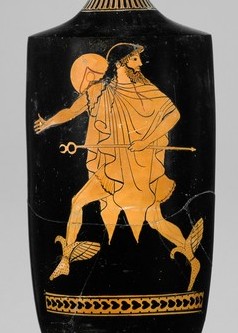
Light on the Rooftop  had an awesome post about street art on Freshly Pressed the other day.  She showed that non-conventional and public art can still be very high quality. I haven’t seen that level of street art while in Europe (unless the Bogside murals count) but I did catch an irreverent cartoon version of a classical Greek god.  I thought it was funny, or at least a funny departure from the typical Hermes iconography.

Hermes, as depicted in antiquity:

Terracotta oil flask depicting Hermes ca. 480–470 BC (Photo: Metropolitan Musuem of Art)

Modern Hermes painted above an abandoned building in Nafplion:  (Google Translate tells me that EPMHE is “Hermes” in Greek if the winged helmet weren’t enough.  On the billboard, he was facing an alligator in a Zoot suit which I am not sure how to interpret.)

Graffiti Hermes in Nafplion

Fakes, Mistakes and Discoveries Exhibit – National Gallery

If you are near London, you have 2 weeks left to see the exhibit Close Examination: Fakes, Mistakes & Discoveries at the National Gallery.  If you are like me and can not make it, they thankfully have a very cool set of case studies on-line to compliment the exhibit.

Conservation Science is the application of chemical and biological techniques to the study of paintings and art objects.  Analysis and identification of an artist’s materials is beneficial for conservators who must select the best processes for cleaning a work.  However, a lot of other information can be gained which helps art historian understand the “life” of the work such as where and when it was executed, how the artist completed the piece and if later additions were made.  For example, x-ray analysis can show places in which a part of a painting, like a hand or face, was reworked.  Sometimes this is done by the artist, or as the National Gallery shows in some examples, by later owners to suit the period’s tastes or possible make the painting more desirable to buyersFour Figures at a Table by The Le Nain Brothers (below) is a really striking example of how much more we can learn about a painting through scientific analysis.

What could be underneath the pleasant country scene in the Four Figures at a Table by The Le Nain Brothers? (Photo: The National Gallery, London)

We take it for granted now that an artist would sign his or her work but this was not always the case.  Carefully connoisseurship of an artist’s style can help attribute paintings but sometimes it is scientific analysis that can either rule out a great master or identify a painting’s creator.  The fakes section of the National Gallery’s on-line exhibit is great too!  In the end, scientific evidence will always trump exquisite craftsmanship.

It looks right, but how would you know if Botticelli painted Madonna of the Veil? (Photo: The National Gallery, London)