Skip to content

Posts tagged ‘archaeology’

Tips for Visiting Delphi, Greece

Delphi was really amazing and should be a priority on any visit to Greece.  A little bit of advice can usually go a long way, so here are some tips to make sure you enjoy your visit.

1) The Delphi Museum Hours Are Variable

Cybele (left) rides a chariot pulled by a lion who is attacking a Giant, from the north frieze (Gigantomachy) of the Siphnian Treasury, on display in the Delphi Museum

I was warned (by a man in Athens no less) that the Delphi museum had odd hours.  This was strangely confirmed when the three recent guidebooks I consulted all listed different hours for the museum.  Once in Greece, I called ahead and found that the museum was closing at 3pm the day we wanted to go.  We had lunch on the run in Thermopylae and made it to Delphi with a hour for the museum.  Since the archaeological site itself is open from ~8am-8pm everyday, we saw bus loads of tourists dropped off just to look at the ruins because the museum was long closed.  I’d have felt a little cheated if I came all that way and didn’t get to see the famous Charioteer statue, the architectural decorations and votive objects in the museum!

2) Pace Yourself

Delphi is a lot bigger than you think it is and built on a steep hill.  If you really want to see most of the site and enjoy the staggering vistas, budget 4 hours at least to see Delphi.  I suppose you could run through it quickly and just see some parts but you wouldn’t have time to start mentally piecing all the ruins together.  It’s hard to approach a large archaeological like Delphi, which contains almost no complete buildings, and immediately grasp the scale.  It’s pretty rewarding to sit at different vantage points and imagine the ancient city.

Reconstruction of Upper Delphi

I was hoping that things would begin to cool in early September but it was still incredibly hot in Delphi.  Since there is very little shade, try to go first thing in the morning or in the afternoon (3-8pm) like we did.  Take breaks, wear a hat and drink lots of water.

3) Stay the Night in Arachova

Arachova – A more authentic and relaxing alternative to staying in Delphi

As you would imagine, the modern city of Delphi is a tourist trap.  The main street is lined with restaurants and cheap hotels each containing some iteration of Oracle, Apollo, Temple or Zeus in their title.  I guessed as much even before I left the US and made alternate arrangements…

Arachova is about 20min east of Delphi and is a lovely town.  What spares Arachova from the cheesy tourist malaise down the road is its status as a top winter destination for skiers who flock to Mt. Parnassos.  Arachova has great hotels and restaurants to serve the influx of mostly Athenians coming up to ski but is empty in the summer months.  Since the city draws Greek sports enthusiasts, you are spared the kitsch seen in Delphi.  Arachova was a beautiful, peaceful town without the crowds and a more authentic place to hang out .

View down the main street in Arachova

There are several nice hotel options; we stayed at Xenonas Iresioni‏.  It is on the edge of town but only a few minutes walk away from the center of things.  The staff was great and the room was comfortable with the biggest double bed we saw in all of Greece.  When I mentioned to the man at the front desk that I was unable to purchase a Delphi catalog because the museum shop had run out of the English version, he gave be an unused one that they had on hand.  Talk about helpful staff!

Libya’s Threatened Archaeological Sites

Sabratha (Photo: Wikipedia)

I have been following the upheaval in Libya and came across a press release from UNESCO pleading for the protections of Libya’s archaeological sites.  As the statement reads: “Experience shows that there is a serious danger of destruction during times of social upheaval. It has taught us to look out for looting by unscrupulous individuals, that often damages the integrity of artifacts and of archaeological sites. Careless dealers who buy these objects and fragments are in fact inciting more looting. It is therefore crucial that the international antiquities market be particularly wary of objects from Libya in the present circumstances,” Irina Bokova [Director-General of UNESCO] cautioned.

Leptis Magna (Photo: wanderingchiara)

I am reminded of the looting in Iraq following the 2003 US intervention but also of citizens protecting the Egyptian Museum in Cairo last February amid the riots.  Libya has 5 designated UNESCO World Heritage Sites spanning Prehistoric, Phoenician, Greek and Roman periods.  I have even seen tours advertised (well, not anymore) to Libya to view these magnificent works of art.  My thoughts are certainly with the Libyan people who I hope have peace and stability soon, but it would be a tragedy if violence and lawlessness destroys their cultural heritage.


#1: The Pyramid Fields from Giza to Dahshur

Hey what's this...

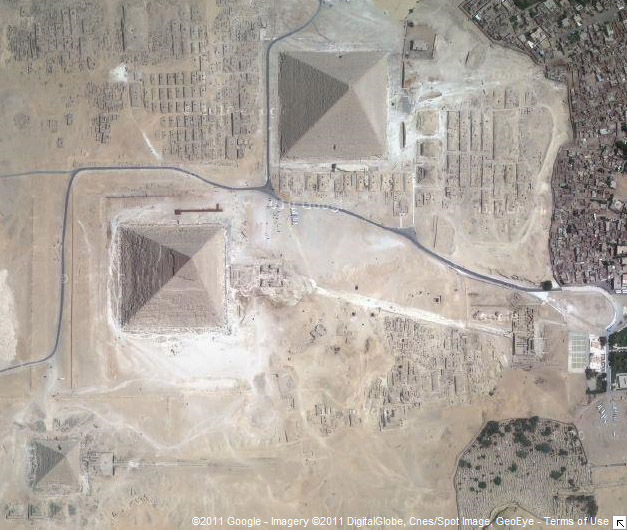
Why not start with one of the most famous ancient sites: the Pyramid Complex of Giza.  The “site” includes several monuments which trace the conceptual evolution of a divine shape now universally recognized as a pyramid but more importantly a visual record of engineering trial and error.  Chronologically, the first innovation can be seen in Djoser’s stacked mastabas or the Step Pyramid in Saqqara.  Previously, pharaohs were buried under large rectangular brick structures until architect, priest and generally creative guy Imhotep though stone would be better and that six progressively small mastabas would be an even better way to exalt the king.  30 years later, King Sneferu was determined to smooth the form a 17 miles south in Dashur.  I would imagine that the visual correlation of ascending to Ra the Sun God made for a strong theological rationale for the pyramid shape.  Sneferu’s reign created the so called Bent Pyramid which rises gradually then changes to a shallow angle of ascent about halfway up.  Presumably there was a problem baring the weight of the building and a more conservative angle was needed to complete it.  I can’t fault the builders at all for this awkward looking pyramid; these were constructed with only the most basic tools, fundamental building technology and the brute force of thousands.  Sneferu was finally successful and completed the Red Pyramid next door.  Finally, the pyramid everyone remembers is that of Sneferu’s son Khufu (2589-66BC) – The Great Pyramid.  Just outside the Cairo, it is constructed from 15 ton stone blocks and surrounded by temple complexes, minor pyramids to Queens, the Sphinx, and an impressive solar boat reconstructed painstakingly from over a thousand pieces.  Set behind Khufu’s pyramid is that of Khafre and Menkaure which get progressively smaller in size.  After this, kings no longer chose to construct pyramids which puts this incredible boom and bust of Old Kindom funerary building in only a ~164 year window.  While you can’t climb the pyramids like you use to do hundreds of years ago, it is still impressive sight and high on my To Do list!

 Getting there: Once in Cairo, taxi tours to Giza, Saqqara and Dashur can be arranged with most hotels.  It generally good advice to arrange the price ahead of time, find a driver who speaks English, and work out how long you want to tour around.  It’s very possible to see all three sites in one day.  Myself, if I’m going to Egypt it’s going to be for a while and I’m going to see more than just the Pyramids.  I’ve got my eyes on Gap Adventure’s Egyptian Archaeology Adventure and will tack on a few days in Alexandria.