Skip to content

A Traveler’s Second Language

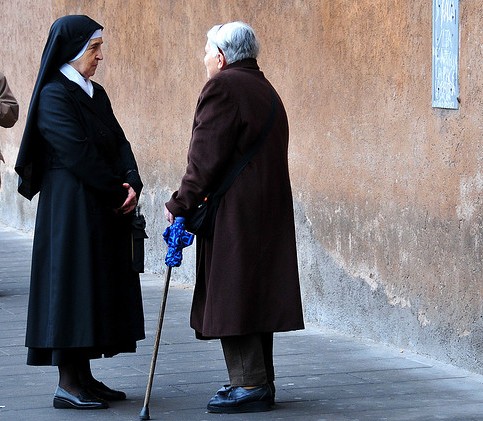
"Bonjour suora, comment allez-vous?" (Photo: Ed Yourdon)

There was a great column by Daisann McLane in National Georgraphic Traveler this month about the value of speaking a second language.  No matter where you are, it gives you another option for communication.   She argues that when people must communicate in neutral language (in her case, an American and Japanese woman speaking Spanish together), they are more conscientious of their pronounciation and use more standard, less slangy vocabulary.  This made me think of my own experience communicating in a third language.

The summer I spent in Florence, I lived in a convent which rented half of its rooms to travelers and students like me.  It was gorgeous place with cool stone floors and a peaceful inner garden, all hidden just down the street from the Duomo.  My room even had a 19th century fresco of angels on the ceiling!  The sisters were very kind and would join the guests for breakfast.  The only problem was that I barely spoke Italian so I limited to “Sì, grazie suora”.  Unless the sisters wanted to sell me a train ticket, I didn’t really know what to say.  But I was in luck; this was a French religious order so they all knew some French!  My four years of high school French came in pretty handy.

What a difference a little communication makes.  It was so much more fun to chat with the sisters, ask them what they were working on and answer their questions about what I had done each day.  As much as I love seeing art and scenery when I travel, it makes for a much richer experience if you can actually talk with locals.

(On a side note, my French is still way better than my Italian.)

A Virtual Visit to the “Cave of Forgotten Dreams”

Every blockbuster seems to come out in 3D these days.  The only one I actually saw this summer didn’t have superheroes, but was actually a documentary about prehistoric art.  In “Cave of Forgotten Dreams”, Werner Herzog and a 3D film crew were allowed to shoot the recently discovered Chauvet Caves in the South of France which contains animal drawings over 30,000 years old.  Realizing that a few decades of tourist traffic has severely damaged the Lascaux Caves, the French government has limited access to Chauvet meaning that this movie may be your only way of seeing the cave art.

Grouping of horses from Chauvet (Image from Bradshaw Foundation)

I know Herzog is famous and an “artist” but this documentary would have been better if the History Channel had complete control and not just acted as a producer.  Herzog tried to be reflective about what it means to be human and our ability as modern people to understand Upper Paleolithic humans but it came off shallow – like he was just throwing out some rhetorical questions.  He tried to add historical context through an atlatl demonstration and a trip to see early female stone figurines, but it wasn’t quite enough.

What I was looking for was more analysis of the cave.  In one of the best scenes, an archaeologist describes a series of painted hand imprints and what this teaches us about the artist.  (Spoiler Alert!  He was six feet tall and had a broken pinky finger!)  There is also cool digital fly-through of the cave but the narration doesn’t clearly enough establish the lay-out of the cave, the locations of the art within it, and the possible cultural meaning of the art’s placement.  I hate to say it, but National Geographic or NOVA would have done this in the first 15 minutes.

Crowd of elegant lions (Image from the Bradshaw Foundation)

As much additional history as I would have liked, the art in Chauvet is absolutely amazing and the film does a good job of capturing its beauty.  I could have watched 20 more minutes of slow pans over the cave paintings.  The horses and lions seemed more realistic than other similarly dated cave drawings.  The composition of the animal groupings is also very sophisticated placing layer on layer of figures.

To explore Chauvet cave on-line, see the French Ministry of Culture or the Bradshaw Foundation which is dedicated to the preservation of rock art.  And by all means, watch “Cave of Forgotten Dreams”.

*UPDATE* – As of June 22, 2014, the Cauvet Caves have been named a UNESCO World Heritage Site!  You definitely need to see this film now since visitors are still not allowed within the real cave.

#2: Ravenna – the Capital of Mosaics

In 2007, I flew in and out of Milan for a conference and decided to sneak in a few days afterward for what I considered to be an Art Pilgrimage.  I love Byzantine art and at the time was obsessed with seeing Ravenna, the self-proclaimed “Capital of Mosaics”.  With the division of the ancient empire and the fall of Rome itself, the center of the western empire was moved to the northern Italian city of Ravenna.  Between approximately 400-550 AD, Emperors Galla Placidia, Theodoric and Justinian constructed fantastic basilicas whose interiors are literally covered with vibrant and expressive mosaics.  Ravenna is so rich with art that 8 of its churches have been cited by UNESCO as a World Heritage Site.

On the coast 75miles south of Venice, Ravenna can be accessed by train from Milan via a transfer in Bologna.  Arriving in the late afternoon, I explored the city a bit and spent the night so that I could start the next morning in the Basilica of St. Vitale.  The Byzantine central circle upon circular chapel architecture provides a heavenly open space which at the time was flooded with golden morning sunlight.  The altar apse mosaics just glittered.  At first its a little disorienting because there is so much to look at.  The brightness and richness of St. Vitale is a good reminder that there was a long tradition of vivid color in Roman art.  I went slowly over each face, bird and Old Testament scene, many of which including a little divine hand directing events from a cloud!  You might think that mosaics – the arrangement of little bits of colored stone and glass – could never be anything more than decorative patterns, but the art was so shockingly expressive.  The faces of the Apostles, Justinian, Theodora and their attendants looked like realistic portraits.
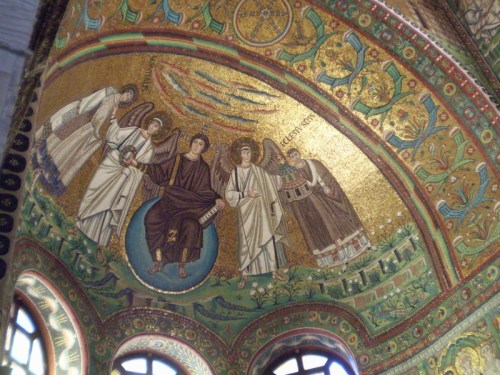
Apse of St. Vitale depicting Christ as the Redeemer

Next I went to the Mausolem of Galla Placidia whose central altarpiece depicts a youthful, beard-less, Apollo-like Christ as the Good Sheppard.
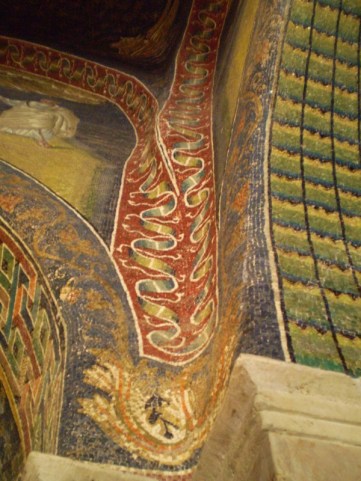
Looking up here, you can see that even the decorative moldings in the Mausolem of Galla Placidia are covered with mosaics!

The Basilica of St. Apollinare Nuovo has parallel scenes of a procession of female and male martyrs.  The women in their gold and pearls and the men in their stark white robes make for an elegant continuity but each figure have enough unique details to warrant a long look.  Above this register are portraits of saints and small scenes from Jesus’ life.  If you are keeping track of Christ’s evolving iconography, he looks like a youthful Roman while performing miracles and is not depicted with a beard until the Last Supper panel.  As is common of early Christian art, the Passion panels jump from Simon carrying a skinny, mostly symbolic cross to the Marys at the tomb.  Even the Byzantines would have been too horrified by crucifixion to visually depict it.

The Arian Baptistry, the Neonian or Orthodox Baptistery (Battistero degli Ortodossi) and the Archiepiscopal Chapel are more intimate art experiences.  If your visit is anything like mine, you will be completely alone in these buildings.  Here again you will find interesting visual details in the procession of apostles.

Procession of saints in the Arian Baptistry

My one regret is that I did not get to St. Apollinare en Classe because it was, well, in Classe about 5km outside of Ravenna.  My plan was to rent a bike but when I couldn’t find a place, I went to the Theodoric’s Mausoleum instead which sits in the middle of a field and is surprisingly undecorated.

At the Mosaic School in Ravenna, you can watch artists work and see some displays about the process.

Beside the incredible art, Ravenna is a charming city in which to spend the day largely free of the tourist crowd.  The warm summer evening I was there, the whole city seemed to be out walking and shopping till 9 or 10pm.  As a single traveler, I felt complete comfortable with the crowd and helped myself to some gelato and people-watching.  The food was great too.  I had an amazing anchovy pizza for lunch and the side of grilled vegetables with my dinner stands out as one of the best dishes I’ve ever had.  I stayed at the Hotel Byron Centrale which was in a great location and cheap even though my single room was adorably small.  I can not understand why more people do not prioritize Ravenna when planning a trip to Italy.  It’s a pleasant city with impressive artistic treasures.  It was well worth the pilgrimage from Milan!
Postcard from Sicily

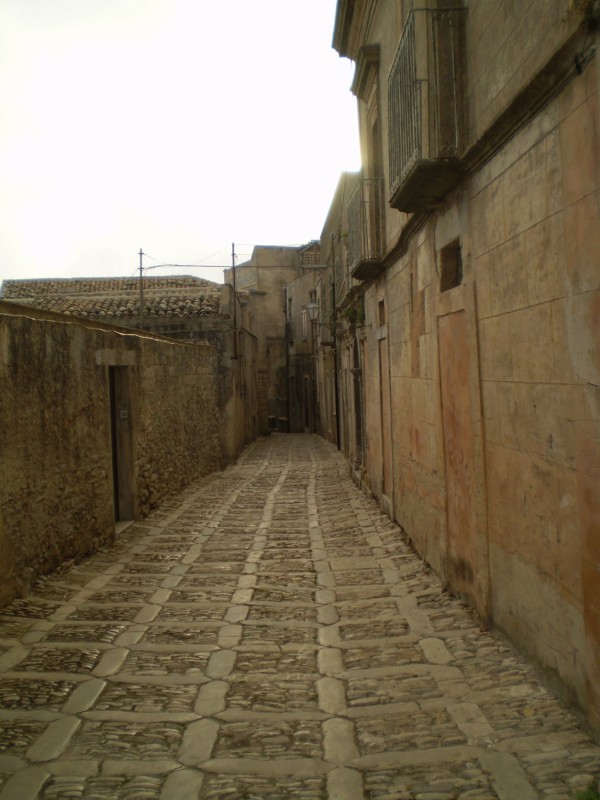
The last book review got me thinking about how much I liked Sicily.  Here are couple pictures from 2007 of the villages of Erice and Trapani.

Erice sits on top of a sharp plateau with stunning views.

I am someone who notices the details.  I was in love with the paving on this street.

Quiet street in Erice

Traveling by Book – The Leopard (Sicily)

After a trip to Sicily, Amazon kept recommending The Leopard by Giuseppe Tomasi di Lampedusa to me.  No matter what else I bought or added to my wish-list, the Leopard did not budge from the number one spot so I figured I might as well give in.  What I found was a true gem of a novel with marvelous characters that inhibited a living Sicily.

The Leopard tells the story of the Prince, a noble in mid-19th century Italy, facing an uncertain future threatened by political revolution and economic flux.  He is clearly a proud man born and raised with aristocratic tastes and manners.  The novel is sympathetic to the out-dated great man but it is interesting to watch as he lets the changing world pass him without even trying to keep up. The book is not driven by plot per say as it only covers a few full days.  The beauty lies in the characters who muse about the mundane and fleeting pleasures of their lives – the Prince’s favorite dog, the childish crushes of the Prince’s daughters, the priest’s political and family troubles.  It’s both nostalgic and comfortable, like picnicking with friends telling stories.

I think what made these docile characters really work though was the setting.  There is a dry heat that permeates the novel and slows the characters making their speech quiet and steps deliberate so as not to kick up too much dust.  Their palaces are thick with detail and you can imagine the flies in their summer countryside manor.  Maybe it’s not fair because I read this after visiting Sicily, but I could perfectly pictured these people in its arid countryside and echoing stone streets.  The Prince has a brilliant monologue at one point about Sicilians claiming that they are a steady, consistent people who having been conquered over and over throughout the centuries and cannot be troubled by anything outside their world.  In traveling western Sicily, I found the pace of life slow (even by Italian standards!) and was surprised how rocky and harsh the landscape was.  A story of waning power and decline seems well-suited for this environment.  I appreciated the rich descriptions of places and people in The Leopard and would recommend it to anyone looking for a book vacation to an often-forgotten, quiet corner of the Mediterranean.