Skip to content

Photo of the Week – Garden Creature

Peacock in the garden planters (Photo: DaydreamTourist)

My New Years resolution was to try to carry a camera with  me more often. I was pretty quickly rewarded for this in 2012!  After finishing up tasting at the Chateau Ste. Michelle Winery in Woodinville, Washington, I came outside to see this peacock perched on some planters.  While I am still getting use to my new camera, I like the composition and colors of this photo.

Reconstructing Art: Duccio’s Maesta

1878 Iguanodon

In1878 this seem like a fine reconstruction of an Iguanodon, despite the fact that its tail would be broken in this posture. (Photo: University of Bristol, Earth Science Dept.)

Walking through the ruins of the Acropolis and looking over the plaster copies of the Parthenon Frieze this last fall, I tried to put it all back together visually.  Thankfully there were digital reconstructions to look to, but I got to wondering if wholesale reconstruction of a work of art is even possible.  In most cases, pieces can be broken or destroyed and critical details of the overall assembly can be lost.  (It’s a tangential example but I’m thinking of all the miss-assembled Victorian dinosaur skeletons.)  Then I remembered Duccio’s Maestà in Siena.

The Three Marys at the Tomb by Duccio, part of the Maestà altarpiece in Siena (Photo: Web Gallery of Art)

Duccio’s expansive Maestà Altarpiece was installed in the Siena Cathedral on June 9, 1311.  The double sided piece is estimated to have been 4.7 by 5 meters in dimension.  It was composed of a central panel (The Virgin and Christ Enthroned with Saints and Angels) and over 70 smaller scenes depicting New Testament iconography.  Sadly this grand style of altarpiece went out of fashion and in 1711, the panels were dismantled, sawed apart, and dispersed.  Most of the pieces are now back in Siena. Careful scholarship, analysis, and restoration has shed light on its original construction and composition.

Maesta alterpiece

Virgin and Child panel of the Maesta alterpiece by Duccio, Museo dell’Opera, Siena (Photo: profzucker, Flickr)

The Maestà altarpiece is not displayed in its reconstructed state which allows for better viewing of the visually rich story panels.  These were likely executed by Duccio’s workshop but are all interesting.  The central Virgin and Child panel alone is incredibly impressive.  I remember seeing it at the Museo dell’Opera del Duomo in Siena.  The room was fairly dark with a few spotlights on the panel which made the gilding glow.

Duccio Maesta front panel

Duccio Maestà front panel reconstruction with missing pieces shown in gray (Image: DaydreamTourist)

On the front of the altarpiece would have been a Marian cycle in the pinnacles and the birth and childhood of Jesus in the lower predella. The reverse panel depicts the Passion sequence in the main section and scenes from the ministry of Christ along the pinnacles and predella. In the reconstruction images above and below, panels not presently in Siena are shown in black and white (missing panels are not shown).  You have to actually go to Washington DC and Madrid respectively to see two of my favorites: the Nativity with Isaiah and Ezekiel and Christ and the Samaritan Woman.  It is also possible to appreciate how pieces may have been shaved and shaped since being freed from the altarpiece frame.  I have also accepted the interpretation that a piece showing the coronation of the Virgin now in Hungry was featured in the central front panel pinnacle.  This makes sense thematically in the context of the smaller pinnacle images showing the life of Mary and would be appropriate subject matter for the period and location.  The reconstructions also assumes that the pinnacle angels mirrored each other since only 4 of the 12 total exist today.

Duccio Maesta back

Duccio’s Maestà back panel assembly with missing pieces noted in gray (Image: DaydreamTourist)

Viewed as a whole, the complexity and ambitiousness of the project is evident.  Whether or not the framing decorative elements are exactly correct is a moot point given the wealth of visual story-telling and the fairly confident reconstitution of the narrative flow.  It’s amazing that almost all of the panels have survived.  The Maestà demonstrates that reconstruction, at least digitally, goes a long way in understanding the artist’s intentions, the work’s visual impact, and how contemporary viewers would have encountered the piece.

Reconstructions adapted from the Web Gallery of Art.

Reference: Siena, Florence and Padua: Art Society and Religion 1280-1400, Volume II: Case Studies, edited by Diana Norman, 1995.

My perfect portrait

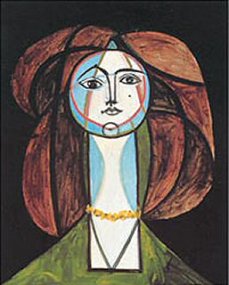
Françoise GilotWhen I started DaydreamTourist, Picasso’s portrait of Françoise Gilot was a convenient logo.  I even joked in the About section that this is what I look like if he had painted me.  But that got me thinking.  Of all artists past and present, who would I want to create my portrait?

I should say I have always loved portraiture.  The end result is a blend of both how the sitter (or their family) wanted the individual to be represented, what society valued at the time, maybe some of what the artist thinks of the subject and, if you’re lucky, a realistic likeness of someone who once existed.

Domenico Ghirlandaio “Portrait of Giovanna Tornabuoni” is a lesson in wealth and virtue as an elegantly put together woman sits amid her possessions.  Her rigidity reflects her status which is emphasized by the inscription, O art, if thou were able to depict the conduct and soul, no lovelier painting would exist on earth.

Domenico Ghirlandaio - Portrait of Giovanna Tornabuoni

Domenico Ghirlandaio “Portrait of Giovanna Tornabuoni” 1489-1490, Museo Thyssen-Bornemisza, Madrid

There is something to be said for sentimentality and tenderness.  For example, Norman Rockwell’s Richard Nixon seems friendly, familiar and just a tad endearing.

Normal Rockwell - Richard Nixon

Norman Rockwell “Richard Nixon”, 1968, National Portrait Gallery, Smithsonian Institution, Washington, DC

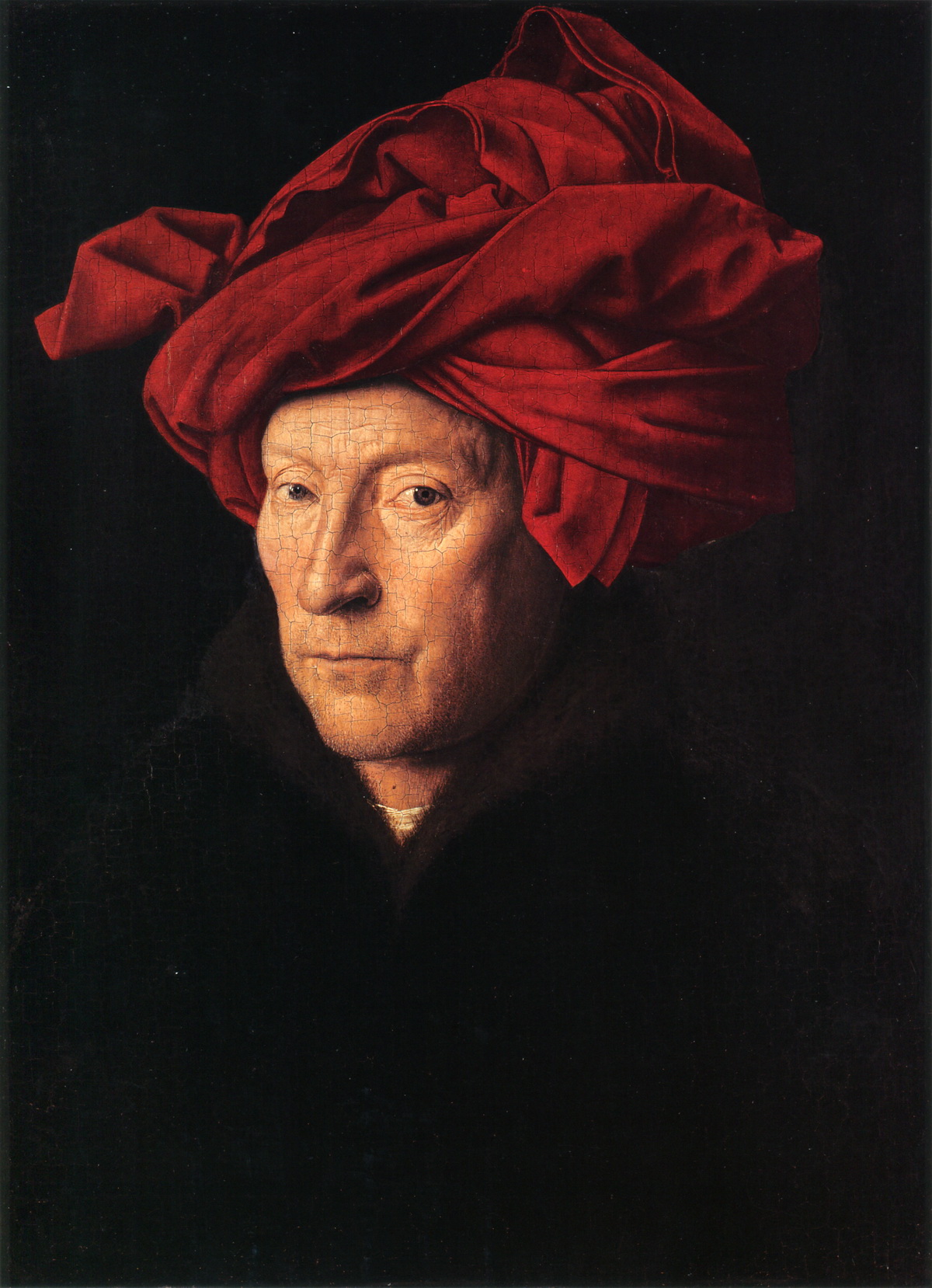
Many of my favorite masters of realism worked during the Northern Renaissance and produced luminous life-like figures.

Portrait of a Man in a red turban by Jan van Eyck

Jan van Eyck, “The Portrait of a Man” (or “Portrait of a Man in a Turban”)  1433, National Gallery, London

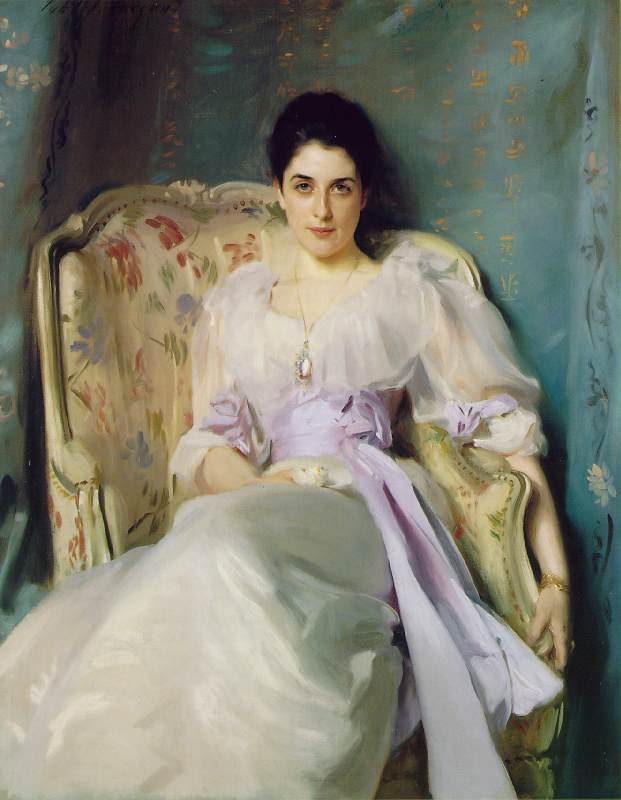
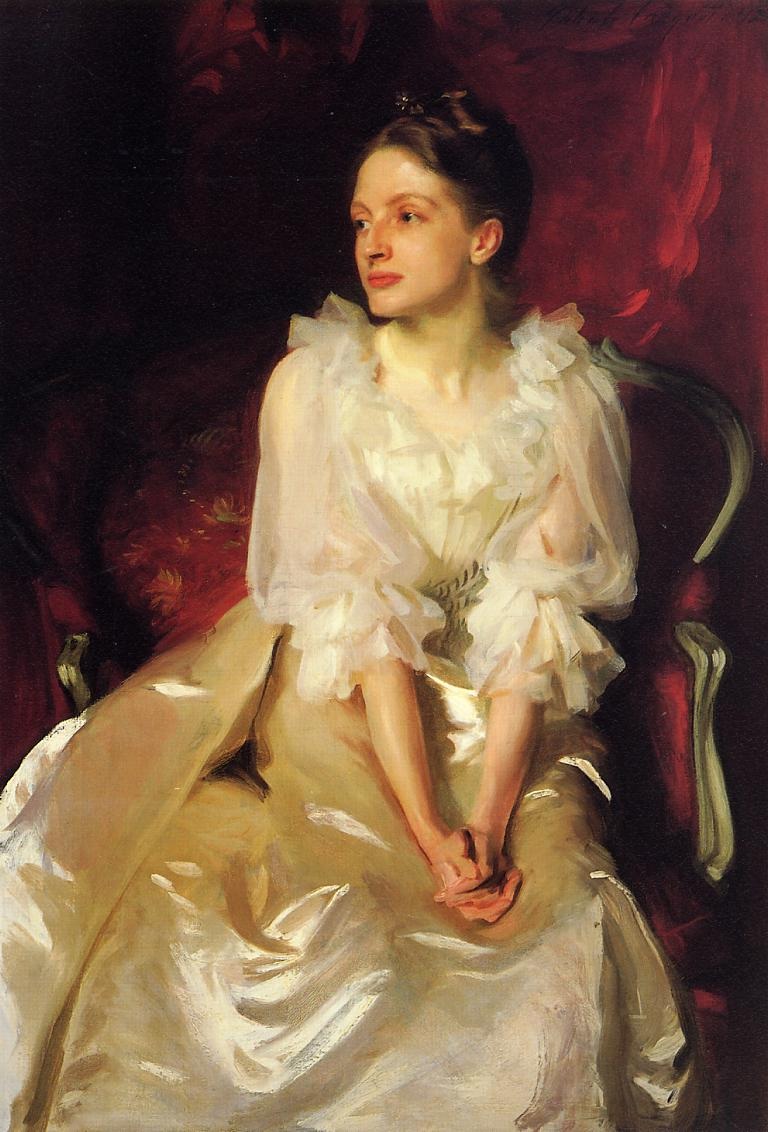
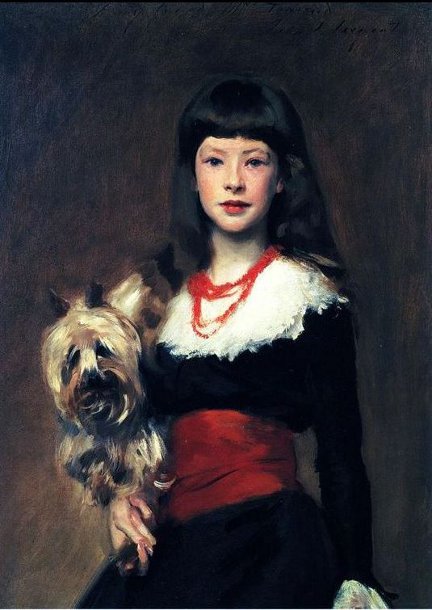
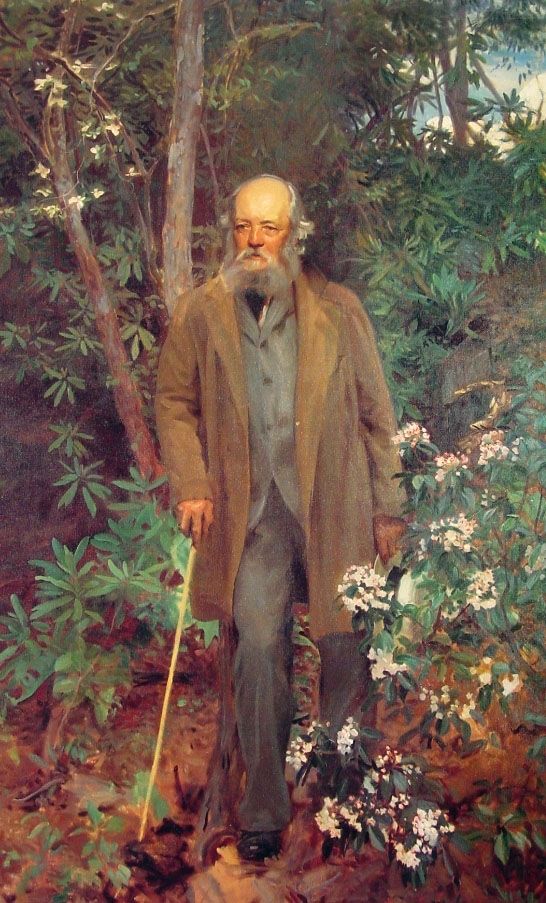
Without a doubt though, I would want my portrait done by John Singer Sargent.  I have heard it said that Sargent liked painting women and it shows in his work.  Looking at his pieces, you start to understand the personality of his subject through quirks in their poses, faces or the portrait’s composition.  I have also admired the fluidity and range of his brushwork moving from well executed facial features to impressionistic clothing and abstracted backgrounds.
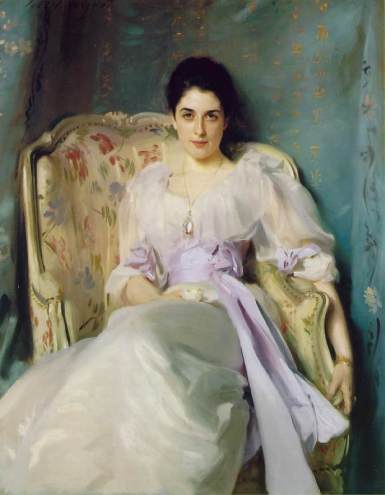
John Singer Sargent "Lady Agnew of Lochnaw"

John Singer Sargent “Lady Agnew of Lochnaw”, 1892-93 National Gallery of Scotland, Edinburgh

John Singer Sargent "Mr. and Mrs. I. N. Phelps Stokes"

John Singer Sargent “Mr. and Mrs. I. N. Phelps Stokes” 1897, Metropolitan Museum of Art, New York City
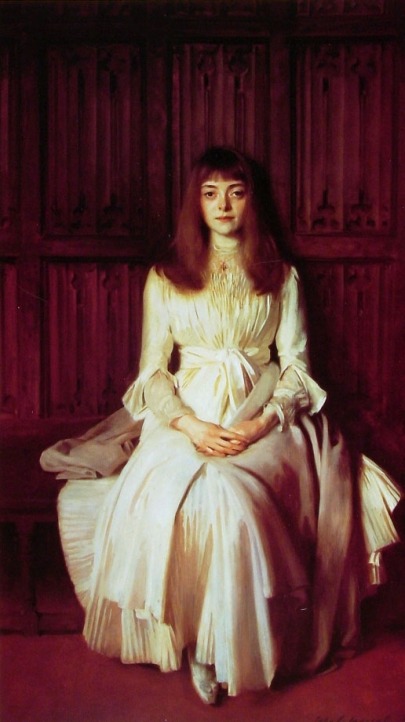
John Singer Sargent, "Miss Elsie Palmer"

John Singer Sargent, “Miss Elsie Palmer”, 1889-90, Colorado Springs Fine Arts Center
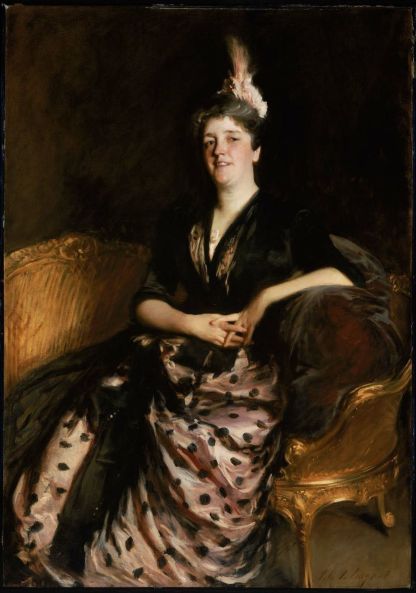
John Singer Sargent - Mrs. Edward Darley Boit

John Singer Sargent, “Mrs. Edward Darley Boit” 1887, Museum of Fine Arts, Boston

John Singer Sargent “Miss Helen Dunham”, private collection
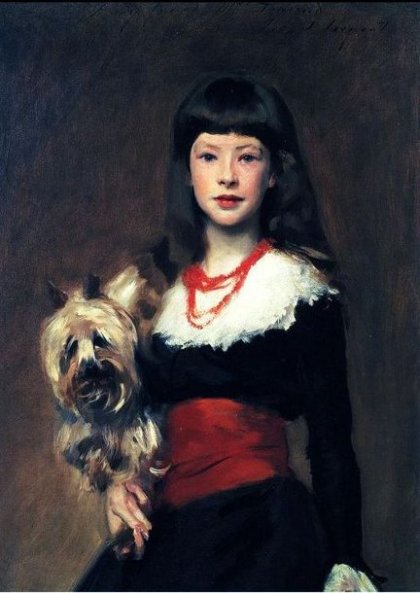
john singer sargent  - beatrice townsend

John Singer Sargent, “Beatrice Townsend” 1882, National Gallery of Art, Washington, DC

I suppose I should also point out that his portraits of men were really amazing too.
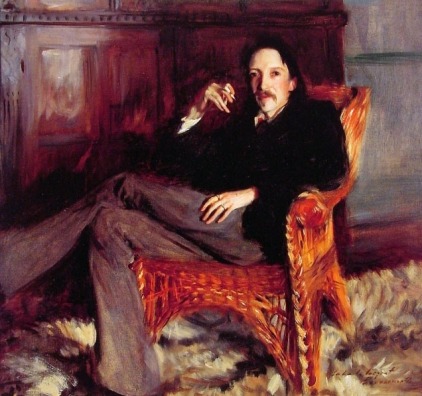
John Singer Sargent - Robert Louis Stevenson

John Singer Sargent, “Robert Louis Stevenson” 1887  The Taft Museum, Cincinnati

John Singer Sargent - Arthur James Balfor

John Singer Sargent, “Arthur James Balfor” 1908, National Portrait Gallery, London

John Singer Sargent - Frederick Law Olmsted

John Singer Sargent “Frederick Law Olmsted”, 1895, Biltmore House, Asheville, North Carolina

Thanks to the John Singer Sargent Virtual Gallery for images and inspiration.

Photo of the Week – Polar Bears in Tokyo

Only because it has been so cold recently….

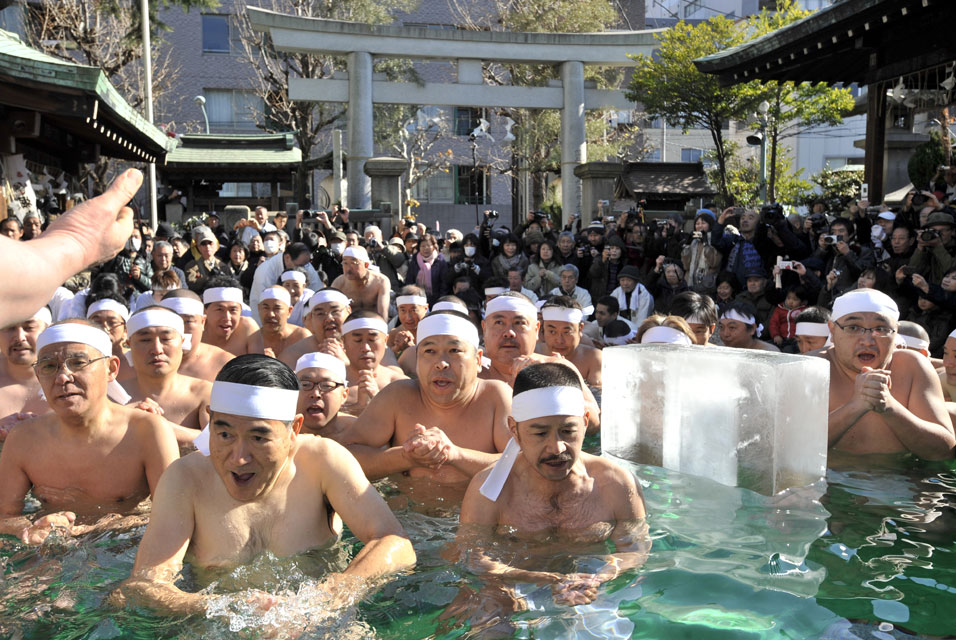
ritual ice water bath in Tokyo

Enjoying a cleansing polar bear swim in Tokyo (Photo: Kimimasa Mayama/EPA)

Participants bathe in icy water during a winter purification bathing or shinto-style polar bear bath at Teppozu-Inari Shrine in Tokyo, Japan, 08 January 2012 at the start of the New Year. Some people participate in purification bathing or swimming at the start of the New Year in Japan in the hope for their wellness. Photo: EPA/KIMIMASA MAYAMA.  Story and photo from Artdaily.com

The Concorde

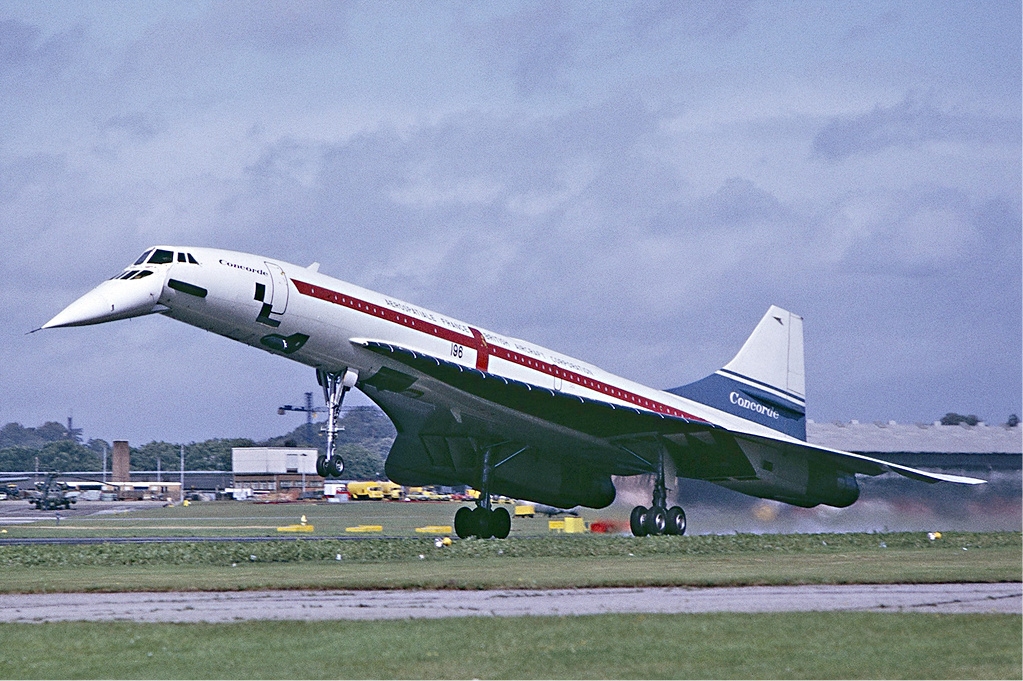
concorde landingWhile in Seattle, I stopped by the Museum of Flight near Boeing Field to visit one of the retired Concorde jets.  There is something really beautiful about the Concorde’s sleek supersonic engineering and its iconic pivoting nose.  Although an old and retired technology, to me it symbolizes innovation and luxuriously fast flight times.

concorde nose and profile

Concorde's profile

The Concorde was a joint project between Air France and British Airways and made its first scheduled flight on January 21, 1976  after over a decade of development, prototypes and test flights.  Twenty planes were produced.  The jets could reach Mach 2.0, or twice the speed of sound, thanks to four turbojet engines.  The heat generated in flight would cause the fuselage to expand by 8-12 inches.  Given the steep angle of approach at take-offs and landings, the pilots’ view of the ground was completely obstructed.  The droop nose, which bent to 12.5 degrees below the plane of the aircraft, was created to maintain the rigorous aerodynamics needed for supersonic speeds while still allowing for safe departures and arrivals.

In this short clip of an aborted Concorde landing, you can see that it flies more like a military fighter jet: (Thanks, Cranky Flier)

Upon breaking the sound barrier, pressure differences around the aircraft produce a loud sonic boom.  (Incidentally, this is not heard by passengers but by those on the ground.)  While this speed was a huge advantage for travelers on the Concorde, noise pollution concerns quickly lead to legislation that forbade supersonic commercial air travel over the US.  The Concorde was then limited to transatlantic or other ocean-going routes.

concorde's turbojet intake system

Hello Turbojets...

The Concorde holds the transatlantic transport record, making it from New York City (JFK) to London-Heathrow in just 2 hours, 52 minutes, 59 seconds.  The quick flight time makes for some interesting paradoxes.  If you were to leave London at 5pm, given the short travel time and 5 hour time difference, you would land in New York City at 3pm  – or before you left the UK!  On July 13, 1985 Phil Collins performed at the Wembley Stadium Live Aid concert, flew to the US on the Concorde and then joined the simultaneous Live Aid concert in Philadelphia.

concorde cabin

Concorde's narrow cabin with not quite first class seating

Passenger accommodations are reported to have been first-class on the Concorde, but walking down the aisle, the plane interior felt like a small commuter jet.  The seats themselves were definitely smaller than those you would find in first class on a Boeing 747.  It must have been a cozy trip for the ~100 passengers.

The high cost of operating the Concorde and a decrease in air travel post-9/11 led to their eventual retirement.  As demand dwindled, transatlantic ticket prices escalated up to $10,000-12,000.  The Concorde was therefore retired in 2003.  Several of the planes have made their way to museums purchased outright or like the one in Seattle, on loan from BA.  It was a great opportunity to visit a luxurious icon of modern air travel.

Concorde's tail colors

On a side note: special permission had to be granted for British Airway’s G-BOAG Concorde to fly to Seattle to become part of the Museum of Flight.  From NYC, the journey took only 3 hours, 55 minutes, and 12 seconds.  (I however had to spend about 6 hours making approximately the same journey.)