Skip to content

Posts from the ‘UNESCO World Heritage Sites’ Category

Ancient Delphi

According to myth, Zeus released two eagles to circle the world and in their flight they crossed above Delphi – the center of the Earth.  Delphi is an expansive site on the side of Mt. Parnassus with sweeping views and layers of ruins to explore.

Delphi is perhaps most famous for the Oracle at the Temple of Apollo.  The heart of the temple was situated over a crack in the ground which spewed noxious gas.  Under its influence and perhaps other substances, the temple priestess would speak which in turn was “interpreted” by the savvy and current events-conscious temple priests. Pilgrims, diplomats and kings came to Delphi for this divine advice which was not always so clear. On his second consultation regarding the impending Persian invasion, Themistocles of Athens was told famously (in cryptic oracle language) that “Though all else shall be taken, Zeus, the all seeing, grants that the wooden wall only shall not fail.”  After the Persians captured and burned much of Athens, it was the decisive Greek naval victory near Salamis that sent the Persians back home.  It seems the Oracle’s “wooden wall” was not a city wall but a fleet of ships!

Delphi - Temple of Apollo

Delphi – Temple of Apollo

 As you would imagine, the Athenians were elated after their victory and most likely brought fine sculptures and gold to the Apollo in thanks.  This is actually what every Greek city-state did after a victory storing the offerings in their own dedicated Treasury building.  The road leading to the Temple of Apollo is lined with Treasuries which acted like both a museum and a bank vault meant to show off the generous gifts of the city to Apollo and to protect the objects.  Today only the Treasury of Athens remains complete after extensive restoration.  At the site today, you can see up the mountain to the Temple, but during the Classical Greek period, the view must have been obstructed with a winding street of proud, glittering Treasuries.

Treasury of Athens - Delphi

Treasury of Athens – Delphi

Delphi hosted the Pythian games every four years for about 900 years beginning in 582 BC.  Since the games focused more on arts, there is a well preserved theater in addition to a stadium for athletic competitions above the Temple of Apollo.  The modern road through Delphi cuts the Treasuries, Temple and event venues from the lower portion of the site.  Here you’ll find an athletic training grounds and a large temple complex dedicated to Athena – Apollo’s sister.  Beside the main Temple is the elegant round Tholos building which is usually (and incorrectly) associated with Apollo, the Oracle and Delphi in general, because of its beauty.  If there is not a picture of white and blue buildings from Santorini on the cover of your Greek guidebook, then it is probably a picture of the Athena Tholos at Delphi!

Temple Complex of Athena Pronaia – Delphi

Delphi does have a small museum which contains some sculptures and architectural elements from the ancient site.  The most notable piece is the bronze Charioteer which survived because it was buried during a landslide.  The figure is elegant, youthful and executed with great detail.  Since the modern world has inherited Roman stone copies of now lost Greek statues, we often forget that bronzes constituted about half of the ancient Greek statues.

Charioteer of Delphi

I have a lot of travel tips for seeing Delphi so I’ll post those separately.  In the meantime, let me say that Delphi is an impressive sight – well worth the trip and greatly enhanced by some historical background before you visit.

Prehistoric sites of Brú na Bóinne (Newgrange, Knowth and Dowth)

On my Irish road trip, I saw a lot of impressive things – jagged mountains, green valleys and wild coastline.  I also saw a lot of historic things – overgrown monastic ruins, abandoned farm houses and the ever present round tower.   But the most impressive and historic sites were Newgrange, Knowth and Dowth, three Neolithic mound tombs along the Boyne River and a UNESCO World Heritage Site.

Newgrange, part of the prehistoric Brú na Bóinne complex

Predating the Egyptian Pyramids, the mounds are passage tombs, meaning they contain one or more stone lined corridors where traces of human remains were found.  Newgrange is the largest and more famous of the three.  It aligns such that on the winter solstice the sunrise illuminates the inner chamber in what must have been a highly potent spiritual moment for its prehistoric builders.  You are allowed to enter the somewhat claustrophobic passage and view a chamber formed by an impressive corbelled ceiling.

While it looks beautiful, the stone exterior of Newgrange is a reconstruction from archaeological guesswork.  The white stone and river stone in the facade can be traced to sites quite a distance away.  It is possible that the stones were brought as offerings and left outside the portal and therefore might never have been part of a collapsed stone wall as the restoration assumes.

Stone carvings at Knowth

I am far more interested in prehistoric carvings and so I enjoyed Knowth a little more.  Both mounds are encircled with meter tall stones but those around Knowth are more extensively decorated.  While it is easy to try an interpret the swirls (everlasting life? rebirth?) and organized dots (there’s 12 on one rock, is this a lunar year reference?), I prefer to enjoy them for their design and to appreciate the ancient conviction that created these deep stone markings.  You cannot go far inside the Knowth passages but you can climb on top of the mound.  The Knowth site was occupied by humans in later periods so in restoring the prehistoric site, archaeologists had to go down through the remains of a Cistercians farm, Norman dwelling and Bronze Age village.

Newgrange as viewed from atop Knowth

The sites are only accessible from the Visitor Center which runs timed tours of 15-20 people by shuttle bus to each tomb.  You can choose just to see just one tomb but you are completely cheating yourself if you don’t visit both Newgrange and Knowth!  (Dowth is closed for posterity with plans to excavate it someday.)  During the obligatory wait before your tour time, the visitor center has a good video about Neolithic religious practices and some interesting exhibits.

Tips for Visiting

While the River Boyne site could be an easy day trip from Dublin, it’s worth spending the night nearby.  (And this way, you can see the carved crosses at Monasterboice before the tour buses show up!)  I found the Scholars Townhouse Hotel in Drogheda about 15 minutes from the UNESCO site.  The hotel is decorated with dark wood paneling and antiques making it feel elegant but very cozy.  When we arrived in the evening, candles lit the reception area and the staff could not have been nicer.  I loved the huge carved Victorian bar and the Cromwell battle ceiling paintings in the breakfast room.  (Disclosure: I am not receiving anything for writing about the hotel.  I just liked it and thought it was a good tip to pass along.)

#2: Ravenna – the Capital of Mosaics

In 2007, I flew in and out of Milan for a conference and decided to sneak in a few days afterward for what I considered to be an Art Pilgrimage.  I love Byzantine art and at the time was obsessed with seeing Ravenna, the self-proclaimed “Capital of Mosaics”.  With the division of the ancient empire and the fall of Rome itself, the center of the western empire was moved to the northern Italian city of Ravenna.  Between approximately 400-550 AD, Emperors Galla Placidia, Theodoric and Justinian constructed fantastic basilicas whose interiors are literally covered with vibrant and expressive mosaics.  Ravenna is so rich with art that 8 of its churches have been cited by UNESCO as a World Heritage Site.

On the coast 75miles south of Venice, Ravenna can be accessed by train from Milan via a transfer in Bologna.  Arriving in the late afternoon, I explored the city a bit and spent the night so that I could start the next morning in the Basilica of St. Vitale.  The Byzantine central circle upon circular chapel architecture provides a heavenly open space which at the time was flooded with golden morning sunlight.  The altar apse mosaics just glittered.  At first its a little disorienting because there is so much to look at.  The brightness and richness of St. Vitale is a good reminder that there was a long tradition of vivid color in Roman art.  I went slowly over each face, bird and Old Testament scene, many of which including a little divine hand directing events from a cloud!  You might think that mosaics – the arrangement of little bits of colored stone and glass – could never be anything more than decorative patterns, but the art was so shockingly expressive.  The faces of the Apostles, Justinian, Theodora and their attendants looked like realistic portraits.

Apse of St. Vitale depicting Christ as the Redeemer

Next I went to the Mausolem of Galla Placidia whose central altarpiece depicts a youthful, beard-less, Apollo-like Christ as the Good Sheppard.

Looking up here, you can see that even the decorative moldings in the Mausolem of Galla Placidia are covered with mosaics!

The Basilica of St. Apollinare Nuovo has parallel scenes of a procession of female and male martyrs.  The women in their gold and pearls and the men in their stark white robes make for an elegant continuity but each figure have enough unique details to warrant a long look.  Above this register are portraits of saints and small scenes from Jesus’ life.  If you are keeping track of Christ’s evolving iconography, he looks like a youthful Roman while performing miracles and is not depicted with a beard until the Last Supper panel.  As is common of early Christian art, the Passion panels jump from Simon carrying a skinny, mostly symbolic cross to the Marys at the tomb.  Even the Byzantines would have been too horrified by crucifixion to visually depict it.

The Arian Baptistry, the Neonian or Orthodox Baptistery (Battistero degli Ortodossi) and the Archiepiscopal Chapel are more intimate art experiences.  If your visit is anything like mine, you will be completely alone in these buildings.  Here again you will find interesting visual details in the procession of apostles.

Procession of saints in the Arian Baptistry

My one regret is that I did not get to St. Apollinare en Classe because it was, well, in Classe about 5km outside of Ravenna.  My plan was to rent a bike but when I couldn’t find a place, I went to the Theodoric’s Mausoleum instead which sits in the middle of a field and is surprisingly undecorated.

At the Mosaic School in Ravenna, you can watch artists work and see some displays about the process.

Beside the incredible art, Ravenna is a charming city in which to spend the day largely free of the tourist crowd.  The warm summer evening I was there, the whole city seemed to be out walking and shopping till 9 or 10pm.  As a single traveler, I felt complete comfortable with the crowd and helped myself to some gelato and people-watching.  The food was great too.  I had an amazing anchovy pizza for lunch and the side of grilled vegetables with my dinner stands out as one of the best dishes I’ve ever had.  I stayed at the Hotel Byron Centrale which was in a great location and cheap even though my single room was adorably small.  I can not understand why more people do not prioritize Ravenna when planning a trip to Italy.  It’s a pleasant city with impressive artistic treasures.  It was well worth the pilgrimage from Milan!

#1: The Pyramid Fields from Giza to Dahshur

Hey what's this...

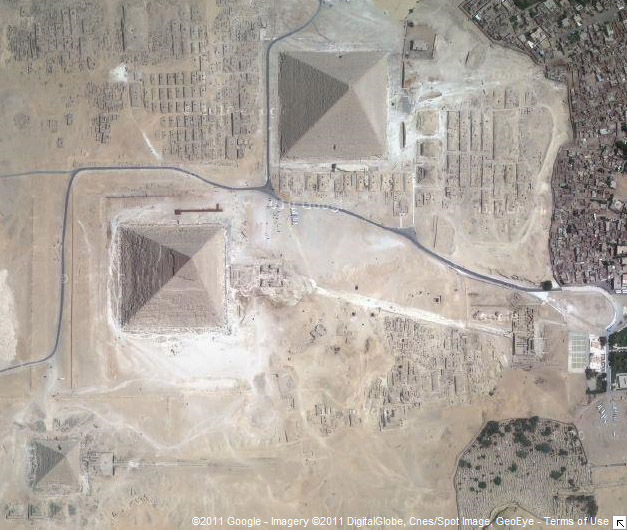
Why not start with one of the most famous ancient sites: the Pyramid Complex of Giza.  The “site” includes several monuments which trace the conceptual evolution of a divine shape now universally recognized as a pyramid but more importantly a visual record of engineering trial and error.  Chronologically, the first innovation can be seen in Djoser’s stacked mastabas or the Step Pyramid in Saqqara.  Previously, pharaohs were buried under large rectangular brick structures until architect, priest and generally creative guy Imhotep though stone would be better and that six progressively small mastabas would be an even better way to exalt the king.  30 years later, King Sneferu was determined to smooth the form a 17 miles south in Dashur.  I would imagine that the visual correlation of ascending to Ra the Sun God made for a strong theological rationale for the pyramid shape.  Sneferu’s reign created the so called Bent Pyramid which rises gradually then changes to a shallow angle of ascent about halfway up.  Presumably there was a problem baring the weight of the building and a more conservative angle was needed to complete it.  I can’t fault the builders at all for this awkward looking pyramid; these were constructed with only the most basic tools, fundamental building technology and the brute force of thousands.  Sneferu was finally successful and completed the Red Pyramid next door.  Finally, the pyramid everyone remembers is that of Sneferu’s son Khufu (2589-66BC) – The Great Pyramid.  Just outside the Cairo, it is constructed from 15 ton stone blocks and surrounded by temple complexes, minor pyramids to Queens, the Sphinx, and an impressive solar boat reconstructed painstakingly from over a thousand pieces.  Set behind Khufu’s pyramid is that of Khafre and Menkaure which get progressively smaller in size.  After this, kings no longer chose to construct pyramids which puts this incredible boom and bust of Old Kindom funerary building in only a ~164 year window.  While you can’t climb the pyramids like you use to do hundreds of years ago, it is still impressive sight and high on my To Do list!

 Getting there: Once in Cairo, taxi tours to Giza, Saqqara and Dashur can be arranged with most hotels.  It generally good advice to arrange the price ahead of time, find a driver who speaks English, and work out how long you want to tour around.  It’s very possible to see all three sites in one day.  Myself, if I’m going to Egypt it’s going to be for a while and I’m going to see more than just the Pyramids.  I’ve got my eyes on Gap Adventure’s Egyptian Archaeology Adventure and will tack on a few days in Alexandria.

UNESCO World Heritage Sites!

The United Nations Educational, Scientific and Cultural Organization (UNESCO) maintains a list of World Heritage Sites.  I am sure there is some degree of preservation and esteem that comes from being on this list, but I look at it as a venerable To-Do List!  There are 936 sites which span from natural landscapes to ancient structures to fragile ecosystems.  You can play with the interactive map here.  Doing a quick count, I’ve seen 31 sites (yay) which is 3.3% (sad).

"It's indescribably beautiful!"

In the Nice to Meet UNESCO feature, I’ll be profiling individual sites.  Maybe we won’t get through all of them, but it will be fun to try!

UPDATE: You can see all the UNESCO Heritage Site post by clicking  “Recurring Features” above in the menu bar.