Skip to content

Posts from the ‘History’ Category

The Shakespeare Travel Tour

In honor of William Shakespeare birthday (thought to be on April 23, 1564), I wanted to take a look at some of this plays. While some were set in England to be historically accurate, many of the plays are set in exotic cities through Europe and the Mediterannean to capture the imagination of the audience.  Here are just a few of my favorite locales.

HAMLET Kronborg Castle, Elsinore, Denmark

Will you find the ghost of the King walking the ramparts of Kronborg Castle? (Photo: Kronborg Castle, Agency for Palaces & Cultural Properties, Denmark)

Read more

The Face of George Washington

US 1 dollarThanks to the US $1, George Washington has one of the most recognizable faces in America.  This President’s Day, I got to thinking about that portrait and two excellent exhibits I saw a few years ago at Mount Vernon and the National Gallery about the real likeness of George Washington.

Gilbert Stuart – “George Washington (The Athenaeum Portrait)” 1796, Museum of Fine Arts Boston and National Portrait Gallery, Washington DC

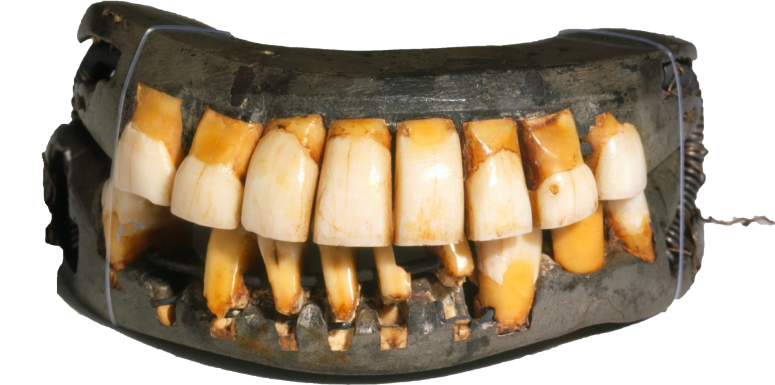
The dollar and a large number of contemporary and future Washington paintings are based on an unfinished portrait done by Gilbert Stuart in 1796.  At the time of the sitting, George was 64 and retired to Mount Vernon.  His teeth had been a constant source of pain since the first one was extracted when he was 22.  When he started his presidency, only one real tooth remained in his head.  Several sets of dentures were made for Washington over his life by incorporating human teeth and carved bone or tusk teeth into a metal cage.  None these were reported to have fit well and must have caused him considerable discomfort.

George Washington's only complete set of false teeth on display at Mount Vernon

George Washington’s only complete set of false teeth on display at Mount Vernon (Photo: Mount Vernon Museum)

On the day Washington sat for Gilbert Stuart, he was struggling with a set of false teeth.  Stuart notes, “When I painted him, he had just had a set of false teeth inserted, which accounts for the constrained expression so noticeable about the mouth and lower part of the face.”  Look back at Stuart’s portrait. Washington’s jaw does appears to be clenched, pushed somewhat forward and bulky.  This immediately recognizable portrait is likely not the most realistic.

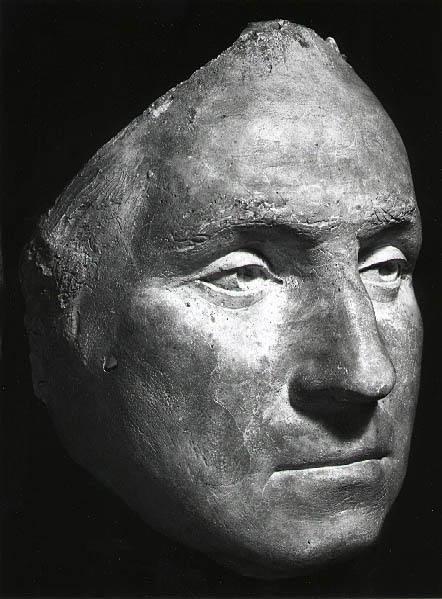
Jean Antoine Houdon - George Washington mask

Jean-Antoine Houdon “Life Mask of George Washington” 1785 (Photo: The Morgan Library and Museum, New York City)

Eleven years before the Stuart portrait, sculptor Jean-Antoine Houdon met with Washington a made a life mask – a process in which plaster is applied to a face for an accurate sculptural model.  This likeness seems less tense and the jaw line less protruded.

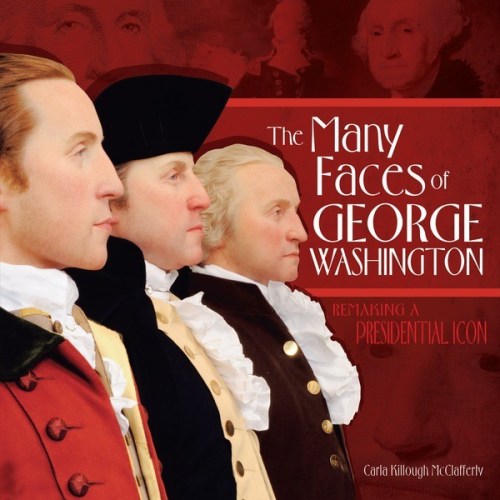
Many Faces of George Washington

Cover of “Many Faces of George Washington” by Carla Killough McClafferty describing the Mount Vernon portrait project

This life mask and the bust Houdon made from it were used by Mount Vernon to create “the real George Washington”.  Through an interesting forensic anthropology project, the sculptures an other artifacts were scanned, analyzed and used to construct three wax faces meant to represent George Washington at 19, 45 and 57 year of age.  Life-sized figures were created by examining existing clothing and written descriptions of the Washington’s posture.  (You can watch a short video about the process done by the History Channel here.)  The end result is incredibly impressive.  The three Washington figures were one my favorite parts of visiting Mount Vernon as they help piece together a more life-like representation an American legends.

Young George Washington

A George Washington we are not used to seeing – 19 year old likeness reconstructed from historical and scientific evidence by Mount Vernon

Marathon Greece and Serious History Tourists

Our last day in Greece, we had a few hours to spare and a rental car so we decided to look for the ancient battlefield of Marathon.  It was here in 490 BC that the Greeks defeated a Persian invasion force.  After which a messenger ran the 24 miles back to Athens to declare the victory inspiring the modern marathon race.

This was the only time our GPS navigation failed us; apparently “Marathon Museum” was a little ambiguous!  Having been directed to the Marathon Run Museum, we got dubious directions toward the ancient battlefield and set out.  After several U-turns, we found ourselves traveling down a narrow road through a field where a crowd had gathered.  I almost didn’t believe what we saw: ancient Greeks engaged in battle.

greek hoplite reenactors

Hoplite reenactors taking a break at Marathon

Read more

Reconstructing Art: Duccio’s Maesta

1878 Iguanodon

In1878 this seem like a fine reconstruction of an Iguanodon, despite the fact that its tail would be broken in this posture. (Photo: University of Bristol, Earth Science Dept.)

Walking through the ruins of the Acropolis and looking over the plaster copies of the Parthenon Frieze this last fall, I tried to put it all back together visually.  Thankfully there were digital reconstructions to look to, but I got to wondering if wholesale reconstruction of a work of art is even possible.  In most cases, pieces can be broken or destroyed and critical details of the overall assembly can be lost.  (It’s a tangential example but I’m thinking of all the miss-assembled Victorian dinosaur skeletons.)  Then I remembered Duccio’s Maestà in Siena.

The Three Marys at the Tomb by Duccio, part of the Maestà altarpiece in Siena (Photo: Web Gallery of Art)

Duccio’s expansive Maestà Altarpiece was installed in the Siena Cathedral on June 9, 1311.  The double sided piece is estimated to have been 4.7 by 5 meters in dimension.  It was composed of a central panel (The Virgin and Christ Enthroned with Saints and Angels) and over 70 smaller scenes depicting New Testament iconography.  Sadly this grand style of altarpiece went out of fashion and in 1711, the panels were dismantled, sawed apart, and dispersed.  Most of the pieces are now back in Siena. Careful scholarship, analysis, and restoration has shed light on its original construction and composition.

Maesta alterpiece

Virgin and Child panel of the Maesta alterpiece by Duccio, Museo dell’Opera, Siena (Photo: profzucker, Flickr)

The Maestà altarpiece is not displayed in its reconstructed state which allows for better viewing of the visually rich story panels.  These were likely executed by Duccio’s workshop but are all interesting.  The central Virgin and Child panel alone is incredibly impressive.  I remember seeing it at the Museo dell’Opera del Duomo in Siena.  The room was fairly dark with a few spotlights on the panel which made the gilding glow.

Duccio Maesta front panel

Duccio Maestà front panel reconstruction with missing pieces shown in gray (Image: DaydreamTourist)

On the front of the altarpiece would have been a Marian cycle in the pinnacles and the birth and childhood of Jesus in the lower predella. The reverse panel depicts the Passion sequence in the main section and scenes from the ministry of Christ along the pinnacles and predella. In the reconstruction images above and below, panels not presently in Siena are shown in black and white (missing panels are not shown).  You have to actually go to Washington DC and Madrid respectively to see two of my favorites: the Nativity with Isaiah and Ezekiel and Christ and the Samaritan Woman.  It is also possible to appreciate how pieces may have been shaved and shaped since being freed from the altarpiece frame.  I have also accepted the interpretation that a piece showing the coronation of the Virgin now in Hungry was featured in the central front panel pinnacle.  This makes sense thematically in the context of the smaller pinnacle images showing the life of Mary and would be appropriate subject matter for the period and location.  The reconstructions also assumes that the pinnacle angels mirrored each other since only 4 of the 12 total exist today.

Duccio Maesta back

Duccio’s Maestà back panel assembly with missing pieces noted in gray (Image: DaydreamTourist)

Viewed as a whole, the complexity and ambitiousness of the project is evident.  Whether or not the framing decorative elements are exactly correct is a moot point given the wealth of visual story-telling and the fairly confident reconstitution of the narrative flow.  It’s amazing that almost all of the panels have survived.  The Maestà demonstrates that reconstruction, at least digitally, goes a long way in understanding the artist’s intentions, the work’s visual impact, and how contemporary viewers would have encountered the piece.

Reconstructions adapted from the Web Gallery of Art.

Reference: Siena, Florence and Padua: Art Society and Religion 1280-1400, Volume II: Case Studies, edited by Diana Norman, 1995.

Happy Winter Solstice Newgrange!

Winter solstice sunrise illuminating the main passage at Newgrange (Photo: Alan Betson, Irish Times)

Earlier in my UNESCO World Heritage Site series, I discussed the Neolithic mound tomb Newgrange which is outside Dublin.  Around the winter solstice, approximately Dec 18-23, the morning sun enters through an opening over the doorway and illuminates the main stone passageway and the central burial chamber.  It’s interesting to think of the religious significance this event – cremated human remains being touched by the sun –  must have held.

Newgrange winter solstice sunrise

Diagram of winter solistice sunrise at Newgrange (Newgrange by G, Stout & M. Stout, 2008, Newgrange)

Over the last few days, a handful of lucky lottery winners have huddled inside the chamber to watch what is usually a magnificent spectacle.  (It’s actually been a little overcast this week so the effect may have been reduced.)