Skip to content

Posts from the ‘Art’ Category

The Life of a Sculpture: “The Sphere” in Lower Manhattan

The Sphere Battery park

I came across and interesting article this week.  “The Sphere”, a 25 foot tall bronze and steel sculpture by Fritz Koenig, was once part of the fountain in the plaza between the World Trade Center buildings in New York City.  The work was meant to symbolize the advancement of peace through international trade.  The sculpture miraculously survived the 9/11 attacks and was moved to Battery Park ten yeas ago as a memorial.  Due to some upcoming improvements to the park, “The Sphere” will be removed and it is unclear where and when it will ultimately be placed.

Read more

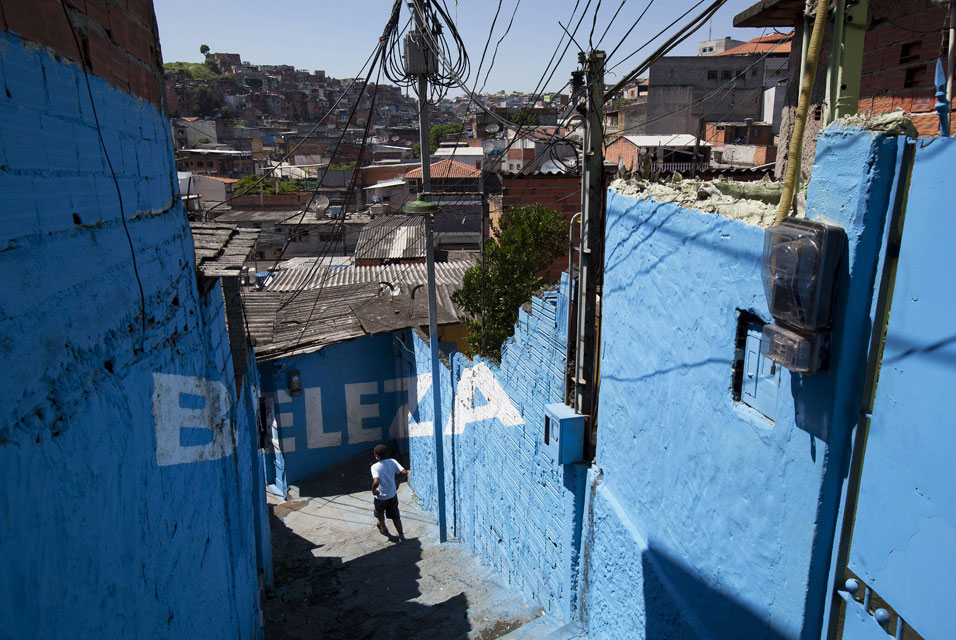
Photo of the Week – Art in the Favela

Beleza (Beauty) written in a San Paulo favela alley (Photo: EPA/SEBASTIAO MOREIRA)

SAO PAULO.- The Portuguese word Beleza (Beauty) written in large white letters on blue walls in an alley in the Brasilandia neighborhood of Sao Paulo, Brazil, 06 March 2012. The graffiti and painted walls are part of an art project by five Spanish artists, entitled Luz nas Vielas (lit. Light in the alleys), which was realized with the inhabitants of Brasilandia, one of the favelas in Sao Paulo. Photo: Sebastiao Moreira/EPA.

Image and caption, Copyright © artdaily.org

Maybe the Best Russian Icon Collection in America

The other day I wrote about the Eastern Orthodox iconography of John the Baptist.  Let me take a step back now and spend a little more time on the amazing institution where I saw those pieces: The Museum of Russian Icons.  Located in Clinton, MA, about an hour drive from Boston, the modern facility displays hundreds of excellent Russian icons.  It was such a pleasant surprise to find this small museum; it is definitely one of my favorite New England hidden gems.

The Museum houses the personal collection of Gordon B. Lankton.  An executive at a plastic company, he bought his first icon at a flea market in Russia while on a business trip.  Mr. Lankton became fascinated by the style and imagery and returned from his subsequent business trips with more icons.  (Now new pieces are acquired through well-respected international auction house.)  With well over 100 icons, Mr. Lankton decided the collection would be best displayed at a museum, but a suitable organization could not be found in New York City or Boston.  He then decided to keep the icons in Clinton and so the current Museum was opened in 2006 in a renovated carpet factory.  The museum space is elegant and an excellent platform for enjoying the art.  The Museum now has over 500 icons and objects in its collection and has a friendly and informed staff.  With 12,000-17,000 visitors annually, you’re also likely to enjoy the works with some peace and quiet.

Images of the collection were taken by me, except the last one of the museum interior.

Mother of God Russian icon

"Vladimir Mother of God" circa 1680 (Museum of Russian Icons)

Russian icon damage

Lower central detail of "Vladimir Mother of God" showing candle damage (Museum of Russian Icons)

Saint Nicholas Russian Icon

"Saint Nicholas of Zaraisk, The Wonderworker and Holy Bishop of Myra with Scenes from his life" Suzdal School, 16th Century (Museum of Russian Icons)

cloth Russian icon

Detail from "Christ, Not Made by Hands (Allegory)", circa 1600 (Museum of Russian Icons)

Mary Magdalene Russian icon

"Mary Magdalene" circa 1890 (Museum of Russian Icons)

The honor system cafe (pay at the gift shop upstairs) is a nice touch with imported Russian treats, a hot beverage machine and these antique tea kettles.


Interior of the Museum

Modern interior of Museum of Russian Icons (Image from Wikipedia)


Photo of the Week – Garden Creature

Peacock in the garden planters (Photo: DaydreamTourist)

My New Years resolution was to try to carry a camera with  me more often. I was pretty quickly rewarded for this in 2012!  After finishing up tasting at the Chateau Ste. Michelle Winery in Woodinville, Washington, I came outside to see this peacock perched on some planters.  While I am still getting use to my new camera, I like the composition and colors of this photo.

Reconstructing Art: Duccio’s Maesta

1878 Iguanodon

In1878 this seem like a fine reconstruction of an Iguanodon, despite the fact that its tail would be broken in this posture. (Photo: University of Bristol, Earth Science Dept.)

Walking through the ruins of the Acropolis and looking over the plaster copies of the Parthenon Frieze this last fall, I tried to put it all back together visually.  Thankfully there were digital reconstructions to look to, but I got to wondering if wholesale reconstruction of a work of art is even possible.  In most cases, pieces can be broken or destroyed and critical details of the overall assembly can be lost.  (It’s a tangential example but I’m thinking of all the miss-assembled Victorian dinosaur skeletons.)  Then I remembered Duccio’s Maestà in Siena.

The Three Marys at the Tomb by Duccio, part of the Maestà altarpiece in Siena (Photo: Web Gallery of Art)

Duccio’s expansive Maestà Altarpiece was installed in the Siena Cathedral on June 9, 1311.  The double sided piece is estimated to have been 4.7 by 5 meters in dimension.  It was composed of a central panel (The Virgin and Christ Enthroned with Saints and Angels) and over 70 smaller scenes depicting New Testament iconography.  Sadly this grand style of altarpiece went out of fashion and in 1711, the panels were dismantled, sawed apart, and dispersed.  Most of the pieces are now back in Siena. Careful scholarship, analysis, and restoration has shed light on its original construction and composition.

Maesta alterpiece

Virgin and Child panel of the Maesta alterpiece by Duccio, Museo dell’Opera, Siena (Photo: profzucker, Flickr)

The Maestà altarpiece is not displayed in its reconstructed state which allows for better viewing of the visually rich story panels.  These were likely executed by Duccio’s workshop but are all interesting.  The central Virgin and Child panel alone is incredibly impressive.  I remember seeing it at the Museo dell’Opera del Duomo in Siena.  The room was fairly dark with a few spotlights on the panel which made the gilding glow.

Duccio Maesta front panel

Duccio Maestà front panel reconstruction with missing pieces shown in gray (Image: DaydreamTourist)

On the front of the altarpiece would have been a Marian cycle in the pinnacles and the birth and childhood of Jesus in the lower predella. The reverse panel depicts the Passion sequence in the main section and scenes from the ministry of Christ along the pinnacles and predella. In the reconstruction images above and below, panels not presently in Siena are shown in black and white (missing panels are not shown).  You have to actually go to Washington DC and Madrid respectively to see two of my favorites: the Nativity with Isaiah and Ezekiel and Christ and the Samaritan Woman.  It is also possible to appreciate how pieces may have been shaved and shaped since being freed from the altarpiece frame.  I have also accepted the interpretation that a piece showing the coronation of the Virgin now in Hungry was featured in the central front panel pinnacle.  This makes sense thematically in the context of the smaller pinnacle images showing the life of Mary and would be appropriate subject matter for the period and location.  The reconstructions also assumes that the pinnacle angels mirrored each other since only 4 of the 12 total exist today.

Duccio Maesta back

Duccio’s Maestà back panel assembly with missing pieces noted in gray (Image: DaydreamTourist)

Viewed as a whole, the complexity and ambitiousness of the project is evident.  Whether or not the framing decorative elements are exactly correct is a moot point given the wealth of visual story-telling and the fairly confident reconstitution of the narrative flow.  It’s amazing that almost all of the panels have survived.  The Maestà demonstrates that reconstruction, at least digitally, goes a long way in understanding the artist’s intentions, the work’s visual impact, and how contemporary viewers would have encountered the piece.

Reconstructions adapted from the Web Gallery of Art.

Reference: Siena, Florence and Padua: Art Society and Religion 1280-1400, Volume II: Case Studies, edited by Diana Norman, 1995.