Skip to content

Posts from the ‘Art History’ Category

Byzantine Fort City of Mystras, Greece
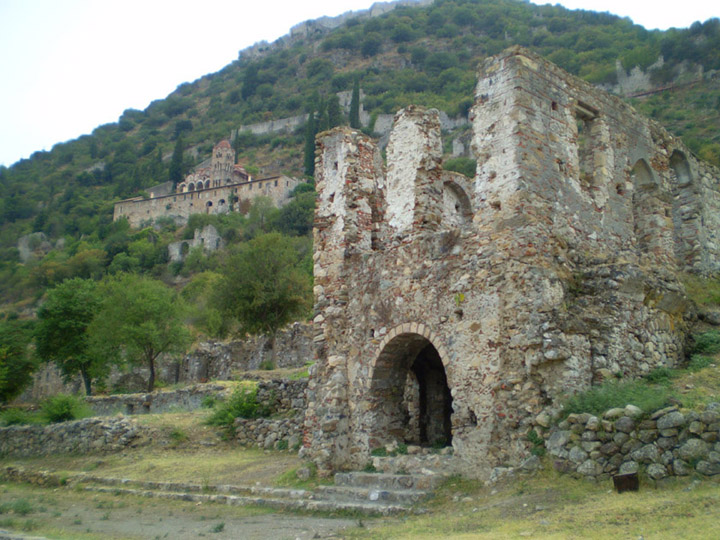
Monestary of Pantanassa, Mystras

Looking up from the ruined domestic buildings of the lower city, you can see the active Monastery of Pantanassa further up the mountain in the the Upper City of Mystras, Greece.

So many European cities are jumbles of art and architecture, a testament to the evolving history of the urban area.  Beneath these modern cities are fractured layers of a Renaissance, Gothic and Ancient past, but you have to try hard to imagine how things looked during any one period.  It’s truly amazing to find a city that retains its character from one specific age.  The abandoned Byzantine city of Mystras in the mountains just above Sparta in the Southern Peloponnese, is one such frozen city.  You can walk through the ruined streets and largely intact religious buildings of this UNESCO World Heritage Site and be right back in 1350 AD.

Read more

Spring Break 2013 in a Museum?

A list went out earlier this week of “100 Museums to See Before You Die” which got me thinking about my next trip.  While this particular list of museums is in no way exhaustive (no Egyptian Museum, no Chicago Art Institute, etc, etc!), it made me realize there are huge clusters of amazing museums I’ve never seen because there are many major international cities I still haven’t visited.  I’m itching for an easy to plan “Spring Break” and what better way to spend a potentially rainy week in March than in museums!  My only problem is deciding where to go….

Madrid, Spain

Museo Prado hall, Madrid

Central gallery, Museo del Prado, Madrid (Photo: Turismo Madrid, flickr)

Read more

ArtSmart Roundtable – Images of Mary Magdalene

The monthly ArtSmart Roundtable brings together some of the best art history-focused travel blogs with a post on a common theme.  For February we are discussing the iconography of a few historical, religious or mythical figures to help you “read” some of the images you may encounter on the road.  I’ve always thought that understanding the context and source material for imagery really deepens your appreciation for art.  You can find links below to all the group’s articles this month.

Flanders Book of Hours Illuminated Manuscript - St Lawrence

The martyr St. Lawrence was “grilled” to death and is usually seen with a metal cooking rack. Book of Hours, 1510, Flanders, Syracuse University Special Collections.

I love seeing Saints in European art because it is so easy to tell who everyone is.  There is a characteristic object or dress to each figure that helps you decipher his or her identity.  I’ve always been partial to John the Baptist with his wild man appearance and camel hair attire.  But what about the saints with less straight-forward stories?  Theological and historical confusion has long shrouded St. Mary Magdalene; consequently, she has a complex visual iconography.

Read more

Examining Michelangelo’s Unfinished David-Apollo

Michelangelo's David-Apollo

Michelangelo’s David-Apollo on display at the National Gallery of Art, Washington, DC on loan from the Museo Nazionale del Bargello, Florence (Photo: adapted from NGA publicity materials)

I personally love artworks with a little mystery and what could be better than an unfinished sculpture by Michelangelo?  His David-Apollo is currently on display at the National Gallery of Art in DC until March 3rd, on loan from the Museo del Bargello in Florence.  The sculpture is so named because there is no real consensus on whom it depicts.  In 1530, Michelangelo started a small marble of David.  It has been speculated that he abandoned this symbol of Florence and tried to adapt it to a classical Apollo but ultimately left the piece unfinished.  To me, there is no evidence to suggest that this figure was ever meant to be an Apollo.  More likely, it was a victim of Michelangelo’s legendary perfectionism.  The beauty of unfinished pieces is that one can walk around them, examine the carvings and try to understand the master’s thought process up close.

Read more

Curators Have All the Fun: San Diego’s “Behold, America!” Exhibit

How would you arrange pieces in an art gallery? Should paintings be placed in groups by artistic movement? Does it makes more sense to see everything in chronological order?  Should geographic differences and temporal differences rigidly divide works?

Time period, artistic movement, and geography are often used to organize a museum.  Imagine how many times you’ve entered into the first room of “old” art and then walk forward in time through each successive room.  Changing this classic approach, San Diego’s three major art museums put together something a little different which I thought made for a really incredible show.  They’ve combined works from their very unique collections into thematically based exhibits broadly entitled “Behold, America!” on display until Feb 12, 2013.

Behold, America! San Diego exhibit banner Read more