Skip to content

Posts from the ‘Art History’ Category

Italian Good Friday Procession Art

It is traditional in Spain, Italy and other Catholic countries to stage elaborate religious procession on Good Friday and Easter.  While in Erice, a village on the Western tip of Sicily, I found a Museum of church objects that had a series of statue used to commemorate the Passion story of Jesus on Good Friday.

Read more

The Mycenae Archaeological Site

Mycenae wall

Mycenae outer wall viewed from below (Photo: Daydream Tourist)

Don’t go to Mycenae if you want classical Greek architecture.  It does not have elegant ionic columns or passionate friezes of Gods battling.  It is not sophisticated artistically but still worth the trip.  You visit Mycenae because it is a fortress so impressive and old that is was selected as a UNESCO World Heritage Site.  (And #6 in my series.)

Read more

Statue Conservation in Action at the MFA Boston

Roman Juno statue

Juno in her former home, a suburban Boston estate garden (Photo: MFA)

The Museum of Fine Arts in Boston is hosting an interesting conservation project.  An impressive Trajanic or Hadrianic Period (early second century A.D.) statue of Juno was moved into the George D. and Margo Behrakis Gallery of ancient art this week.  Given its massive size of 13ft and 13,000 lbs, conservator will be examining, cleaning and repairing the work in situ.  Recently donated to the Museum of Fine Arts, the statue has spent the last 100 years in an estate garden just outside of Boston.  The resulting wind, snow, freeze-thaw, biological and vandal damage has taken a toll on the piece.  The Museum is raising money to support the conservation.  You can learn more about this on-going project at the MFA’s website.

I’m particularly interested in the analysis of the head.  It is clear that it was reattached at one or more times in the piece’s history; however, it also seems that the head and body are not the same marble and may have been united at a later time.  Given that little historical information exists about the piece prior to the 17th century, curators and conservators will have to rely on scientific analysis to understand the past of this statue.

Juno's head was removed to protect it during transport (Photo: MFA, Boston)

Layers of plaster and glue illustrate past repairs to the neck of Juno. (Photo: MFA, Boston)

roman statue repair with iron pin

Close up of the iron pin holding the right arm in place. (Photo: MFA, Boston)

Happy St. Patrick’s Day Book of Kells

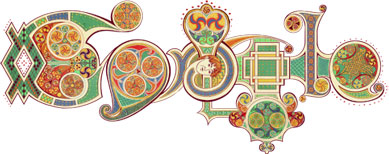
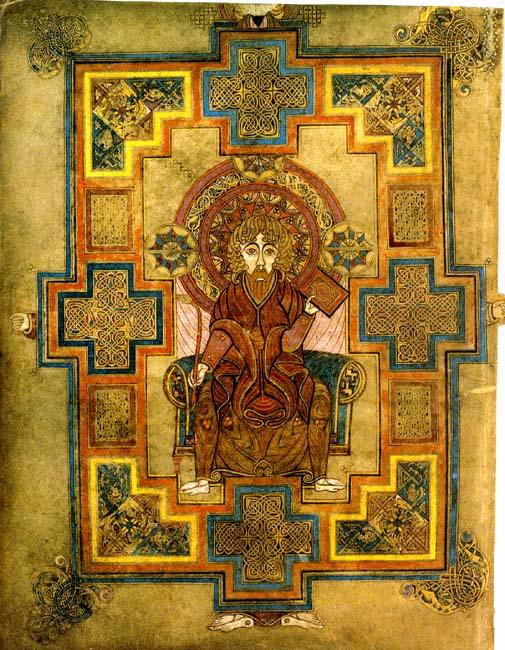
Google has the best logo today to celebrate St. Patrick’s Day 2012.  It’s based on the Book of Kells which you can see in Dublin at Trinity College Library.  The four gospel volume was created by Irish monks around 800 AD.  It is richly decorated and draws from traditional Hibernian Gothic design elements.  The text and its excellent exhibit at Trinity College is definitely one of the top things to see in Dublin!

Book of Kells, Folio 291v contains a portrait of John the Evangelist (Wikipedia)

Book of Kells, Folio 7v contains an image of the Virgin and Child. This is the oldest extant image of the Virgin Mary in a Western manuscript (Wikipedia)

Book of Kells, Folio 34r contains the Chi Rho monogram. "Chi" and "Rho" are the first two letters of the word Christ in Greek.

Introduction: The Friedrich Wahle Project

This last Fall, I finally took the leap from lover of art history to art owner.  The piece is beautifully executed with a cool palette and impressionistic brushwork.  I was really drawn to the unusual, but clearly narrative subject matter.  Unfortunately, there was very little information available about the work or its artist.  I have therefore taken it upon myself to turn this painting into a little research project.

The oil on board painting was done by Friedrich Wahle.  A quick pre-auction search told me that Wahle was born in 1863 in Prague and died in 1927 in Munich.  He worked mainly as an illustrator.  The date and title of my painting are unknown.  (For the sake of the sale, it was titled “The Discourse”.)

The goals of this project seem pretty clear:

1. Biography – Friedrich Wahle is not a well known artist.  I’d like to know more about his life, education, artistic influences and employers.

2. Develop a Catalog – Since I can’t find much information about his portfolio, I would like to build an authoritative Wahle catalog.  I’ll start with auction records and published records of his paintings.  I’m really curious to see how this piece fits into his body of work.  Is the subject matter, size, style, color scheme, etc. of “The Discourse” typical?  Did he even have a “style” or as an illustrator did Wahle adjust for the commission?  How many paintings did he create?  There are a lot of open questions here.

3. Find “The Discourse” – Looking at the two men in fine clothing talking, I can’t help but think that there is a story behind this.  Since Wahle was an illustrator, there may very well likely be an actual “story” or text that accompanies the painting.  I would be thrilled to find “The Discourse” printed in a book or periodical!

I plan to document my findings here as the Friedrich Wahle Project.  I’m excited  to dust off my researcher hat and hoping to find some interesting things!

***UPDATE: You can read all my subsequent Wahle discoveries by clicking here.***