Skip to content

Archive for

Bob Dylan’s source material uncovered

For starters, I didn’t even realize that Bob Dylan painted but apparently he has a show which opened at the Gagosian Gallery in New York City.  It is not the brush work or color choices but the subject matter of this show that is getting some media attention.  The New York Times reports that many of the works are copied from known photographs including two by Henri Cartier-Bresson and Life Magazine’s Dmitri Kessel.  Artinfo.com has a good slide show comparing the Dylan work with the source photograph.

Top: An early 1900's photograph of a field worker in China Bottom: A painting from Dylan's "Asia Series" (Photo: artinfo.com)

Is this the art equivalent of sampling someone’s song?  Should we consider this forgery? Is this worth hanging in a gallery? Yes and No.  Artists have always trained by copying paintings or, in the last century, photographs.  There are prestigious museums today that exhibit workshop copies of masterworks or paintings done in the style of a master by one of their apprentices.  These pieces lose composition points because the student artist didn’t think of the subject, colors or lay-out themselves, but they are still well executed and beautiful so we admire these paintings.  Likewise, Dylan doesn’t get any credit for creative design since the photographer set up the composition of the image.  I suppose he did select the collection and add color since these are black and white photographs but there is no strong theme among the paintings’ subject matter and the color is more naturalistic than anything.  Next we look for execution, and baring something truly creative that I am not seeing in these news article photos, this looks like a high school gallery show.  So what we are really left with is the artist’s celebrity, which is fine.  Fame often removes the objectivity of subjective art appreciation.  (How many actors or actresses release terrible music or musicians try to act?)  It doesn’t necessarily mean these paintings are outstanding on their own; the works should be viewed within the context of a famous and/or creative individual. That context helps us understand the artist better rather than understanding the art.  It’s not the most thought-provoking artistic theme but like I said, that’s fine.

However, it seems inappropriate to exhibit these paintings as if they were unique creations since the source material is so clearly known – many with their own copy-rights.  Maybe the gallery should rehang the show with the photographs nearby?  It might make for a more interesting exhibition.  One last, more important note to the Gallery though, I probably would not write this in the exhibition website/catalog:

[Bob Dylan] often draws and paints while on tour, and his motifs bear corresponding impressions of different environments and people. A keen observer, Dylan is inspired by everyday phenomena in such a way that they appear fresh, new, and mysterious.

MFA to Sell Impressionist Works to Purchase Rare Caillebotte

"Man at His Bath" by Gustave Caillebotte

To help fund the purchase a rare piece by Impressionist Gustave Caillebotte, the Museum of Fine Arts in Boston is selling eight works.   These paintings by Claude Monet, Paul Gauguin, Alfred Sisley, Camille Pissarro, Auguste Renoir and Vasily Vereshchagin are expected to fetch between $16.6 million and $24.3 million.  It is not surprising that the MFA will need to sell art to raise the funds; its donors have recently and generous supported a fantastic new American Art wing and a Contemporary Art wing.  The painting is well worth the sell-off (especially since the paintings in question have not been exhibited since 2003) and I look forward to its permanent place at the MFA.

The new acquisition is “Man at His Bath” which is notable because there are not many works Caillebotte available and is extraordinary because there are very few Impressionist male nudes.  Gustave Caillebotte (1848 – 1894) was fortunate enough to be wealthy during Belle Epoch Paris which allowed him to buy works from his friends Monet, Renoir and others known today as the Impressionist.  While his patronage may have had a longer lasting effect, Caillebotte himself was a very gifted artist.  He and Édouard Manet are my favorite painters from the late 19th century Parisian art scene mainly because they focused on daily activities while often alluding to the darkness of modern urban life.  While “Man at His Bath” is mundane but intimate, his most famous work “Paris Street; Rainy Day” at the Art Institute of Chicago depicts isolated figural groupings moving through dreary streets.  Both paintings are expertly composed with a balance of light and dark and interesting lines.  Caillebotte’s unique nude “Man at His Bath” is an excellent addition at the MFA – definitely worth a landscape or two.

"Paris Street; Rainy Day" by Gustave Caillebotte

Street Art – Hermes

Light on the Rooftop  had an awesome post about street art on Freshly Pressed the other day.  She showed that non-conventional and public art can still be very high quality. I haven’t seen that level of street art while in Europe (unless the Bogside murals count) but I did catch an irreverent cartoon version of a classical Greek god.  I thought it was funny, or at least a funny departure from the typical Hermes iconography.

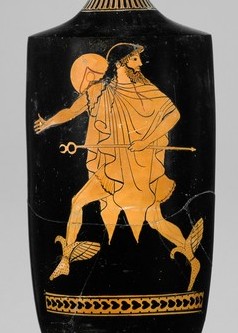
Hermes, as depicted in antiquity:

Terracotta oil flask depicting Hermes ca. 480–470 BC (Photo: Metropolitan Musuem of Art)

Modern Hermes painted above an abandoned building in Nafplion:  (Google Translate tells me that EPMHE is “Hermes” in Greek if the winged helmet weren’t enough.  On the billboard, he was facing an alligator in a Zoot suit which I am not sure how to interpret.)

Graffiti Hermes in Nafplion

Ancient Delphi

According to myth, Zeus released two eagles to circle the world and in their flight they crossed above Delphi – the center of the Earth.  Delphi is an expansive site on the side of Mt. Parnassus with sweeping views and layers of ruins to explore.

Delphi is perhaps most famous for the Oracle at the Temple of Apollo.  The heart of the temple was situated over a crack in the ground which spewed noxious gas.  Under its influence and perhaps other substances, the temple priestess would speak which in turn was “interpreted” by the savvy and current events-conscious temple priests. Pilgrims, diplomats and kings came to Delphi for this divine advice which was not always so clear. On his second consultation regarding the impending Persian invasion, Themistocles of Athens was told famously (in cryptic oracle language) that “Though all else shall be taken, Zeus, the all seeing, grants that the wooden wall only shall not fail.”  After the Persians captured and burned much of Athens, it was the decisive Greek naval victory near Salamis that sent the Persians back home.  It seems the Oracle’s “wooden wall” was not a city wall but a fleet of ships!

Delphi - Temple of Apollo

Delphi – Temple of Apollo

 As you would imagine, the Athenians were elated after their victory and most likely brought fine sculptures and gold to the Apollo in thanks.  This is actually what every Greek city-state did after a victory storing the offerings in their own dedicated Treasury building.  The road leading to the Temple of Apollo is lined with Treasuries which acted like both a museum and a bank vault meant to show off the generous gifts of the city to Apollo and to protect the objects.  Today only the Treasury of Athens remains complete after extensive restoration.  At the site today, you can see up the mountain to the Temple, but during the Classical Greek period, the view must have been obstructed with a winding street of proud, glittering Treasuries.

Treasury of Athens - Delphi

Treasury of Athens – Delphi

Delphi hosted the Pythian games every four years for about 900 years beginning in 582 BC.  Since the games focused more on arts, there is a well preserved theater in addition to a stadium for athletic competitions above the Temple of Apollo.  The modern road through Delphi cuts the Treasuries, Temple and event venues from the lower portion of the site.  Here you’ll find an athletic training grounds and a large temple complex dedicated to Athena – Apollo’s sister.  Beside the main Temple is the elegant round Tholos building which is usually (and incorrectly) associated with Apollo, the Oracle and Delphi in general, because of its beauty.  If there is not a picture of white and blue buildings from Santorini on the cover of your Greek guidebook, then it is probably a picture of the Athena Tholos at Delphi!

Temple Complex of Athena Pronaia – Delphi

Delphi does have a small museum which contains some sculptures and architectural elements from the ancient site.  The most notable piece is the bronze Charioteer which survived because it was buried during a landslide.  The figure is elegant, youthful and executed with great detail.  Since the modern world has inherited Roman stone copies of now lost Greek statues, we often forget that bronzes constituted about half of the ancient Greek statues.

Charioteer of Delphi

I have a lot of travel tips for seeing Delphi so I’ll post those separately.  In the meantime, let me say that Delphi is an impressive sight – well worth the trip and greatly enhanced by some historical background before you visit.

Athens at Night

The Acropolis at night as viewed from above Monastiraki Square

On the flight back from Greece, I was getting excited to post about my trip but I have been a lazy girl since I got back.  Normally I get jet-lag for a day at the most, but I have been out by 8pm almost all week!  I’m finally feeling back to normal and am now sorting through my 600 photos.  Greece was so much fun.  It was one of those 10 day vacations which is so relaxing and so filled with sights that it feels like you were gone a month! (Maybe that’s why it took so long to adjust when I returned…)

In the meantime, here is a Acropolis view taken our first night in Athens from a sixth floor bar on Monastiraki Square.  The view was well worth my 9 Euro Metaxa-sangria (which itself was good too)!